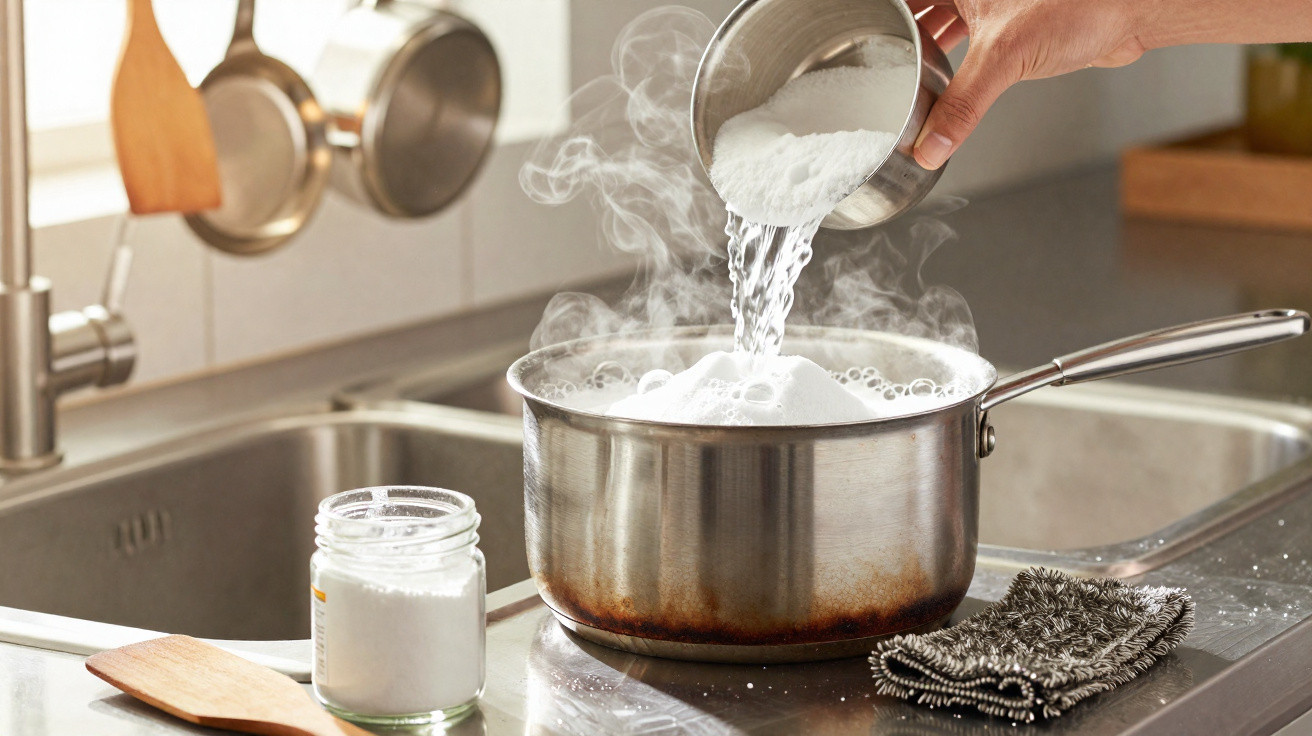
You could go at the burnt-on crust with a scourer and plenty of determination. Or you could follow the approach used by restaurant teams when the pass is frantic and every second matters: let heat and chemistry take over. No scraping, no damaged pan base, simply a calm and effective reset.
During a packed service in a small Soho kitchen, a sauté pan returned with its base coated in a lacquer of burnt soy sauce and honey. The cook barely paused. He poured in water, added a spoonful of white powder from a deli tub, then placed it on a rear burner. As he plated cod and called checks, steam drifted upwards in slow ribbons. Ten minutes later, he emptied the pan and the blackened layer came away like a scab. A soft cloth finished the job in a few wipes. The pan was back in action, immaculate and unmarked. It was not a dramatic rescue, just part of the rhythm: one modest, accurate move that helps a kitchen stay sane.
Why restaurant pans stay spotless
Chefs tend to regard pans as working partners. You do not batter them into submission; you use their properties properly and allow physics to do the heavy lifting. When a pan base is scorched, the standard restaurant response is straightforward: simmer, loosen, rinse. That is the explanation for the remarkably clean pan bottoms often visible on an open pass.
I once saw a sous-chef in Manchester rescue a stainless-steel pan after a sticky teriyaki glaze had turned into a carbonised black ring. Rather than reaching for steel wool, he deglazed it with water, added ordinary bicarbonate of soda and allowed it to gently bubble while he torched mackerel. During service, there is no time to exhaust your wrists with scrubbing, and no room for damaging the base. Heat and time provide the elbow grease.
In simple scientific terms, the black layers are browned sugars and proteins that have polymerised and bonded to the metal. Heated water causes them to expand and soften. The alkalinity of bicarbonate helps break the bonds keeping burnt residue together. Small bubbles work beneath the crust and lift it away. There is no abrasion, no microscopic scratching and no compromised heat distribution. The pan remains in good condition, and dinner remains on schedule.
The bicarbonate of soda method restaurants use
The method, in brief: while the pan is still warm, add enough water to cover the burnt section to a depth of roughly 1 cm. Use 1 tablespoon of bicarbonate of soda for each litre of water, along with a small drop of washing-up liquid. Return the pan to a gentle simmer for 5 to 12 minutes, easing any loosened pieces with a wooden spoon. Empty the pan, wipe it with a soft sponge, then rinse with fresh hot water. For burns caused by caramel or jam, turn off the heat and add a splash of vinegar at the end to help release the sugar glass.
Two useful warnings from the pass: do not turn the heat up to a vigorous rolling boil, as this can bake the mess more firmly onto the edges. And however tempting it may be, avoid using metal utensils to scrape it off. With aluminium, leave out the vinegar stage and keep the simmer brief. For non-stick pans, use only water, low heat and patience. Everyone has had a pan that seemed “ruined”. Allow the simmer to do its work before attempting a second round.
Realistically, nobody follows this routine every single day. But on the occasions when you do, it protects both your cookware and your temper.
“Heat and chemistry do the scrubbing. Your job is to wait just long enough,” said a London line cook, flicking the burner off like it was nothing.
- Ratio: 1 tbsp bicarbonate per litre of water.
- Simmering time: 5–12 minutes; allow longer for thick, sticky burns.
- Tools: use a wooden spoon to loosen residue, then a soft sponge to finish.
- Surface guidance: stainless steel responds well; non-stick requires gentle water-only heat.
- For sugar burns: add vinegar at the end, once off the boil.
Which pans to protect and which to restore
Stainless steel is the ideal material for this technique, which explains its popularity in professional kitchens. It withstands mild alkalinity, gentle simmering and repeated cleaning cycles without warping. Aluminium needs more care: keep the simmer shorter, do not add an acidic finish and avoid lengthy soaking. Cast iron and carbon steel require a different follow-up-simmer water to release the residue, dry the pan thoroughly, then re-season it with a thin coating of oil. The aim is to leave the base clean while ensuring it still cooks well the next day.
Most errors stem from panic. Allowing a blackened pan to cool with its crust intact quickly makes the bond tougher. Beginning the rescue while the pan is warm is a large part of the solution. Strong chemicals may sound like the bold option, but they can be unpleasant for both your lungs and your cookware. When one simmering cycle is not enough, let the pan rest, repeat the same gentle process and stop once bright metal appears. Think of it as a short marathon rather than a sprint.
There is a human element as well. At home or in a professional service, one apparently ruined pan can disrupt an entire evening. The simmer-and-lift technique reduces the tension in the room as much as it lowers the heat on the hob. No scrubbing. No sulking. Just reset and carry on. If there is one point to remember, it is that the water should be doing the difficult work-not your wrists.
This small ritual travels through kitchens by word of mouth for a reason. It recovers valuable minutes in a trade dependent on them and protects equipment meant to last years rather than months. Home cooks gain the same benefits: a cleaner base, fewer scratches and a less stressful clean-up. Pass it on to the friend who always reaches for steel wool. Test it on the “ruined” pan reserved for camping. The bicarb-and-boil feels like a magic trick the first time it works. Once you have watched the crust release in one satisfying sheet, you will never view a burnt pan in quite the same way.
| Key point | Detail | Benefit for the reader |
|---|---|---|
| Gentle simmer + bicarbonate | 1 tbsp per litre, 5–12 minutes | Releases burnt layers without abrasion |
| Surface-specific adjustments | Stainless steel: full method; non-stick: water only; aluminium: no vinegar | Helps protect pans from pitting and scratches |
| Extra step for sugar burns | A splash of vinegar at the end, off the heat | Breaks down caramel glass quickly and saves effort |







Comments
No comments yet. Be the first to comment!
Leave a Comment