A glass topples, laughter catches in everyone’s throat, and a royal splash of merlot lands squarely on the pale tablecloth you adore. Panic erupts. Napkins are snatched up. Somebody whispers “salt?” as though it were an incantation. There is a quicker answer.
One broad movement, one daring Cabernet, one disastrous trajectory. The stain appeared instantly and dramatically, a purple comet disappearing into the cotton. We stood still, then did what people usually do: hesitated.
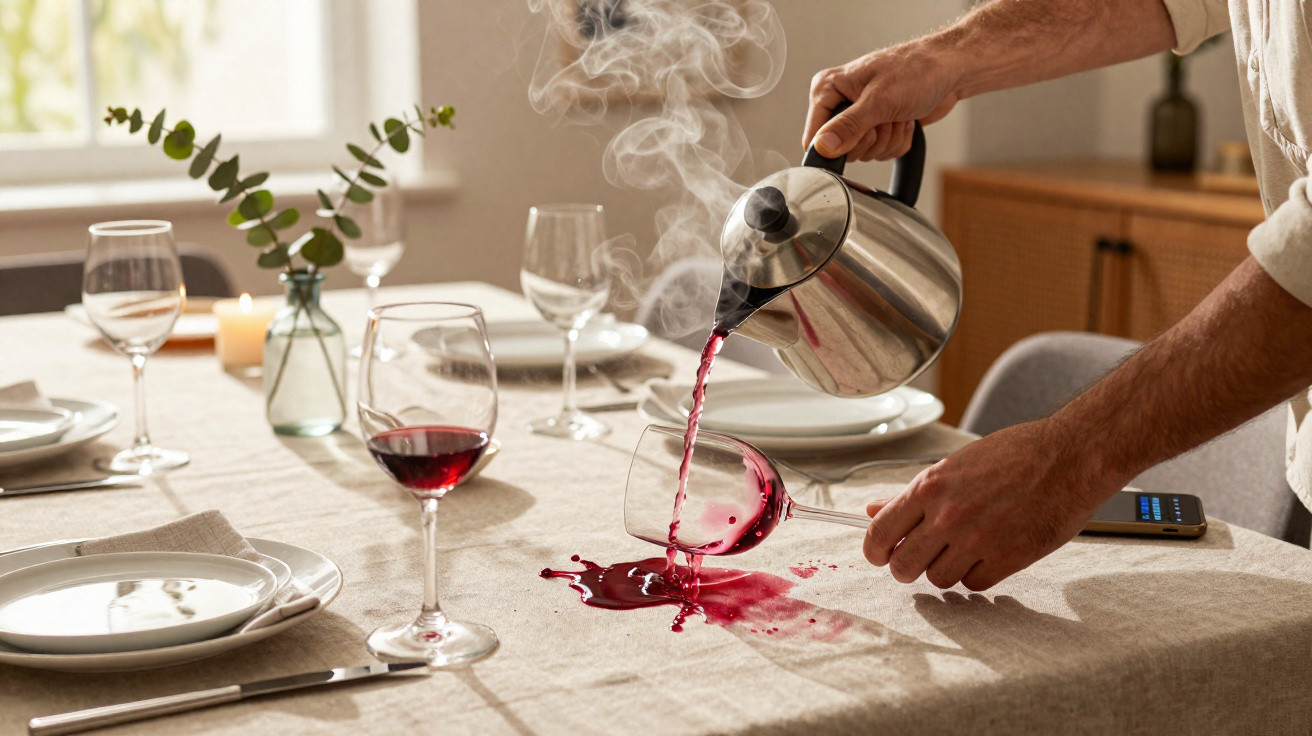
I reached for the kettle and a mixing bowl, then fastened the cloth over the rim like a drum. Everyone watched. The water thundered through, the red flowed away, and the mark vanished as though it had been washed off a postcard. We breathed out and laughed because it seemed like a magic trick. It was not. It was chemistry in a cape.
Within two minutes, calm had returned to the table. The stain had disappeared. The story remained.
And yes, it succeeds much more often than you might expect.
When a red wine stain lands: what really works
Your first instinct is to scrub. Your hands want to act. Hold back. Blot with a clean, absorbent material: kitchen roll, an unpatterned napkin or an old tea towel. Press, lift, move to a fresh area, and repeat. This is not silver polishing; the aim is to remove the liquid before it settles.
We all know the moment: conversation falls silent and that crimson spill meets the linen. The advantage is acting swiftly without creating mayhem. Place the tablecloth across a bowl, with the stain facing downwards and the fabric pulled taut like a miniature trampoline. It may look makeshift, but that does not matter. This arrangement gives you control, while the method handles the rest.
Red wine leaves colour behind in two ways: water-loving pigments known as anthocyanins, and tannins that attach themselves to fibres. Heat interrupts that relationship, while dilution carries the colour away. On cotton and linen, the usual materials for pale tablecloths, boiling water reframes the issue. The stain travels out of the fibre and into the flowing water, much like ink washing from a brush beneath a tap. For most fresh spills, that is enough.
The two-minute trick: step by step
Boil the kettle. Pull the stained section tightly over a bowl and secure it using pegs or hair grips. Hold the kettle 20–30 cm above the fabric and pour a slim, consistent stream of just-boiled water through the middle of the stain for 30–60 seconds. You should see the red colour run into the bowl. Turn the cloth and repeat if necessary. Should a faint pink tinge remain, apply a pea-sized amount of washing-up liquid, gently work it in with a finger for ten seconds, then complete the process with another short pour. That is the two-minute trick.
Do not rub furiously. Do not scatter salt and grind it in: it may roughen the fibres and push pigment further into them. Sparkling water can help when it is all you have nearby; its bubbles provide agitation and the liquid flushes the stain. For older marks, a brief application of a 1:1 mixture of 3% hydrogen peroxide and washing-up liquid may remove them quickly, although test it on a seam first if you are concerned about colour. Let us be realistic: no one pre-treats table linen before every meal. You need a solution you can manage in the middle of the chaos, while guests look on and the gravy is setting.
This is not witchcraft; it is hot water and gravity taking on dye chemistry. Boiling water weakens the pigment’s hold on cellulose. Pouring from a height focuses the stream, driving the colour out in one direction instead of spreading it. Cotton and linen can withstand this short burst of heat. Synthetic fabrics, silk and wool are less fond of it, so use cool sparkling water and gentle soap instead.
“Pour from above, don’t scrub below-that’s the whole show,” says textile restorer Ellie March, who treats red wine like a soluble problem rather than a permanent disaster.
- Fast kit: kettle, bowl, two pegs, kitchen roll
- Fresh spill: boil, stretch, pour for 30–60 seconds
- Shadow left? Apply a tiny amount of washing-up liquid, then rinse quickly
- Delicate fabric: sparkling water + dab, no heat
- Older stain: 1:1 peroxide (3%) and washing-up liquid, patch test
Why the red wine stain method works - and when to adapt it
For its first five minutes, a red wine stain remains a moving target. That is encouraging. The pigments have not yet become fixed, allowing you to guide them out with heat and water flow. The boiling-water technique works so quickly because it alters three things simultaneously: temperature, pressure and dilution. The fibres loosen, the dye loses its grip, and the stream carries it in one direction into the bowl. There is no swirling, spreading or forcing it further into the material.
With fibres containing animal proteins, such as wool, or with heat-sensitive synthetics, take a different approach. Use plenty of sparkling water and blot with a white cloth. Dab on a drop of glycerine or washing-up liquid, leave it for 30 seconds, blot once more, then rinse with cool water. A small bottle of 3% hydrogen peroxide kept in the cupboard can be a discreet miracle worker for pale, washable cotton. A fingertip of the 1:1 washing-up liquid mixture may remove a lingering pink trace in half a minute. Rinse thoroughly afterwards.
Avoid chlorine bleach on wine stains. It can set the tannins in unexpected ways and leave the area yellowed. Oxygen bleach is milder for the final wash, although the purpose of the two-minute trick is to prevent a laundry emergency in the first place. When a stain has been sitting for hours, you will probably need both treatments: a hot-water flush to remove most of it, followed by a brief oxygen-bleach soak to brighten the remaining shadow. That is not a failure; it is simply removing layers of stain quickly.
Small preparations for becoming the calmest host in the room
Keep a bowl you are happy to use and two pegs in the kitchen drawer nearest the dining table. Practise once with an old tea towel and a splash of cold brew or cranberry juice, simply to get the feel of the process. You will react more quickly when it happens for real. If dinner is already under way, ask someone to switch on the kettle while you blot. The mess becomes a small performance, and your table survives to tell the story.
| Key point | Detail | Benefit for the reader |
|---|---|---|
| Boiling-water flush | Pour just-boiled water from 20–30 cm through the stain over a bowl | Removes fresh wine in under two minutes without scrubbing |
| Delicate-fabric adjustment | Use sparkling water and mild soap, with no heat | Protects silk, wool and synthetics while lifting the colour |
| Stubborn-shadow solution | Use a 1:1 mixture of 3% hydrogen peroxide and washing-up liquid, then rinse | Quickly clears lingering pink from pale cotton and linen |








Comments
No comments yet. Be the first to comment!
Leave a Comment