A kitchen-cupboard remedy with an unexpected advantage: a simple thyme vapour can ease a weary chest, clear a clouded mind and shift the course of the day when fatigue makes every job feel like a climb.
The first inhalation came up sharp, green and peppery, as though the air had been buffed clean. My ribcage relaxed. My shoulders lowered slightly. It seemed far too simple to make a difference, and that was precisely the point.
Steam gathered on the window, turning the morning into its own little weather pattern. Against the kitchen’s low hum, I watched her take slow, even breaths, eyes shut, chest expanding like a sail filling with wind. The room carried the scent of a freshly rained-on forest. She opened one eye and said, “Give it two minutes. Then tell me what lifted.”
I tracked my breaths, trying not to hope for much. The haze flickered.
How thyme vapour can break through fatigue - and what it feels like
Thyme makes an entrance rather than arriving quietly. Its first breath brings a warm, resinous sharpness that appears to press through a blocked nose and clenched jaw. Many people describe a clarity at the “top of the head”, as if a window has been opened where there was none five minutes earlier.
We all know the hard afternoon dip: emails merge into one another and your brain cannot retrieve ordinary words. Several deep, warm breaths of thyme vapour can feel as though somebody has tapped the windscreen from inside. It is not magic, merely a prompt. During workshops, I have watched nurses, developers and sleep-deprived new parents sit up straighter halfway through steaming and say, “Oh. There you are.” The earliest change is often this: shoulders relax, blinking becomes slower and breathing grows longer.
Behind the sensation, thyme’s volatile oils - particularly thymol and carvacrol - move quickly. Heat and moisture carry them to the upper airways, while warm vapour moistens dry mucous membranes and encourages movement. That alone can make congestion feel less stubborn. Its aroma also stimulates the trigeminal nerve, the route that responds to mint, pepper and wasabi. When this system is activated, breathing deepens and alertness increases. Early research suggests aromatic stimulation may influence attention through olfactory-limbic pathways. In everyday terms, it is simpler: when breathing becomes easier, the mind often follows.
How to use thyme steam safely, with quick options for busy days
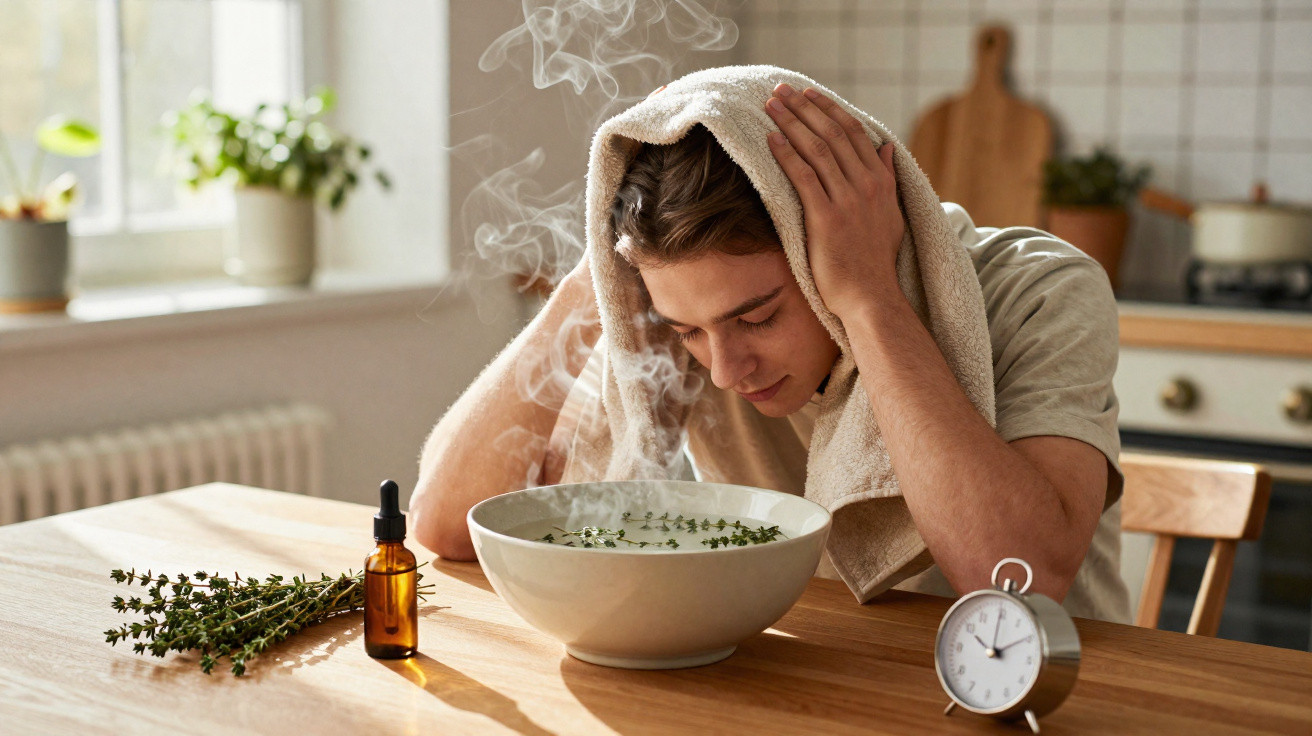
Take a ceramic bowl and fill it with freshly boiled water. Add 2 teaspoons of dried thyme or a small handful of fresh sprigs. If using essential oil, one drop is enough. Sit down, position your face roughly 20–30 cm above the bowl and loosely drape a towel over your head to make a tent. Breathe in through your nose and out through your mouth for 3–5 minutes. Pause when needed, keep your eyes closed and stop once you feel warm, open and slightly brighter.
Keeping your distance matters. Should the heat sting your skin, raise the towel to allow in cooler air. Avoid essential oil if fragrances have affected you before or if scents trigger asthma flare-ups. If you are pregnant, use the culinary herb only rather than essential oil, and make each session brief. Do not continue beyond 10 minutes. Drink water afterwards, as vapour helps loosen things. If preparing a bowl feels like too much effort, run a hot shower for a moment, hold a thyme sprig near your chest and breathe in the rising steam. Honestly, nobody does this every day.
People often ask what it should feel like when it is “working”. Think of a well-lubricated nose, not fireworks. The first breaths can sting slightly before the feeling becomes smoother and broader.
“The steam does the heavy lifting, and the thyme gives it direction,” the herbalist told me. “You’re helping your body remember the easy breath it already knows.”
Small adjustments can make the ritual work in ordinary life:
- Focus blend: thyme with a pinch of rosemary for a brisk, pine-like lift.
- Desk shortcut: put thyme in a mug of hot water, then lean over it and breathe between tasks.
- Evening reset: combine thyme with lemon peel to cut through the day’s heaviness.
- Travel option: place one drop of thyme essential oil on a cotton pad and sniff gently - do not let it touch your skin.
What may happen afterwards - and when to avoid thyme vapour
For the following twenty minutes, a thyme steam can make everything seem a little taller. The world may appear slightly crisper, as if the contrast has been adjusted. Your chest can move more freely and words may come together faster. Some people give a light cough as mucus loosens, which is good news in a very human sense. If your head feels buzzy, have some water and step outside for a minute; the initial lift should settle into a calmer, clearer focus.
There are situations when it is better to wait. If you are healing after a nosebleed, have severe asthma brought on by powerful scents, or have a respiratory infection for which steam feels suffocating, opt for gentler hydration and rest. Children under six do not need essential oils at all; use mild herbal steam from a safer distance, or leave it out and try a warm bath in a steamy bathroom. If pregnant or breastfeeding, stay with the kitchen herb and use light, short sessions. If fatigue feels immovable or unusual - including new breathlessness, chest pain or headaches that do not ease - that needs medical attention, not a spice jar.
At the centre of this ritual is everyday kindness. Steam softens what a demanding day tightens. Thyme adds a bright note that tells your system, “Wake up, but gently.” It is an inexpensive, modest practice for busy people unable to take an hour to reset. The kettle is quick, and your breath is quicker.
On some days, thyme steam marks the difference between dragging yourself along and moving with intention. It is small enough to do again and effective enough to stay in the memory. You may find yourself pairing it with a two-minute stretch, a glass of cold water or a walk to the letterbox - tiny anchors that bring your mind back online. Pass it on to a colleague buried under a mountain of browser tabs. Ask your family what they notice after three slow breaths. Every home has its own medicine cupboard; sometimes it is tucked beside the salt. The aim is not perfection, but a kinder route through a long afternoon, one warm plume at a time.
| Key point | Detail | Benefit for the reader |
|---|---|---|
| The mechanism in simple terms | Warm vapour moistens the airways; thyme’s aromatic oils engage breathing and alertness | Helps explain why it can feel freeing rather than like a placebo |
| A straightforward method | Bowl, boiling water, a small handful of thyme and 3–5 minutes of relaxed breathing | Can be tried today without specialist equipment |
| Sensible safety | Be gentle with heat and scent; avoid essential oils for children, during pregnancy and with scent-sensitive asthma | Delivers benefits without unwelcome surprises |















Comments
No comments yet. Be the first to comment!
Leave a Comment