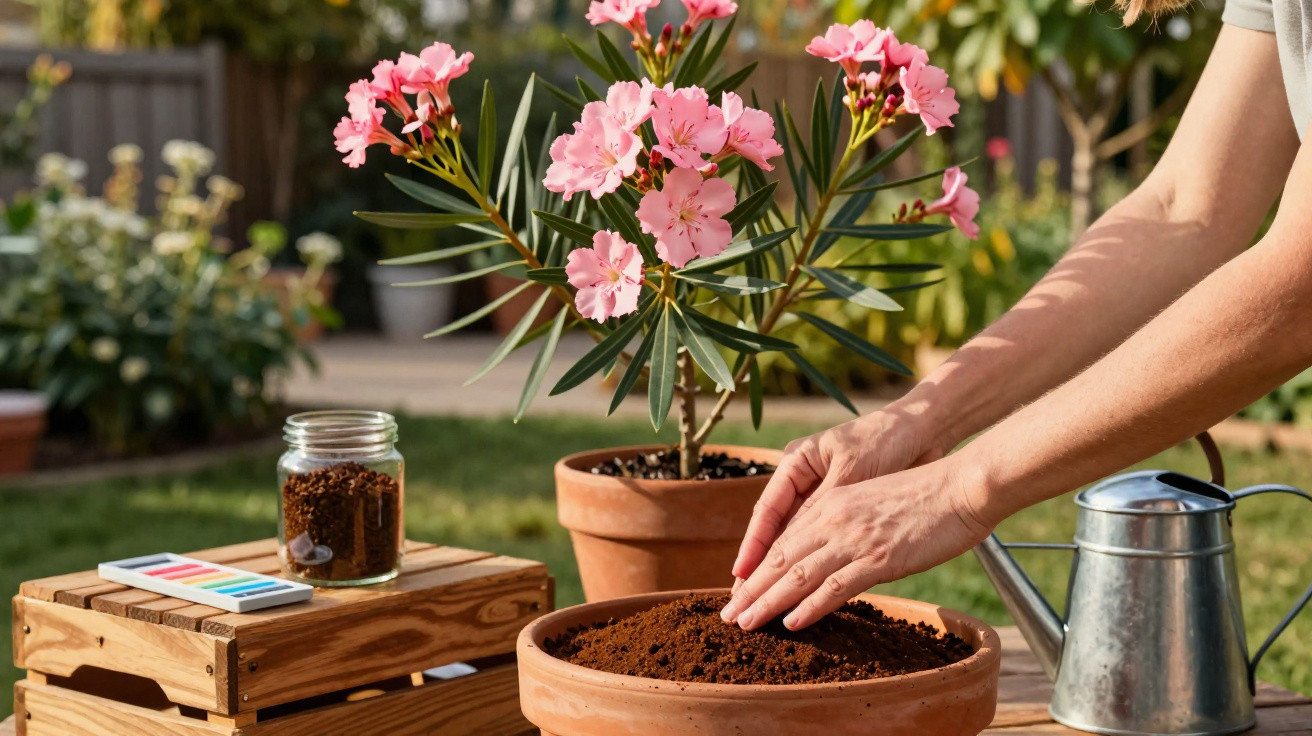
The Mediterranean oleander is widely regarded as a hardy container plant that thrives in sunshine and heat. For years, online advice has promoted feeding it with coffee grounds. It sounds like ideal recycling – yet only a few wrong moves separate abundant flowering from a stressed plant. Used correctly, this brown material can genuinely boost the display of blooms rather than quietly weakening the shrub.
Why coffee grounds can be either a blessing or a curse for oleander
At first glance, coffee grounds appear to be a free premium fertiliser. They contain, among other things:
- Nitrogen – essential for leaf growth
- Phosphorus – supports flower production and root development
- Potassium – strengthens the plant and improves its resilience
This makes them broadly suitable for oleander, which is considered a heavy feeder. However, one detail is often overlooked: the pH value.
Coffee grounds usually have a pH of around 6.5, making them slightly acidic. Oleander, by contrast, prefers a neutral to slightly alkaline environment, roughly between pH 7 and 8. Applying too many coffee grounds directly to the growing medium gradually shifts its pH into the acidic range.
A soil that appears rich in nutrients can still leave an oleander starving if its pH is no longer suitable.
The nutrients may still be present, but the roots are less able to absorb them. This causes the familiar signs of deficiency, even though the plant has been diligently “fed”.
Typical warning signs: how oleander shows it has had too much
Anyone using coffee grounds should keep a close eye on the shrub. Common indicators of an imbalance include:
- Yellow leaves, particularly on younger shoots
- Slower growth despite warmth and sufficient water
- Very few buds or noticeably reduced flowering
- A dark, crusty surface on the compost in the pot
- A fine coating of mould on the compost, especially in shaded areas
If several of these signs appear, too much coffee grounds has usually been added to the pot or around the root zone. In that case, good intentions are more likely to hold the oleander back.
How to use coffee grounds correctly for oleander
Always dry coffee grounds first
Fresh grounds that are still damp quickly clump together and can become mouldy. A better approach is to:
- Spread the coffee grounds over a plate or baking tray
- Leave them to dry completely in an airy place
- Use them only once they are fully dry
Dried material is easier to measure accurately and spread evenly. This reduces the chance of mould and dense crusts forming on the surface.
Never tip it straight onto the compost
The major mistake is adding a thick layer of coffee grounds directly onto the growing medium. This speeds up the pH shift and prevents air from reaching the roots. A mixture works far better.
As a general rule, use around one tablespoon of dried coffee grounds for roughly half a kilogram of mature compost.
Then spread this mixture in a thin layer over the compost surface and work it in gently. A small hand cultivator or fork is sufficient. The important point is not to dig deeply, as this could damage the roots.
The right quantity and frequency
Organic leftovers also follow the rule that less is often more. For a strong oleander in a container, the following is generally enough:
- Spring to late summer: a thin layer of the compost and coffee grounds mixture every two weeks
- Autumn and winter (in a cool position): fertilise very sparingly, no more than once a month
Coffee grounds are not a replacement for a complete specialist fertiliser; they are an addition. A balanced oleander fertiliser provides the basic nutrition, while coffee grounds offer an extra organic boost.
What to do if the oleander looks stressed
If the plant shows signs of fatigue, it is worth checking the growing medium straight away. A dark, compact layer on the surface indicates that the dose was too high. The following measures can help:
- Carefully remove and discard the top layer of compost.
- Loosen the root ball without pulling roughly at the roots.
- Repot into fresh, free-draining compost if the growing medium is severely compacted.
- Stop using coffee grounds altogether for several weeks.
- Restart later with much smaller amounts – always mixed with compost.
It is also worth reviewing the watering routine at the same time. Oleander does not like sitting in water. Waterlogging intensifies the negative effects of excessive coffee grounds, because decomposing material and poor air supply reinforce one another.
Drainage, position and fertiliser: what else oleander needs
Coffee grounds are only one small part of the picture. Several factors need to work together to achieve truly abundant flowering:
| Factor | What oleander prefers |
|---|---|
| Position | Full sun, warmth and shelter from wind |
| Growing medium | Free-draining, fairly mineral-based, with good water drainage |
| Watering | Generous in summer, greatly reduced in winter |
| Fertilising | Regular feeding with a specialist flowering-plant or oleander fertiliser |
| Pruning | Light pruning after flowering encourages branching |
Those who get these basics right can use coffee grounds as targeted support rather than trying to hide problems that are actually caused by an unsuitable position or waterlogging.
How pH determines the success of coffee grounds treatment
The pH value decides whether nutrients remain available or become effectively locked into the soil. Many gardeners judge only by leaf colour, but a test provides greater clarity.
Simple test strips and liquid testing kits are available in shops. They make it possible to assess the growing medium roughly. If the reading is clearly below 7, coffee grounds should be used extremely cautiously or avoided completely. In slightly alkaline compost, however, a small organic acidic input may be useful.
Anyone who knows the pH range of their growing medium uses coffee grounds not blindly, but as a targeted tool.
Practical examples from everyday gardening
For a large oleander in a 40-litre pot, a heaped tablespoon of dried coffee grounds can be mixed into a larger quantity of compost about every two weeks. This mixture is then spread around the root area. At the same time, the usual liquid fertiliser in the watering water is retained.
If the shrub is instead growing in a rather heavy, clay-rich medium, improve the compost first with sand, expanded clay or lava granules. Organic additions such as coffee grounds only deliver their benefits without overburdening the roots once aeration is adequate.
Risks, limitations and sensible alternatives
Coffee grounds contain small residual amounts of caffeine. At normal garden application rates, this is not a major issue for oleander, but very intensive use can affect soil microorganisms. Anyone drinking several strong coffees each day and disposing of all the grounds in the same plant pot will quickly overload the system.
Well-rotted compost, horn shavings or specialist slow-release fertilisers for Mediterranean plants are suitable alternatives. They supply nutrients more consistently, whereas coffee grounds are better viewed as a bonus: useful when applied consciously and moderately, but risky when treated as an all-purpose solution for every plant.
Ultimately, it pays to observe your own shrub carefully. If it responds with dense, dark-green foliage and plenty of flowers, the balance of growing medium, water, fertiliser and coffee grounds is right. If it looks tired, the cause is rarely a single factor – coffee grounds may be the final straw or precisely the boost that corrects a nutrient shortage. The dosage is what matters.















Comments
No comments yet. Be the first to comment!
Leave a Comment