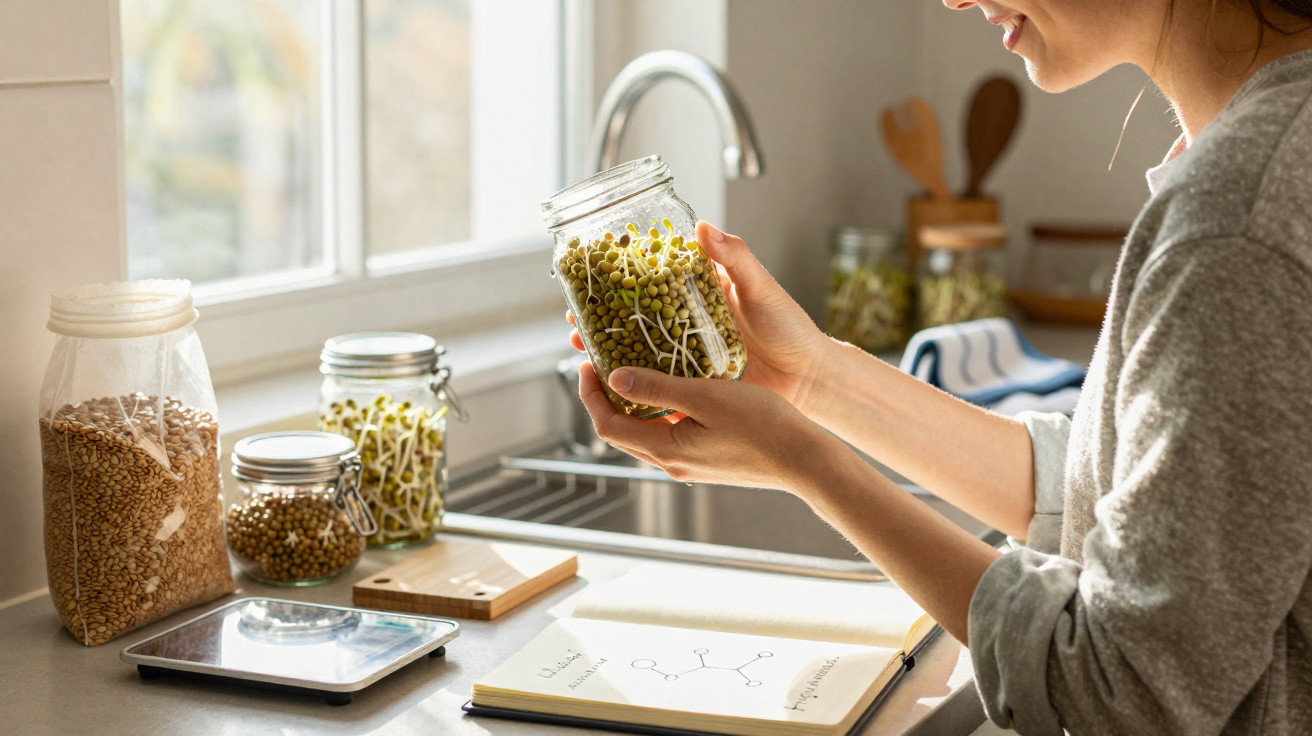
People say it all the time: sprouted lentils are “higher in protein” and easier on the digestive system. It may sound like a miracle claim, yet the changes taking place in that jar on your worktop are more specific-and more compelling-than a catchy phrase. This is the biochemistry, made practical for an ordinary kitchen.
By morning, the seeds had sent out fine pale shoots: a small crowd coming to life in slow motion, with a faint rainy scent. In the laboratory, we would watch similar awakenings beneath harsher lights, as enzymes switched on one after another in the dark.
My son asked, “Did you just make protein?” I laughed before stopping to think. He was not entirely mistaken. Some figures increase, some decrease, and the explanation soon becomes complicated. The maths is odd.
What happens inside a sprouting lentil jar
As a lentil absorbs water, it moves from storage into growth mode. Sprouting reprogrammes the seed: proteases, amylases and phytases become active, breaking large molecules into smaller, usable components. To produce the first few millimetres of new life, the seed begins using its reserves-starch and certain stored compounds.
You do not need a microscope to notice the transformation. Most of us have watched a jar of beige little stones become a lively green mass and felt unexpectedly pleased. Energy from the seed is redirected into fresh tissue, while its enzymes work like stagehands rearranging scenery between acts.
This is where the idea of “more protein” enters the picture. Protein content often increases as a percentage of dry weight because sprouting uses carbohydrates as fuel, while changes in water weight make the calculation less straightforward. Protein appears “higher” partly because there is less starch in the denominator. Meanwhile, the sprout does create new proteins, including structural proteins, but the more meaningful benefit is elsewhere: storage proteins are cut into shorter peptides and amino acids that your digestive enzymes can process more readily.
Sprouted lentils: nutrient changes your body can notice
Phytic acid, the compound in legumes that binds minerals, begins to break down through the action of phytase. This releases iron, zinc, magnesium and calcium that were already present. Research on sprouted legumes commonly finds reductions in phytic acid of between 30% and 70%, potentially improving mineral absorption in actual meals rather than only in laboratory tests.
Other barriers decline as well. Trypsin inhibitors-small compounds that make protein more difficult to digest-usually decrease during sprouting, and fall further after a brief cook. Lectins are reduced by soaking and germination. Overall, this often results in improved in vitro protein digestibility, commonly by 10%–30% for pulses. Rather than simply encountering “more protein”, your body gets protein that it can use with less resistance.
Vitamin changes are rather more encouraging. Vitamin C, which is virtually absent from dried lentils, develops during sprouting, and some B vitamins may increase too. Folate often rises. Fibre also takes on a different form, with more soluble portions developing as starch is reworked; for some people, this can feel kinder to the digestive system. Sprouted lentils are not a magic cure, but they do make a familiar seed feel remarkably different.
How to sprout lentils without a laboratory
Choose whole, unsplit lentils-green, brown and black varieties are all suitable. Rinse until the water is clear, then soak for 8–12 hours in cool water, using a 1:3 lentil-to-water ratio. Drain thoroughly, position the jar at a 45-degree angle with a mesh lid or cloth, and rinse 2–3 times daily until the shoots measure 1–2 mm; this generally takes 24–48 hours.
Keep the jar away from direct sunlight and never allow the lentils to remain in standing water. Fresh sprouts should smell clean, rather like cucumbers after rain. Honestly, nobody does this every day. When life is hectic, place the jar in the fridge once the shoots are tiny and eat them within 2–3 days. Alternatively, blanch them quickly for 60–90 seconds before storage for an additional safety margin.
Red split lentils cannot sprout because they have been hulled and divided. Steer clear of very warm kitchens and, where possible, aim for 18–22°C. If they smell sour or turn slimy, do not try to save them-compost them and begin again. Phytic acid falls more quickly when the lentils are not allowed to over-sprout; short shoots offer the best mix of crunch, sweetness and improved nutrient availability.
“The protein story isn’t just about counting grams,” says the biochemist in me. “It’s about accessibility-how much of that protein stops being locked behind antinutrients and becomes easy work for your enzymes.”
- Typical shifts: protein digestibility +10–30%; phytic acid −30–70%; trypsin inhibitors −30–80%.
- Sweet spot: 24–48 hours, tails 1–2 mm, rinse 2–3 times daily.
- Minerals: iron and zinc absorption potential rises as phytic acid drops.
- Safety nudge: quick blanch or sauté if serving to children, older adults or anyone with reduced immune defences.
What sprouted lentils mean for your plate
Sprouting does not make lentils into steak. Instead, it makes them lentils that your body can understand slightly more easily. That is the understated advantage. Their texture becomes more lively, their flavour turns sweeter and nuttier, and the nutritional exchange in your gut may become friendlier.
There is a rhythm to the process, too. You rinse, wait, tip the jar, forget about it, then rinse once more. Let’s be honest: nobody really does it every day. Yet when you do, lunch can be as simple as a bowl of sprouted lentils with lemon, olive oil, chopped herbs and a handful of toasted seeds. It tastes like momentum.
I often think about that first jar on the windowsill. The proteins did not multiply by magic; rather, access to them opened up more widely. Tell that to someone who keeps asking what “better protein” means, then hand them a fork. They will understand after the first mouthful.
| Key point | Detail | Why it matters to the reader |
|---|---|---|
| Protein “increase” explained | The higher percentage mainly comes from carbohydrate use and water shifts, alongside improved digestibility | Helps set realistic expectations and supports smarter meal planning |
| Antinutrients reduced | Phytic acid and trypsin inhibitors decrease during sprouting, and decline further with heat | Improves access to iron, zinc and usable amino acids |
| Simple home method | Soak for 8–12 hours, sprout for 24–48 hours, rinse 2–3× daily and aim for tiny shoots | Turns the science into a quick routine you can repeat |













Comments
No comments yet. Be the first to comment!
Leave a Comment