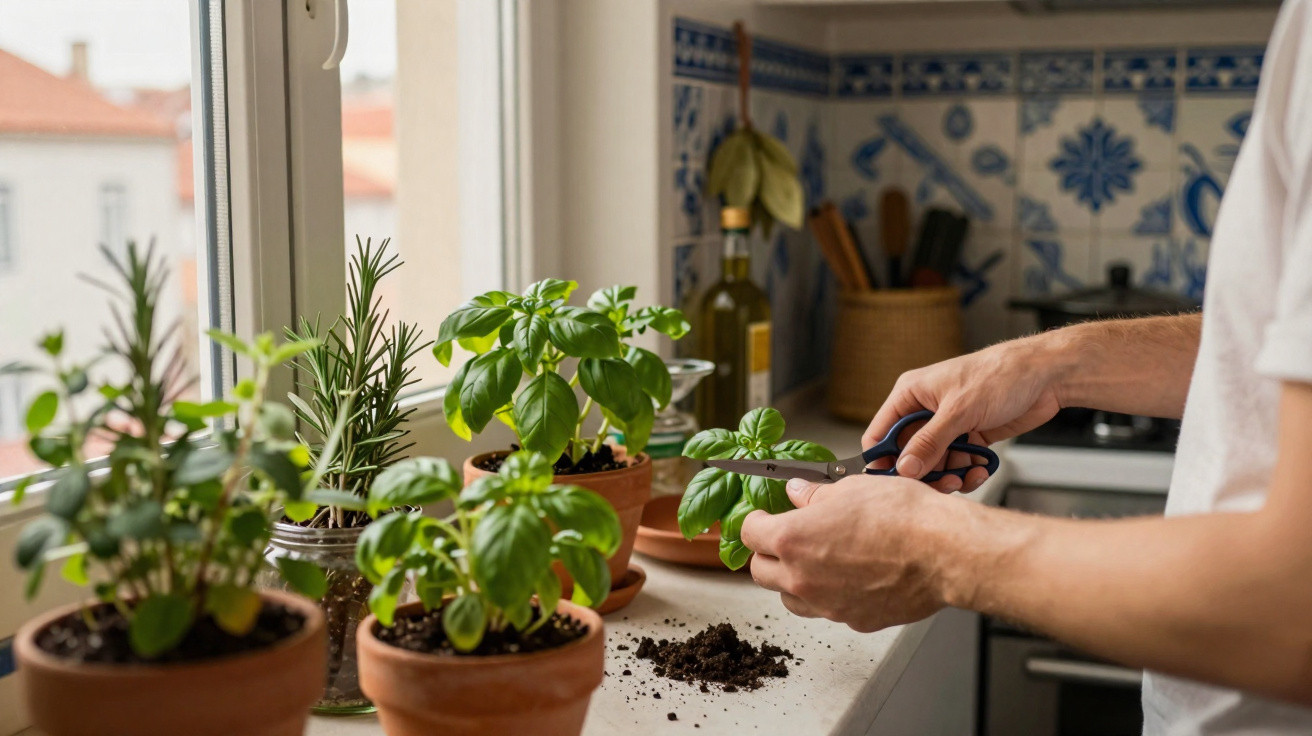
Cold tiles, a bottle of washing-up liquid tipped to one side, and light arriving and disappearing like a delayed bus: this is enough space for your herb garden. It does not need a patio or a greenhouse. All it requires is a windowsill, a tray and a little attention each day.
One overcast Tuesday in my third-floor London flat, I pushed aside a mug and arranged three odd pots in a row. There was market basil, mint with the scent of a mojito recalled, and a tiny rosemary cutting that seemed almost shy. Steam from the kettle clouded the window. A bus exhaled beyond the glass. I nipped off a basil tip, inhaled its scent, and suddenly my kitchen seemed half a metre larger. Nothing was tidy. Water dripped onto my sock. The mint drooped before lifting again as sunlight briefly broke through. The scene was small, familiar and strangely daring. Then the basil showed me something useful.
A windowsill herb garden really can thrive
Study a windowsill closely and it becomes a microclimate. It receives warmth from indoors, brightness through the glass and a breeze whenever you open the catch. Herbs enjoy precisely that combination. Light is their currency, and a sill offers far more of it than any shelf. Urban air does not trouble herbs. Our routines are the bigger danger: radiators roaring beneath pots, curtains leaving plants in darkness, and anxious overwatering. Change those habits and even the narrowest ledge becomes productive. It is ordinary magic, scented with supper.
A friend in a one-bedroom Manchester flat began with supermarket basil. Within a week, it had collapsed. She divided the packed clump into three containers, set up a table lamp with a bright white bulb, and gave each pot a quarter-turn every Sunday. Two months on, she was snipping generous handfuls for pasta and sending photographs as though they were baby portraits. Herbs react quickly; that is their appeal. Six hours of strong light and a free-draining pot can transform a plant’s outlook. They can improve yours as well. A single sprig scattered over eggs can feel like a miniature break away.
There is straightforward science at work. Soft-stemmed herbs, including basil, coriander and parsley, benefit from regular pinching. Woody varieties such as rosemary and thyme would rather dry out slightly between waterings while sitting in the warmth beside the glass. Roots require pockets of air rather than sodden soil, so a gritty compost blend is better than garden earth. Windows intensify light, while walls retain heat. Combined, they provide growth with free energy. Keep the roots comfortable, supply light to the foliage and harvest gently. Surprisingly often, everything else falls into place.
Setting up your windowsill herbs for success
Begin with pots containing drainage holes, saucers for catching drips and a loose, airy compost. Combine two parts peat-free compost with one part perlite or coarse grit. Settle the mixture by tapping the pot rather than packing it down. For supermarket herbs, gently pull the clump apart into two or three sections, then give each section its own pot. Water them once, preferably from below: place the pots in a tray and allow them to absorb water for 20 minutes. Remove them afterwards so excess water can drain away. Choose a bright sill that receives at least some direct sunlight. For a north-facing window, use a basic cool-white LED grow light positioned 20–30 cm above the leaves.
Most disappointments result from care taken a little too far. Saturating the roots “just in case”. Leaving pots directly above a radiator. Shutting plants behind blackout curtains overnight. Remove those pitfalls and the results shift quickly. Feel the compost: water when it is cool and a little dry one knuckle below the surface. If it is not, hold off. Take basil from the top, immediately above a pair of leaves, rather than stripping it from the base as you would salad. Give mint a pot of its own, otherwise it will overwhelm its neighbours. Honestly, no one manages this perfectly every day. You will miss the occasional watering, and the plants are more forgiving than you might expect.
Set a handful of rules that you can genuinely maintain. Keep an inexpensive mister for heatwaves. Turn the pots once a week. Every two or three weeks, feed sparingly with half-strength liquid seaweed. That first picking will taste better than any recipe.
“A windowsill is a narrow stage,” an old gardener told me. “Your job is cues and lighting. The plants know their lines.”
- Easiest herbs for beginners: basil, chives, mint, flat-leaf parsley, thyme.
- Watering sign: compost that is dry on top but faintly cool below.
- Light goal: a bright window, plus 12–14 hours beneath a 4000–6500K LED where necessary.
- Cutting rule: do not remove more than a third of any plant in one go.
- Watch for draughts: open windows are acceptable, but direct blasts from heaters are not.
Harvest, refresh and enjoy the rhythm
This is the routine that helps the habit last. Sow seeds or divide plants in small batches at two-week intervals, ensuring that something is always reaching its best. Regularly pinch basil and mint to encourage branching. Allow parsley to recover by cutting the outer stems first and keeping its crown untouched. Feed sparingly, then give it a week without feed. When coriander bolts, do not be frustrated: use its flowers and green seeds before sowing again. Once a pot is exhausted, lift out the strongest parts, renew the compost and begin afresh. We have all faced an evening when dinner needs some lift but the shops have closed. A discreet snip from the sill changes both the dish and the night. A rented kitchen becomes your own patch. Care becomes flavour. The plants will show you when to act; your appetite will take care of the rest.
| Key point | Detail | Why it matters to the reader |
|---|---|---|
| Light is everything | Choose your brightest sill; if light is poor, position a cool-white LED 20–30 cm above the leaves for 12–14 hours. | More reliable growth during UK winters and in north-facing rooms. |
| Drainage saves plants | Use holed pots, drip-catching saucers and airy compost with perlite or grit; water from below whenever possible. | Less root drowning, fewer fungus gnats and more consistent herbs. |
| Pinch, do not pluck | Snip tips just above a leaf pair; take no more than a third at each harvest; cut parsley’s outer stems first. | Bushier plants, quicker regrowth and larger weekly harvests. |










Comments
No comments yet. Be the first to comment!
Leave a Comment