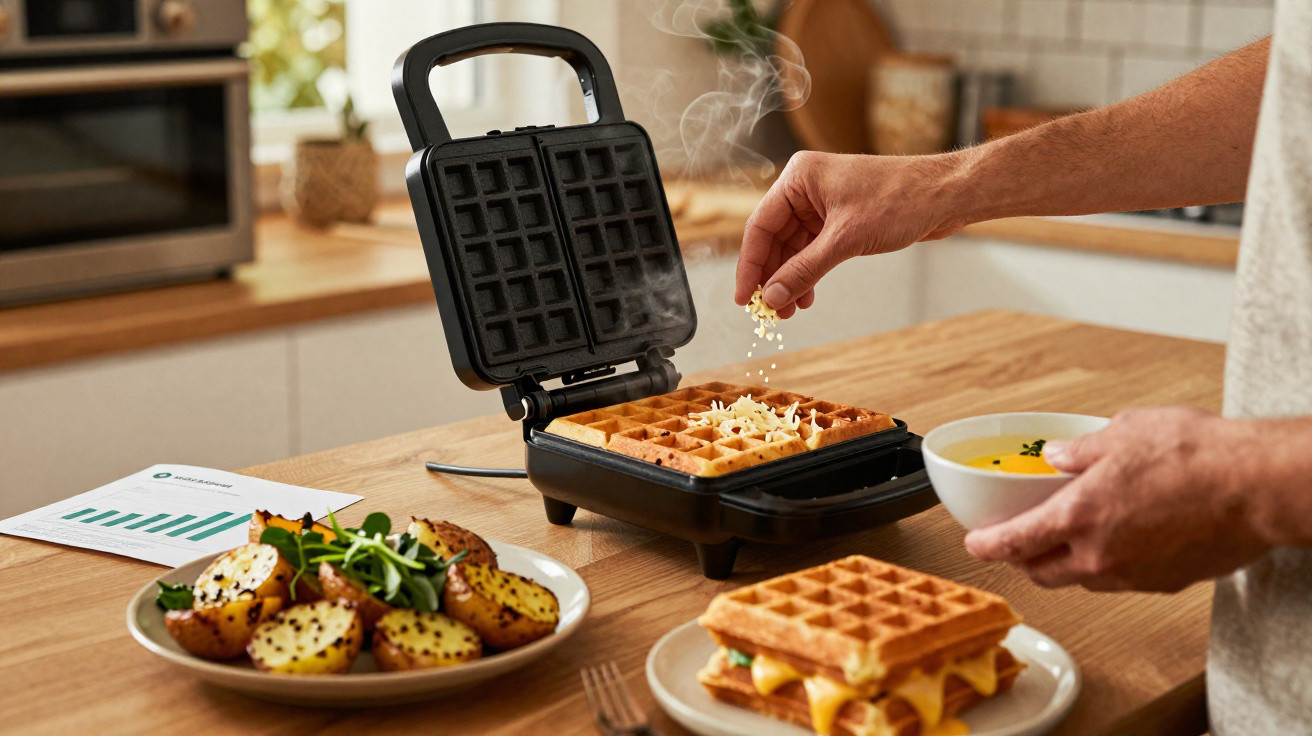
While the oven warms up half the kitchen, an unobtrusive appliance works much more directly: the waffle maker. Many people use it only for sweet Sunday waffles, but it is actually a mini oven for quick savoury dishes. Three straightforward recipes show how it can save time, electricity and even washing-up, without sacrificing flavour.
Why the waffle maker can be smarter than the oven
A conventional oven first has to preheat – mainly a large volume of air. It usually takes 10 to 15 minutes to reach temperature. During that time, the food does nothing. A waffle maker works very differently: it heats two metal plates that sit directly against the food. There is no hot air, no large cavity and barely any wasted heat.
“If you are cooking for only one or two people, an oven often wastes more energy heating empty space than heating the food.”
Typical real-world figures are:
- Oven: roughly 2000–3000 watts, plus a lengthy preheating stage
- Waffle maker: roughly 700–1200 watts, with virtually no preheating required
Time is another benefit. Many dishes are ready in the waffle maker within three to seven minutes. The appliance heats up as soon as it is switched on and transfers its heat straight to the food. Evenings feel more relaxed when there is no need to wait ages for the oven timer to sound.
Crisp results through contact heat: what happens in a waffle maker
The waffle maker offers a benefit also familiar from contact grills: heat reaches the food from above and below at the same time. Specialists refer to this as “double contact heat”. This reduces cooking time while browning the surface quickly and evenly.
That is precisely what creates the well-known golden-brown crust, known as the Maillard reaction. It delivers toasted flavours otherwise associated with a frying pan or grill. Unlike an oven, where hot air circulates around the food, a waffle maker holds it directly between two heated metal surfaces.
“Contact rather than air: the waffle maker focuses energy exactly where the food sits – not throughout the entire interior.”
Especially after work, it can feel like a small shortcut: plug it in, add batter, vegetables or bread, close the lid – and just a few minutes later, a hot, crisp meal is on the plate.
Three savoury waffle maker recipes for this evening
1. Waffle maker omelette – no frying pan, no turning
For a quick hunger fix, a basic recipe is enough and can be adapted in countless ways.
- Beat 2 eggs in a bowl
- Stir in a little grated cheese
- Season with salt, pepper and, if desired, herbs
Lightly brush or spray the waffle maker plates with oil. Slowly pour the egg mixture onto the hot surface, then close the lid. After around two minutes, the omelette will be set and browned on both sides.
The advantage is that there is nothing to turn and nothing sticks to a frying pan. The waffle pattern creates small pockets where the cheese and fat collect, resulting in unexpectedly succulent mouthfuls.
Variations for extra flavour:
- Mix in small cubes of ham or bacon
- Add chopped spring onions or diced peppers
- Use feta and spinach to make a Mediterranean-style “waffle omelette”
2. Waffle maker rösti – crisp outside, soft inside
Rösti, or potato fritters, normally need plenty of oil in a frying pan and attention when turning them. In a waffle maker, the process is much more effortless.
- Coarsely grate 2 raw potatoes
- Squeeze the mixture firmly in a clean tea towel
- Combine with 1 egg and a little salt
Spread the fairly dry potato mixture over the plates and press it down lightly. Close the lid, wait five to seven minutes, and it is ready. A deeply browned layer forms on the outside, while the middle remains soft and moist.
“The key to good waffle maker rösti: squeeze the potatoes really thoroughly – the less water they contain, the crisper they become.”
A dollop of herb quark, a fried egg or a fresh salad makes a good accompaniment. For a heartier version, mix grated cheese or finely sliced onions into the potato mixture.
3. Toasted sandwich classic – quicker than the oven
A filled slice of toast becomes a small savoury meal in the waffle maker. It takes seconds to assemble:
- Place one slice of toast on the lower plate
- Top it with ham, then add plenty of cheese
- Put a second slice of toast on top and press the lid down firmly
After about three minutes, the bread is crisp on the outside and hot and cheesy within. Pressure almost fuses the slices together, seals the edges and keeps most of the cheese inside.
Variations can turn this snack into something close to a small gourmet dish:
- Add sliced tomatoes, pesto or mustard between the layers
- Use leftover fried vegetables that would otherwise end up sitting in the fridge
- Add chicken strips, olives or sun-dried tomatoes for extra seasoning
When a waffle maker is genuinely worthwhile – and when it is not
For small portions, snacks or meals for no more than two people, the waffle maker plays to its strengths. It saves not just electricity but time as well: no preheating, scarcely any waiting and short cooking times. Anyone wanting to warm up just a small meal after a long day will find it much more efficient than a large oven.
It is different with bakes or roasts for the whole family. A large tray of lasagne or roasted vegetables needs surface area and volume, so the oven still has its place. In that case, the energy is shared across several portions, improving the overall balance.
“Rule of thumb: small quantities, short cooking times, quick snacks – waffle maker. Large bakes, roasts, several trays – oven.”
One simple trick can reduce electricity use further: switch off the waffle maker about 90 seconds before the planned cooking time ends. The metal plates remain sufficiently hot to finish cooking and browning the food. This makes sensible use of residual heat.
Practical tips for safe, clean cooking in a waffle maker
A few basic rules help keep cooking with a waffle maker enjoyable over time:
- Never pour in mixtures that are too runny, otherwise they will spill out at the sides.
- Oil the appliance only lightly; too much makes it smoke and harder to clean.
- After each use, wipe the plates with kitchen paper while they are still warm but no longer hot.
- For stubborn residue such as cheese or egg, gently use a wooden spatula from time to time – never metal.
Anyone who regularly prepares savoury foods in it can use thin, heat-resistant baking liners or suitable inserts. They make cleaning easier and prevent stubborn burnt-on residue.
How much the electricity bill can really be reduced
Actual savings depend on your energy tariff and how you use the appliance. What is clear is that every occasion when a small appliance with a shorter running time replaces the large oven reduces the energy used. In households where only one portion is often warmed up, the difference adds up over weeks and months.
There is another benefit too: anyone who keeps a waffle maker ready to use is less likely to reach for expensive ready meals or delivery services. A few eggs, potatoes, slices of toast and a piece of cheese can make an impromptu meal that costs considerably less than ordering through an app.
Once people have understood the principle, they usually start experimenting: filled pastries, vegetable fritters and even leftover pasta bake can be crisped up in individual portions in the waffle maker. An underestimated kitchen appliance then becomes a flexible everyday helper, using less electricity while delivering surprisingly big flavour.












Comments
No comments yet. Be the first to comment!
Leave a Comment