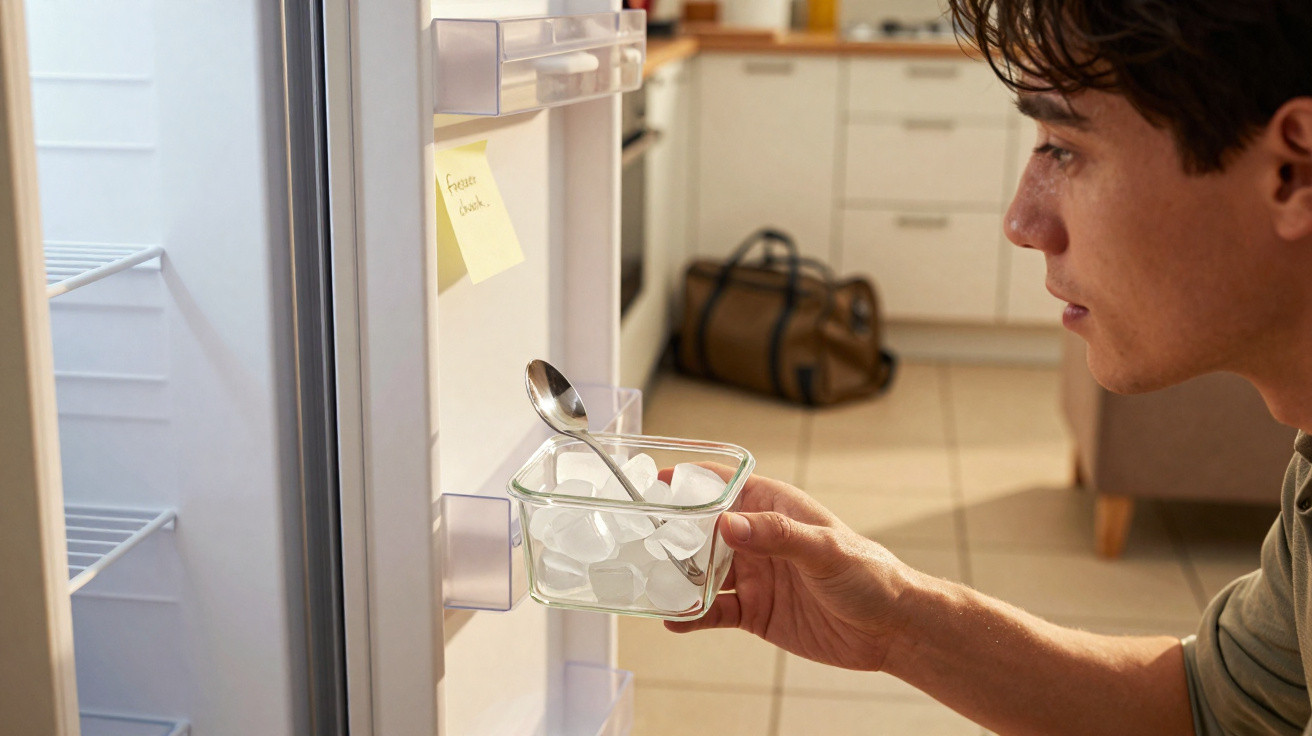
Two days after leaving home, you find peas still perfectly frozen, the freezer light steady and a persistent question in your mind: did the electricity fail while you were away? Food can appear completely normal after a power cut. That is precisely the issue. You need a way to find out what happened inside the freezer while nobody was there to see it.
I first came across the spoon trick through a neighbour who travels for work and cannot stand wasting food. He described a humid summer spell when he returned to a flat with a smell that was… slightly off. The ice cream had frozen again but was a bit grainy. The chicken looked all right, so he ate it. You can imagine how that ended. Afterwards, he discovered a straightforward method for checking whether a freezer warmed up during a power cut: a spoon and a cup of water. It sounds almost absurdly simple, but it works.
The little metal truth-teller in your freezer
Take a look inside your freezer and you are looking at a fragile time capsule. Frozen food can survive a brief power cut without any obvious change, then silently freeze again when the electricity returns. You cannot always spot that thaw by looking, and your sense of smell may not detect it either. A spoon can reveal it.
The method is clever because it uses basic physics most of us learned at school and then forgot. Water freezes solid at 32°F (0°C). As temperatures rise, it melts. If a power cut lasts long enough for the ice in a cup to soften or become liquid, anything placed on top will drop down. Once the power comes back and the freezer cools again, the water freezes with the spoon trapped lower in the cup. That small change tells the story at a glance.
After a storm, many of us have looked at a freezer and wondered, “Is this safe?” The spoon creates a record, much like a tide line on a pier. If it remains on the surface, the food stayed frozen. If it has dropped halfway, there was a partial thaw. If it is sitting at the bottom, the freezer became a fridge - or worse - for a period. No app can retrospectively show you that as clearly as a piece of metal resting on ice.
How to set up the freezer spoon trick and trust the result
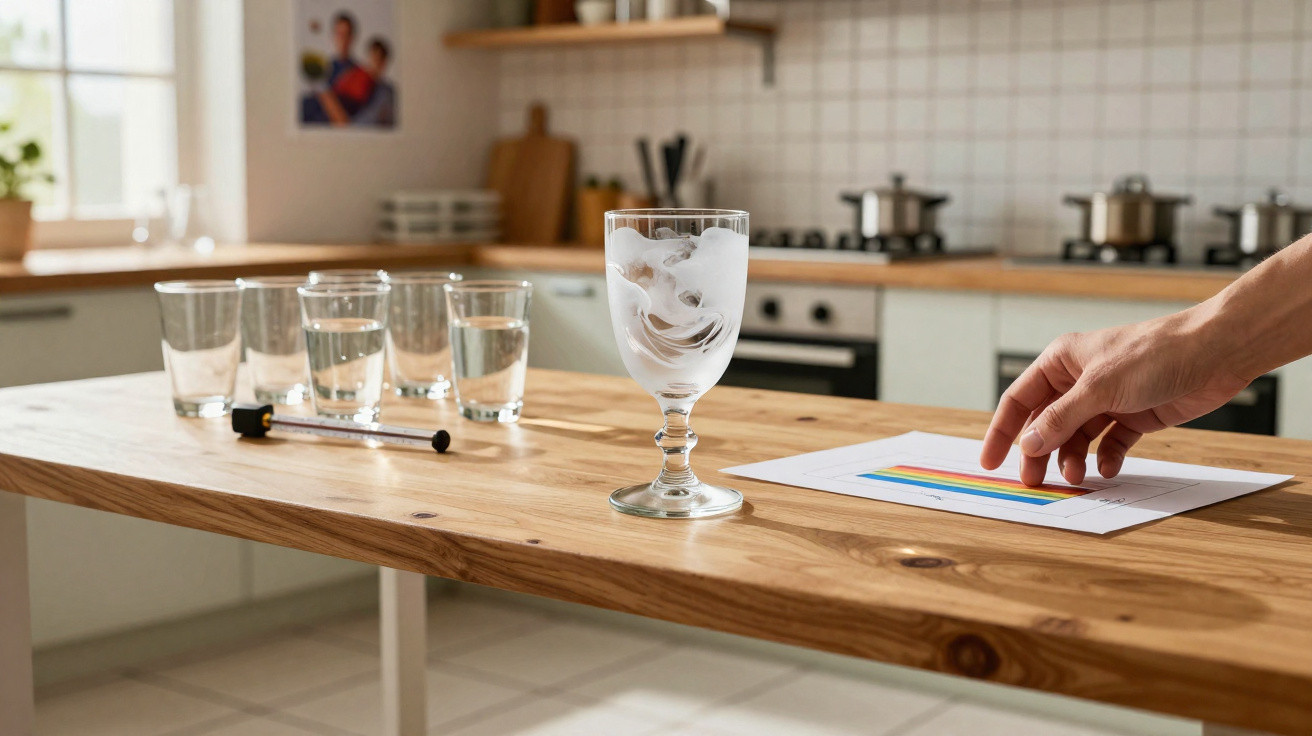
Find a small cup, fill it with water and freeze it until the water is completely solid. Put a metal teaspoon flat on the ice, bowl facing down, keeping it as level as possible. Place the cup towards the back of the freezer, where temperatures tend to be more consistent. That is all you need to do. When you get back from a trip - or see clocks flashing after a power cut - look at the spoon’s position. At the top means it remained frozen throughout. Halfway down indicates a partial thaw. At the bottom means the ice fully melted and froze again. Treat a spoon at the bottom as a warning sign, not a mystery to solve.
A few details will make the test easier to interpret. Choose a metal spoon rather than a plastic one, as the weight of metal makes movement obvious. Do not lodge the spoon against the cup edge; it needs to sit freely on the ice. In a full freezer, leave the cup somewhere visible and take a quick photograph before you leave, so you can recall its starting position. Realistically, nobody will do that every day. Do it before bank holidays, longer breaks, storm season or whenever bad weather is expected.
You can also place a coin on top of the ice in a second cup if you prefer - it works on the same principle and provides another visual marker. However, a spoon is easier to notice quickly and is less likely to roll away.
“A spoonscape in your freezer is more reliable than your memory after a blackout. It’s a simple audit of what really thawed while you were gone.”
- Spoon at the top: keep the food and use it as normal.
- Spoon halfway down: look for ice crystals on food; cook or dispose of it in line with food safety guidance.
- Spoon at the bottom: throw away high-risk foods, including meat, fish, dairy products and leftovers.
The spoon trick is not a substitute for common sense or food safety guidance. Instead, it supports both, rather like a dashcam for your freezer.
Why the spoon test matters more than you might expect
Power cuts can be deceptive. In the United States, customers who experienced outages in recent years were without electricity for around five to six hours on average when major storms were included. Many outages occur when homes are empty: during workdays, school runs or weekend breaks. A freezer remains cold during a short interruption, then resumes normal operation when the lights come back on. Without a marker, all you can do is guess.
This concerns health as well as flavour and texture. Food safety guidance states that perishable food can become unsafe when kept above 40°F (4°C) for more than roughly two hours. Freezers are intended to run at 0°F (-18°C). During a lengthy outage, the temperature can pass through the range between those figures without you knowing. Food may then refreeze and look harmless, particularly once frost has concealed the evidence. The spoon test is a basic tool that deliberately favours caution. That is its purpose.
The reasoning is straightforward. If the spoon has not shifted, the freezer did not warm up significantly. If it has moved a little, surface melting occurred, putting the contents in a borderline situation. If it dropped, the ice became water, suggesting that the entire freezer compartment warmed for some time. The metal doesn’t lie because gravity doesn’t negotiate. If you are unsure, prioritise safety over saving money. Groceries can be replaced; your stomach may be less forgiving.
Pro tips, frequent mistakes and the human element
Turn the test into a nearly invisible habit. Freeze the cup once, leave the spoon on the ice and keep it in a place where it will not be moved around. Reset the cup after defrosting the freezer. If you have a chest freezer in a garage, put a cup and spoon in there as well, since outbuildings experience greater temperature swings. Label the cup “Power Test-Do Not Move” so roommates and guests don’t turn it into an ice bath.
The most common error is adding the spoon before the water has frozen completely. If it sinks into slush straight away, there is no reliable starting point. Another problem is knocking the cup while searching for frozen chips. Move it even once and the result is no longer accurate. Where power cuts often last a long time, consider keeping a small standalone freezer thermometer with maximum-temperature memory beside the spoon. The spoon indicates whether thawing occurred; the thermometer gives an idea of how far the temperature rose.
Some people fear that the spoon will “overreact.” It will not. It only descends when the ice softens or melts.
“Think of it as a low-tech lie detector for your freezer-cheap, quiet, fiercely honest.”
- Use a metal teaspoon only, with the bowl facing down on solid ice.
- Keep the cup at the back of the freezer or in a cold corner.
- Photograph the starting position before going away.
- Check the spoon before anything else after storms or trips.
- If in doubt, dispose of high-risk food.
This small routine offers peace of mind in exchange for one spoon that was probably not being used anyway.
What changes when you rely on a spoon
You no longer have to second-guess something you cannot see. A storm passes through, the neighbourhood loses power and you are away from home. You return to a freezer that looks entirely normal. The spoon shows whether that normal appearance is genuine or simply the result of refreezing. Pass the tip on to a friend who has just moved out, a neighbour with an emergency food store or a parent concerned about a basement freezer. Its appeal lies in its everyday simplicity, like putting a lamp on a timer.
There is a quiet satisfaction in solving a digital-age uncertainty with something physical and uncomplicated. Food is personal, as is the worry of making the wrong call. With almost no effort, this lets you make a promise to your future self: if you are safe to eat, I will eat you; if not, I will let you go. It replaces a shrug with a decision. And that decision fits into one instruction: check the spoon.
| Key point | Detail | Benefit for the reader |
|---|---|---|
| Spoon-on-ice test | Freeze water until solid, place a metal spoon on top and check its position after power cuts | An immediate yes-or-no indication of hidden thawing |
| What movement means | Top = solid; middle = partial thaw; bottom = full melt/refreeze | Clear prompts to keep, cook or discard food |
| Safety window | Perishable food above 40°F (4°C) for around 2 hours enters a risk zone | Protects health without relying on guesswork |












Comments
No comments yet. Be the first to comment!
Leave a Comment