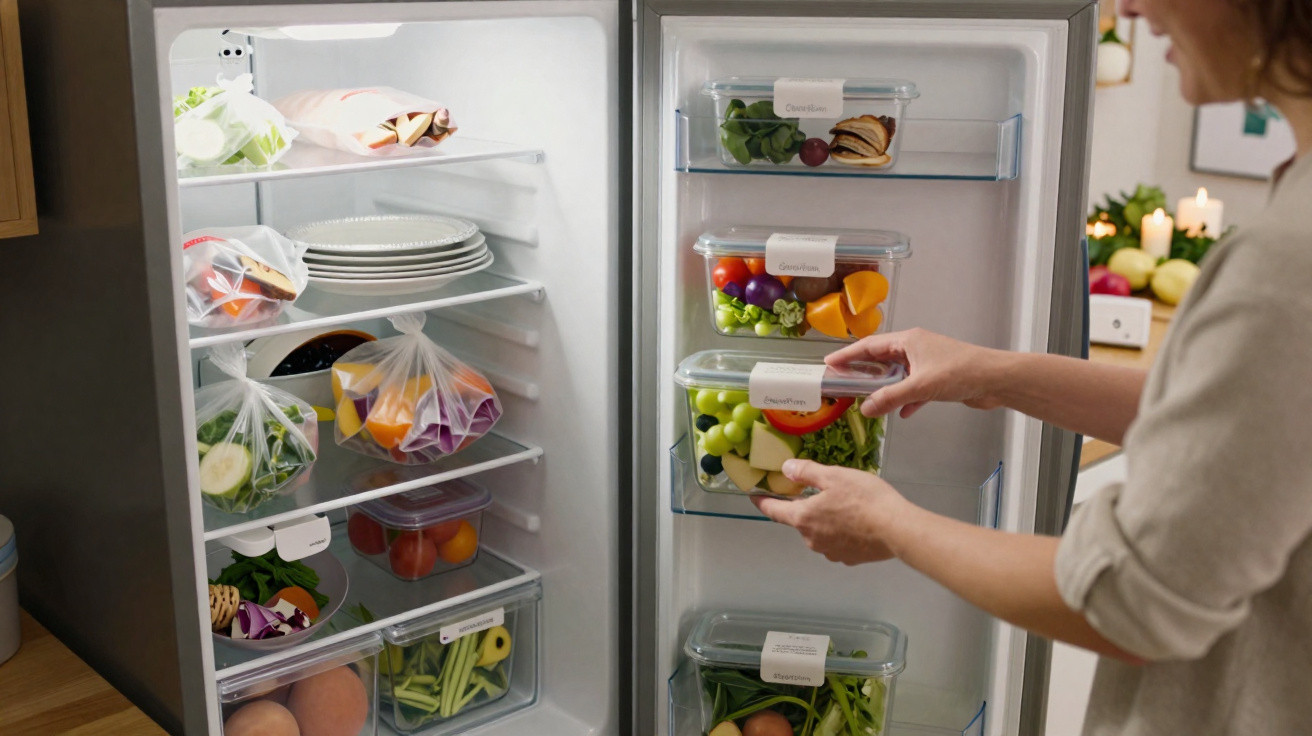
It tends to happen on Boxing Day morning. Still half asleep, you open the fridge in search of milk and face a solid mass of cling-filmed plates, unexplained foil-wrapped parcels and an unsteady Tupperware tower. Something is leaking from the top shelf. At the back, a bag of salad leaves has sunk into dark green slime. The cranberry sauce has been opened, but which of the three matching jars was actually used yesterday? You nudge the door shut with your hip, act as though you have not noticed the leak, and vow to “sort it later”.
When “later” eventually comes around, much of that food is already destined for the bin. Oddly, most of us believe we are being sensible when we put everything in the fridge as quickly as possible. But fresh consumer data indicates that one fridge-storage habit does more than waste food: it can quietly double the amount we throw away during the holidays. It begins when we pack the fridge as though it were a suitcase.
The false reassurance of an overstuffed fridge
In December, there is something reassuring about a fridge crammed full. With trays, leftovers and desserts squeezed inside, and shelves slightly bowed under their weight, it can seem like evidence that you have done Christmas “properly”. You have provided. Nobody has gone without. Everything is close at hand, ready to be eaten over the coming days. On social media, a packed fridge can even feel like a badge of domestic pride.
The evidence presents another picture. UK consumer research from grocery apps and waste charities repeatedly records a rise in food waste after Christmas, and it is not solely caused by buying too much. The main issue is what happens after the shopping bags arrive home: we fill the fridge so tightly that cold air has little room to circulate. Food is obscured, forced to the back and left to spoil while we nibble at whatever is most visible. The fridge turns into a cold, buzzing version of the “chair of doom” in the bedroom – the place where clothes disappear.
This is the error: seeing the fridge as a storage cave rather than a display shelf. Carelessly piling food inside creates ideal circumstances for waste. What is out of sight genuinely slips out of mind, particularly when everyone is exhausted, slightly tipsy and grazing rather than organising proper meals. We do not intend to waste food; we simply lose track of it amid the disorder.
The fridge-storage mistake that quietly doubles holiday food waste
Several UK consumer surveys suggest that households discard up to twice as much chilled food in the week after Christmas as they do in an ordinary week. Purchasing more is not the only explanation. The trend is remarkably clear: the more crowded the fridge, the more food reaches the bin. Researchers identify the particular habit as “deep stacking” – layering tubs, containers and packets in front of, and on top of, each other until the items behind are no longer visible.
It may appear harmless, even practical, but it misleads the brain. You open the door, look at the front layer, quickly decide “there’s nothing good in here”, then close it again. Sliced turkey beneath leftover potatoes, cheese under a half-finished trifle and perfectly edible coleslaw behind the open milk all vanish from your mental stocktake. By the third day, their appearance and smell can feel slightly questionable, so you throw them away to be cautious.
Honestly, hardly anyone rotates their fridge contents like a professional chef over the holidays. You may be entertaining relatives, a new board game may be spread across the table, somebody may be crying over a broken toy, and rearranging Tupperware is the last thing you want to do. That is precisely what the consumer data captures. We are not “bad people” for wasting food; we are distracted people with too much going on. The problem is not buying too much – it is concealing what we have bought from ourselves.
When the fridge is not cold enough
There is another aspect that most of us literally fail to see. In a tightly packed fridge, cold air cannot move around properly. Some areas become warmer, especially by the door and in cramped corners. Meat and dairy stored there sit at a marginally higher temperature than they should, and their usable life shortens rapidly. Refrigeration may seem to be keeping everything safe, while the conditions inside are quietly doing the opposite.
Consumer tests indicate that leftovers in a crowded, poorly arranged fridge can spoil a whole day earlier than they would in a clear fridge that is cooled evenly. That is one lost day simply because a dish was pushed behind three other items in a warm pocket of air. The problem is that you generally realise only when you lift the foil and the smell reaches you. At that stage, it is more than a little waste: it brings a rush of guilt and irritation, with all that money and cooking discarded alongside a sour smell.
The emotional aftermath of food waste
Food waste is often discussed through figures and charts – tonnes, percentages and carbon footprints – but its sharpest impact is personal. You remember the time spent at the hob stirring gravy, or your dad peeling potatoes until his back ached. You think about the particular cheese your aunt sought out because she knows you love it. Disposing of it does not feel neutral. Even when nobody sees it, it can feel disrespectful.
Most of us know the moment: pulling a sticky container from the back of the fridge, holding it at arm’s length and murmuring “oh no” to ourselves. You lift the lid, spot the fuzzy edges and feel an oddly intense sense of shame. The bin closes with a muted thud, and you promise to be more disciplined next year. Then December returns, and once again you are shifting shelves with one hand while holding a turkey with the other, assuring yourself that things will be different this time.
That is why this fridge-storage mistake matters. It is not merely a technical point about airflow; it takes choice away from us. We cannot eat food that we cannot see, and we cannot plan meals around food we have forgotten is there. During the holidays, when feelings and expectations are already close to the surface, losing control over something as fundamental as food can sting more than we acknowledge.
The “shop window” trick that changes everything
The most notable finding within the consumer research is how straightforward the solution may be. Households that arrange their fridge like a shop window – keeping food visible, front-facing and loosely grouped – waste far less, even when they still buy too much. This does not require labelling every jar or colour-coding the shelves like an influencer’s kitchen. It means reversing the question: rather than asking “where can I squeeze this in?”, ask yourself “will I actually see this again?”.
Treat the front of the fridge as valuable space. Put leftovers you want to use there, including sliced turkey, cooked vegetables and partly used cream. Newer products, along with those that keep longer, can go behind them. Where possible, keep every category just one layer deep. Have one row of leftovers instead of three towers. Keep fruit in a single clear bowl rather than across four bags. All at once, the Boxing Day fridge looks less like a Tupperware Jenga challenge and more like a buffet you can properly understand.
Give leftovers a deadline rather than a hiding place
Households that waste less often share one quietly effective practice: they give leftovers a mental deadline. For most cooked dishes, that might be two days, or perhaps three at a stretch. Afterwards, the food is frozen or turned into something else. They are not flawless; they simply create a small sense of urgency. That urgency is effective only when the food confronts you each time you open the fridge.
Clear containers can help here, as can simply using plates without coloured lids. Your brain needs to register “pasta bake, day old” at a glance. When everything is covered in anonymous silver foil or stored in black plastic tubs, it all merges together. You can’t feel urgency for something you don’t quite recognise. As a result, leftovers remain untouched until guilt overtakes hunger and they end up in the bin.
The unusual psychology of the holiday fridge
Researchers studying food behaviour frequently discuss “choice architecture” – the way our surroundings guide decisions we barely realise we are making. The holiday fridge is a perfect if slightly disorderly illustration. Put a plate of cold roast potatoes at eye level and it will probably be finished within a day. Leave a bowl of perfectly good sprouts behind the juice and it may be forgotten. You are not selecting food through a rational, carefully measured process; you are choosing whatever is visible while you are already distracted.
The same consumer data that identifies waste doubling also reveals a straightforward point: when leftovers sit at eye level and are grouped together, they are eaten first. In practical terms, that means less partly used cream thrown out on the fourth day and fewer slices of ham left to develop a sheen in the salad drawer. The fridge becomes its own gentle prompt, directing you towards the food that needs saving. There is no need to scold yourself about waste. You see what is available and respond.
Naturally, life is not a laboratory experiment. At times, six different people may open the fridge within ten minutes, each shifting items around as though hunting for buried treasure. Someone puts the champagne where the leftover roast was. Grandma moves the cheese into the vegetable drawer “to keep it safe”. That is real life. Even so, small fixed points – a shelf for ready-to-eat food and a corner for items nearing their deadline – can prevent the gradual slide towards the bin bag.
Small rituals that quietly save plenty of food
Most people do not need to completely overhaul their fridge; they need small routines that work within genuinely chaotic December days. One family I spoke to follows a “front row rule”: anything that should be eaten within one or two days belongs on the first shelf visible when the door opens. If there is no room, something older goes into the freezer or becomes that evening’s meal. It is not flawless, but their post-Christmas food bin is noticeably lighter than before.
Another easy practice is a five-minute “fridge check” after the main meal. It is not a deep clean, merely a quick rearrangement while the kettle boils. Put leftovers together, group unused raw ingredients and mentally allocate them to later meals. Place the gravy somewhere it will not be forgotten. Give the expensive cheese a clearly visible spot rather than burying it below three tubs of trifle. That brief moment of intention can shape the whole week that follows.
The data also suggests one final point: people who waste less tend to be less rigid about their holiday menu. If turkey curry was planned but the ham plainly needs using first, they change course. The fridge, rather than the recipe book, determines the menu. That flexibility can seem almost like a personality trait, yet it can be learnt. You begin to view each container not as “what we had yesterday” but as “tomorrow’s lunch, if I use it in time”.
Why this matters more than it appears
At first glance, throwing out some leftover stuffing or half a tub of cream may not seem catastrophic. It is an unpleasant moment, then it passes. But viewed nationally, those individual moments build into something remarkable. Supermarkets record their highest sales in December, food banks face record demand and, at the same time, household fridges quietly send black bags of perfectly edible food that has gone just too far to landfill. There is a muted heartbreak in that contrast.
Halving that waste is not about perfection; it is about visibility. It means changing the fridge from an overcrowded storage space into a slightly messy but honest display of what you truly have. Once it is visible, you can make a decision: eat it, freeze it, reinvent it or share it. The holidays are supposed to represent generosity, and that generosity can include the food itself by giving it a real opportunity to be enjoyed rather than left behind.
The next time you open the fridge and feel that familiar sense of overwhelm, stop for a moment. Move a few containers, bring the oldest leftovers forward and rescue the cheese from its hiding place. Nothing major is required, only a small act of attention. That one adjustment – declining to bury food behind more food – is the message consumer data repeatedly returns to. The true issue is not what we purchase, but what we let disappear in plain sight.















Comments
No comments yet. Be the first to comment!
Leave a Comment