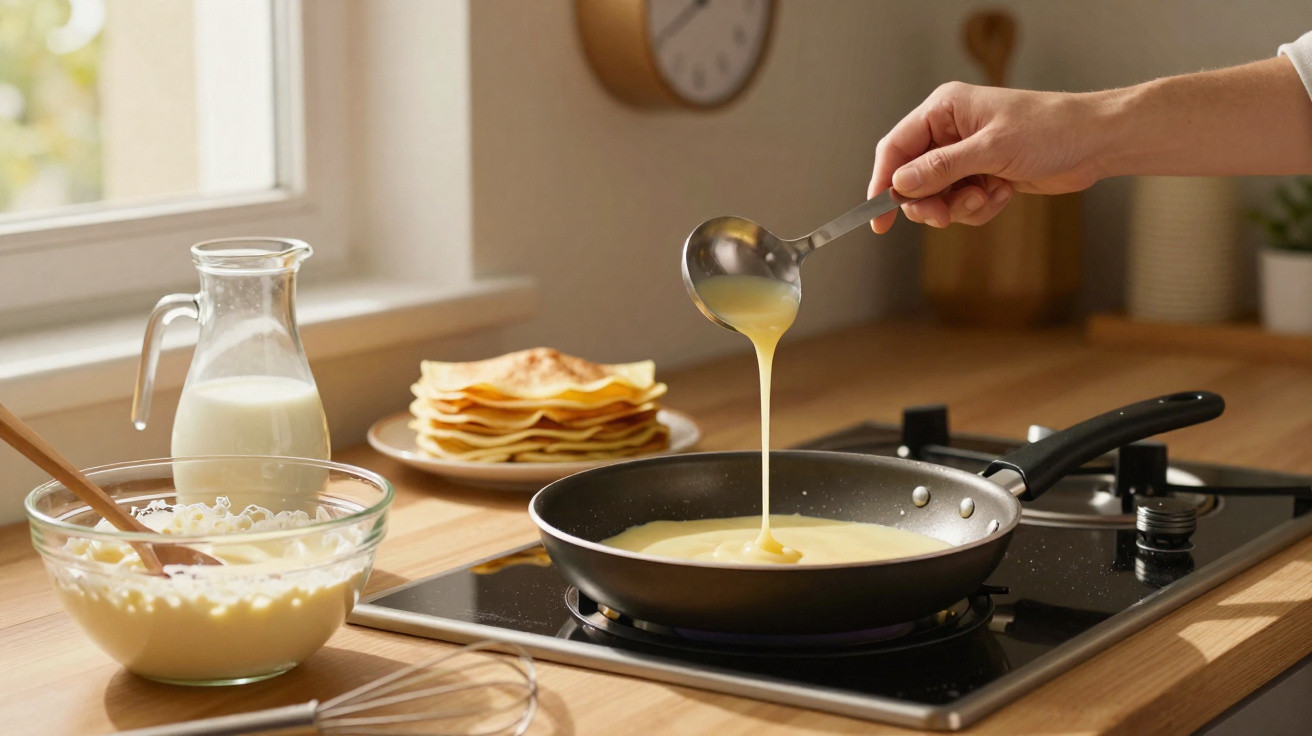
Many people whisk the batter together in a rush, heat the pan and then wonder why they end up with thick, fragile discs. Others insist on a long resting period, yet have little patience for it in everyday life. One straightforward kitchen technique promises both: reliable batter and far less waiting.
Why Crêpes batter needs to rest at all
Almost every traditional recipe gives the same instruction: mix the batter, then leave it to stand. That may sound like kitchen folklore, but there is a very practical scientific reason behind it.
As soon as flour meets liquid, its starch begins to absorb moisture and swell. At the same time, gluten forms a network that gives the batter its structure. Neither process happens in a matter of seconds; both develop gradually.
“The longer the batter rests, the more effectively the starch and gluten can form a stable, elastic network – the foundation for tender, flexible Crêpes.”
Giving the batter this time brings several benefits:
- The mixture becomes smoother and contains fewer lumps.
- The batter spreads thinly and evenly around the pan.
- Crêpes are far less likely to tear when turned.
- They feel softer in the mouth while still holding together well.
Crêpes can still be cooked without resting the batter. However, they are often more brittle, less even and slightly floury in texture.
The shortcut: why warm milk speeds up the process
Anyone unwilling to wait 15 or even 30 minutes can deliberately speed up the effect of resting. The key is the temperature of the liquid – more specifically, warm milk.
When flour is combined with warmed milk rather than cold milk, several things happen in the batter:
- The starch swells much faster because heat speeds up liquid absorption.
- The gluten network develops more quickly and more evenly.
- After a short time, the batter feels as smooth as conventional batter that has rested for longer.
“Warm milk replicates the effect of resting time – simply on a fast track. It produces an elastic Crêpes batter that is easy to work with almost immediately.”
The milk temperature matters here: it should be warmer than lukewarm but never boiling. Around 40 to 50 degrees is a useful guide – warm enough to touch without burning yourself.
Crêpes batter with warm milk: step by step
A few details help make the most of warm milk. One possible method is as follows.
1. Heat the milk correctly
Pour the milk into a saucepan and warm it over a medium heat. Stir from time to time so that it does not catch on the bottom. Remove the pan from the heat once light steam appears and the milk is clearly warm.
Do not let it boil, as the eggs may curdle more easily later and give the batter an unwanted texture.
2. Prepare the flour and eggs
Mix the flour with a pinch of salt in a large bowl. If you like, add a little sugar and vanilla. Beat the eggs in a separate bowl, then set them aside.
One useful extra tip: sifting the flour beforehand greatly reduces lumps and helps it combine with the warm milk more quickly.
3. Mix the batter – without overworking it
This is where the warm milk comes in. First, pour part of the milk into the flour and gently stir from the centre outwards using a wooden spoon or balloon whisk.
“The aim is to break up lumps and incorporate air gently – not to use so much force that the batter becomes rubbery.”
Gradually add the remaining milk, followed by the eggs at the end. Mix only until you have a smooth, pourable batter with no lumps. A few minutes of standing will never hurt, but with warm milk it is no longer essential.
Wooden spoon instead of a mixer: the detail that matters
A hand mixer will certainly produce a smooth result quickly, but it often works too much energy into the batter. This can overdevelop the gluten network, leaving the mixture rubbery and tough.
A wooden spoon or a simple balloon whisk is a better choice. Both introduce less air and develop the gluten only as much as needed for Crêpes that are flexible yet tender. It may seem like a minor detail, but the difference is noticeable in the pan.
How the trick affects flavour and texture
Many home cooks worry that skipping a lengthy resting period will affect the flavour. With Crêpes, however, flavour development in the batter itself plays a smaller part than it does in bread or yeasted dough.
Warm milk quickly creates a structure that promotes even browning during cooking. The characteristic flavour develops mainly in the pan, as sugar and proteins react to the heat. This batter trick therefore has less effect on flavour and chiefly improves texture and ease of handling.
If you do have time: a short pause, a big difference
If you are not under complete time pressure, you can still leave the batter made with warm milk for ten to fifteen minutes after mixing. This combination often gives the best result: batter prepared quickly, but still given a little final refinement.
That brief pause can be put to good use. Prepare toppings, slice fruit, melt chocolate or bring the first pan up to temperature. As a result, the wait does not feel like wasted time.
Common mistakes with quick Crêpes batter – and how to avoid them
| Mistake | Result | Solution |
|---|---|---|
| Milk is too hot | The eggs set and the batter becomes grainy | Let the milk cool briefly before combining it with the eggs |
| Mixing too vigorously with a mixer | Rubbery, tough Crêpes | Use a wooden spoon or balloon whisk and mix gently |
| Flour is tipped directly into a large amount of milk | Heavy lumping that requires lots of mixing | Add the liquid gradually: make a paste first, then thin it out |
| Batter is too thick | The result is more like thick pancakes than Crêpes | Thin it with a little more warm milk |
When skipping the resting time is worthwhile – and when it is not
The warm-milk method is especially useful when things need to happen quickly: an impromptu Crêpes session with friends, impatient children at the breakfast table or a late-night craving for something sweet.
If you are planning a celebratory meal, expecting many guests or aiming to cook especially thin, almost transparent Crêpes, a slightly longer resting time can still be worthwhile. Combining warm milk with a short pause produces very consistent results.
More than just batter: small adjustments with a big impact
Even the best Crêpes batter will not achieve much if the pan and cooking fat are unsuitable. A good non-stick pan or a cast-iron Crêpes pan provides even heat. A light coating of clarified butter or neutral oil prevents sticking and encourages delicate browning.
The temperature of the pan is equally important. If it is too cool, the batter becomes tough and pale. If it is too hot, the surface burns before the inside has set. A good test is to add a small drop of batter: it should sizzle immediately and set within seconds without smoking.
Why this kitchen trick works so well in everyday life
Using warm milk may sound simple, but it solves a familiar everyday dilemma: when time is short, batter rarely gets to rest. When it does not rest, the finished result can be disappointing. This method greatly shortens the gap between “a spontaneous craving for Crêpes” and “finished, delicious discs on the plate”.
After trying the method a few times, you will quickly develop a feel for the right temperature, consistency and mixing technique. Crêpes then move from the category of “weekend project” to a “quick everyday treat” – without compromising on quality or texture.







Comments
No comments yet. Be the first to comment!
Leave a Comment