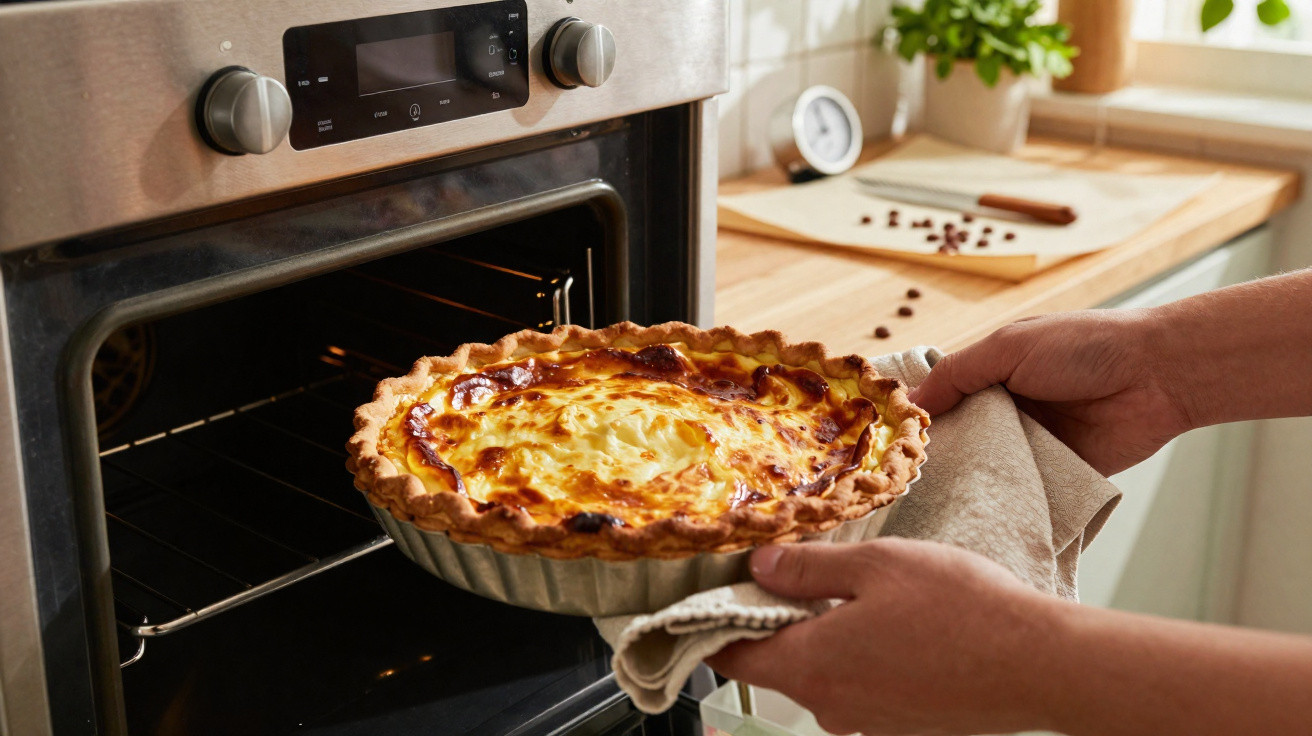
Turning the wrong dial can decide whether your quiche base stays crisp and supportive or collapses when you slice it. The issue is often neither the recipe nor the ingredients, but simply the oven setting you choose. And yes: the popular fan oven setting is more of a troublemaker when it comes to quiches and tarts.
Why fan ovens ruin your quiches and tarts
In fan oven or convection mode, a fan circulates hot air around the oven cavity. This brings some clear benefits: heat is distributed evenly, several trays can be used at once, food cooks more quickly and browns more consistently overall. It is ideal for bakes, roasts and traybakes.
However, this principle works far less well for shortcrust pastry, puff pastry and sweet tart pastry. The reason is the way heat reaches the pastry. Air flows all around the dish instead of building targeted heat from below. As a result, the filling sets and browns first, while the base lags behind.
“The biggest weak point in a quiche or tart is almost never the filling – it is nearly always the soft, pale base.”
The filling releases moisture from the very beginning. Unless the base bakes firmly at the same time, the pastry absorbs that liquid. Everything may look golden and finished on the outside, while the pastry underneath remains tough, flexible or even partly raw. When sliced, the base tears or sticks to the knife – a familiar problem that almost everyone has encountered.
Top and bottom heat on a low shelf: the professional trick
For quiches and tarts, the most suitable setting is usually straightforward top and bottom heat, often called conventional heating. Its symbol shows one line at the top and one at the bottom. With this setting, heating elements warm the oven from above and below, without the extra air circulation of a fan.
This makes the heat rise more clearly from the bottom upwards. Place the tin on a lower shelf and the pastry base will sit close to the lower heating element. That is exactly what it needs to bake quickly, dry out and develop a firm crust before the filling can soak through it.
- Oven setting: top and bottom heat
- Shelf position: as low as possible
- Temperature: usually 190–200 °C
- Baking time: 30–45 minutes, depending on depth
This approach works just as well for savoury favourites, such as a generously filled quiche with bacon and cheese, as it does for an apple tart topped with juicy fruit slices. The edge turns golden brown, the base becomes sturdy, and the filling stays creamy rather than scorched.
Blind baking: the shortcut to extra-crisp bases
If you are using particularly juicy fillings, such as tomatoes, courgettes, plums or berries, consider blind baking. This means baking the pastry case first without its filling, usually with baking parchment and dried pulses as weights.
A typical method is:
- Line the tin with pastry and prick the base.
- Cover it with baking parchment, then weigh it down with dried pulses or baking beads.
- Bake for 15 minutes at around 190 °C on a low shelf.
- Remove the weights and parchment, then bake briefly again until the edge starts to colour.
- Add the filling and finish baking.
This extra stage gives the base a head start. It firms up before the filling is added. It makes a particular difference with fruit tarts: instead of a soggy underside, you get a base that still has some bite even the following day.
What to do if your oven only has a fan setting
Many modern appliances include a fan setting but do not offer traditional top and bottom heat. This is more common than you might think in small kitchens or rented homes. You are not entirely stuck in that situation, although your options are more limited.
These adjustments can still improve the result considerably:
- Use the lowest shelf: Position the tin as low as possible so the base is nearer the heat source.
- Lower the temperature: Set it around 10–20 degrees lower than a recipe written for top and bottom heat, preventing the surface from browning too quickly.
- Allow extra baking time: You will generally need 30–35 minutes or more, depending on the tin and filling.
- Check beneath the tin: Towards the end, carefully lift it once. If the underside is still very pale, give it a few more minutes.
If you bake regularly, dark metal tins are also worthwhile. They transfer heat to the base more effectively than thick glass dishes, which tend to respond slowly and take even longer to reach temperature in a fan oven.
Common mistakes that lead to soggy bases
Choosing the wrong oven setting is only part of the story. In many kitchens, several smaller errors add up and collectively spoil the base.
Common pitfalls include:
- Not preheating the oven properly: The pastry goes into a lukewarm oven and starts to soften before it begins baking.
- Using a tin that is too thin or unstable: Cheap disposable tins can distort, leaving the pastry unevenly supported.
- Using pastry that is too warm and soft: Well-chilled pastry holds its shape more reliably during baking.
- Adding too much liquid to the filling: Undrained vegetables, too much cream or milk introduce moisture from above.
- Setting the temperature too low: Long cooking times at moderate heat do little to dry the base properly.
Keep these points in mind, alongside using the correct oven setting, and the soggy-base problem can usually be solved for good.
How to adapt popular recipes for quiches and tarts
Many online recipes routinely specify a fan oven because it cooks more quickly and is treated as the standard option. If you are a quiche or tart fan, it is worth confidently adjusting the instructions yourself. Check the stated temperature and convert it for top and bottom heat by adding around 20 degrees.
For example, a recipe may call for 180 °C in a fan oven for 30 minutes. In practice, a more reliable pastry base is likely to need:
- 200 °C top and bottom heat
- a low shelf position
- 35–40 minutes of baking time, depending on the depth of the filling
From around the 25-minute mark, it is worth checking carefully. If the centre of the tart still feels very soft, leave it in the oven for a few minutes longer. Pastry is more forgiving of a little extra heat than it is of a damp centre.
Why the extra effort is genuinely worthwhile
A dry, crisp base turns a pleasant quiche into a dish that makes an impression at the table. Portions stay neat when served, the filling does not spill out sideways, and the plate remains largely free from clumps of pastry and tough crust.
Anyone catering for guests or preparing larger quantities benefits especially from repeatable results. Once you understand that the base plays the leading role in quiches and tarts, and that the oven setting determines its success, confidence quickly follows. The good news is that there is no need to buy a new oven: in most kitchens, the right setting and a few adjusted habits are entirely enough.

















Comments
No comments yet. Be the first to comment!
Leave a Comment