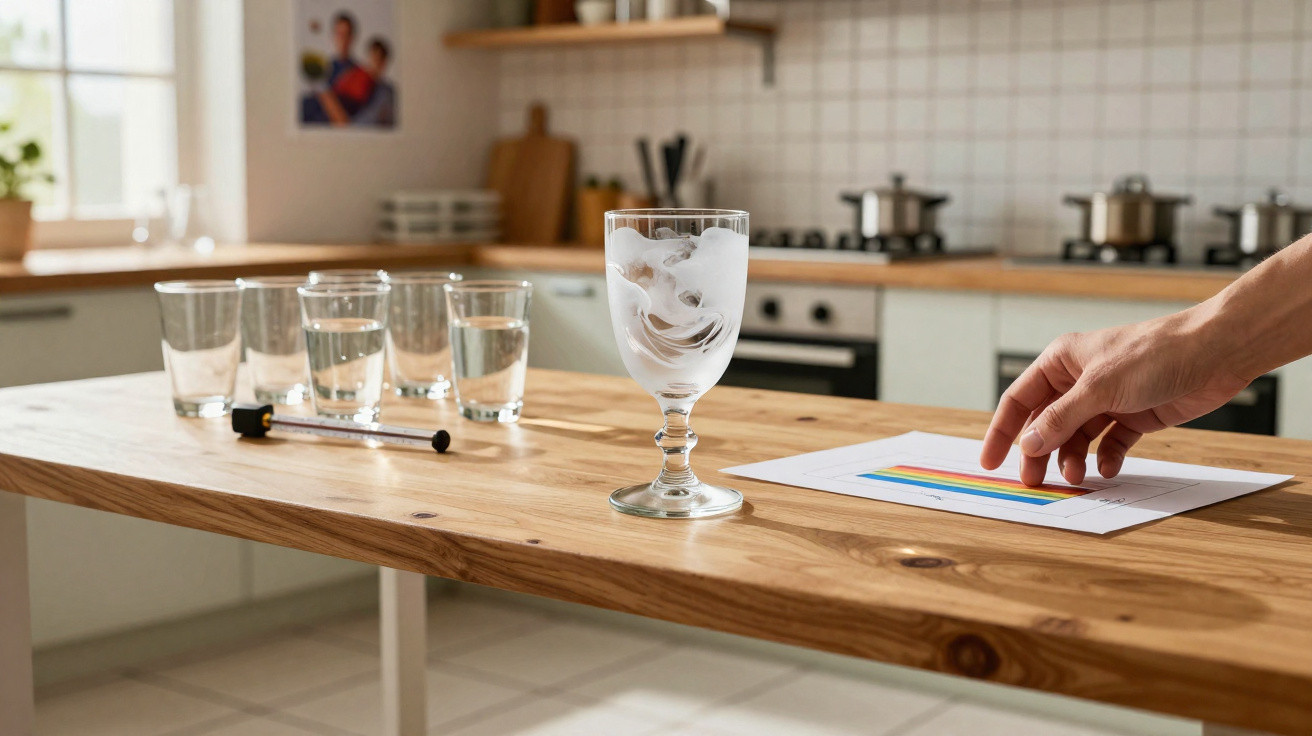
Duralex, founded in the 1940s, combines design, materials science and the hard realities of manufacturing. Now the company is asking the public to support its revival, drawing on the technology that originally made its name.
How heat toughening changes the rules
The glass owes its resilience to thermal tempering. Engineers raise soda-lime glass to about 700°C, then rapidly cool its outer layer with blasts of cold air while its centre cools at a slower rate. This carefully managed difference creates permanent internal stresses within the material.
Surface in compression, core in tension. That hidden stress profile is the quiet reason a Duralex tumbler shrugs off knocks and heat swings.
This process alters the way glass fractures. Compression in the outer layer prevents cracks from spreading, as even a small scratch finds it difficult to open when the surface is pressing in on itself. Testing indicates that a tempered Duralex item has around 2.5 times the mechanical strength of standard glass. It can also withstand thermal shock of close to 130°C, enough for the demands of a busy kitchen.
This is why, within sensible limits, a cup can move from the freezer to the microwave without incident. The science operates close to the glass transition temperature, at which viscosity falls sharply as the glass heats. Rapid cooling locks in a stress pattern before the atoms have time to rearrange fully.
The process, step by step
- Form: Molten glass is moulded into a tumbler while it remains hot and workable.
- Heat: The item is placed in a furnace, where it is evenly heated to around 700°C.
- Quench: Strong air jets cool the exterior within seconds, while the interior cools more gradually.
- Lock: The outer layer enters permanent compression and the core develops balancing tension.
- Test: Production batches undergo impact and thermal-shock checks to confirm consistent performance.
What goes into the Duralex recipe
The choice of raw materials is important. Duralex uses Fontainebleau sand, valued for fine grains that produce clear, bright glass. This silica is combined with soda ash and limestone, alongside up to 40% cullet from manufacturing offcuts. Recycled glass lowers the melting temperature, reduces energy use and helps maintain colour consistency.
At La Chapelle-Saint-Mesmin, near Orléans, a 54-square-metre furnace operates continuously. Around 30 tonnes of sand are delivered each day by lorry. At full pace, the factory can produce about 100 glasses every minute. Exact firing temperatures, holding times and airflow settings remain confidential. In glassmaking, minor adjustments to those variables affect the depth of internal stress and, ultimately, performance.
Designed for safety and hygiene
Tempered glass breaks in a different way. When a Duralex tumbler fails, it shatters into numerous small and comparatively blunt fragments. This is less likely to cause cuts than the long, razor-sharp splinters produced by annealed glass. The same approach is used for vehicle side windows and many public-space safety panels.
When it lets go, it goes safe: thousands of small crumbs instead of a few dangerous knives.
The company tests its products against European thermal-shock standards, including EN 1183 protocols. Its smooth, non-porous finish helps prevent bacterial build-up, odours and staining. The glass also withstands dishwashers and everyday detergents, helping to explain why sets are often handed down through families and remain usable decades later.
From canteen tables to museum shops
Introduced in 1954, the Picardie tumbler has nine sharply defined facets and a shape that is instantly recognisable on camera. It has appeared in films, including a cameo in Skyfall beside a serving of Macallan. The glass is now stocked by museum shops ranging from the Centre Pompidou to the MoMA design store, where it represents a compact example of democratic design.
Its name references the Latin legal phrase Dura lex sed lex: the law is harsh, but it is the law. The saying reflects the brand's image of durability and discipline, from factory production lines to school canteens.
A cooperative seeks public backing
After the business entered court-supervised reorganisation, its employees assumed control as a worker cooperative in July 2024. On 3 November, the new organisation opened a citizen funding round seeking €5 million. The money is intended to upgrade machinery, introduce new collections and establish a mustard-jar production line with Martin-Pouret, another long-established Loiret company.
The offer is aimed at French residents, with investments starting at €100. It consists of participatory notes yielding 8% per year for seven years, together with an 18% income-tax deduction under current rules. Management has set a revenue target of roughly €30 million for 2025, while stating that break-even is closer to €35 million. The funding period lasts until 15 November and may be extended to 15 December. At stake are 243 jobs and a century of manufacturing expertise.
Key terms at a glance
- Target: €5 million in citizen funding.
- Minimum investment: €100.
- Yield: 8% per year over seven years.
- Tax perk: 18% deduction for eligible French taxpayers.
- Uses: equipment upgrades, new ranges, mustard jar line with Martin-Pouret.
- Timeline: open from 3 November to 15 November, possibly to 15 December.
How tempered Duralex compares with ordinary glass
| Feature | Ordinary soda-lime glass | Tempered Duralex glass |
|---|---|---|
| Mechanical strength | Baseline | About 2.5× higher |
| Thermal shock resistance | Often near 60°C | Up to ~130°C |
| Breakage mode | Long, sharp shards | Small, blunt granules |
| Hygiene surface | More prone to chips and stains | Non-porous, stain-resistant |
What buyers and backers should know next
Tempered soda-lime glass is not the same as borosilicate glass. A borosilicate laboratory beaker can tolerate higher temperatures, but it does not have the compressive outer layer that gives Duralex its resistance to impacts. Kitchen use should take this into account. Avoid deep scratches, which can initiate cracks, and discard items with chipped rims that disrupt the compression layer. Use microwave heating sensibly to reduce hotspots caused by syrupy liquids.
The funding proposal comes with the usual risks. Furnaces require substantial energy, and real-time margins are affected by gas and electricity costs. Worldwide glass production also varies with construction activity and demand for containers. The cooperative intends to counter these pressures through a broader product range, increased recycled content and better kiln control. Every improvement in yield, measured by the number of acceptable products per tonne of molten glass, has a financial effect.
There is also a sustainability aspect to follow. Increasing the use of cullet cuts CO₂ emissions and reduces melting temperatures. Electric or hybrid furnaces could reduce emissions further as grid electricity becomes cleaner. Households can contribute in a straightforward way by recycling clear glass correctly, as high-quality cullet reinforces supply for tableware makers.
For users at home, a simple test demonstrates the design principle. Fill a chilled tempered glass with hot tap water and observe it briefly. A sound item should cope with the temperature difference without stress marks or pinging noises. That usually unseen moment is where the Picardie establishes its reputation.






Comments
No comments yet. Be the first to comment!
Leave a Comment