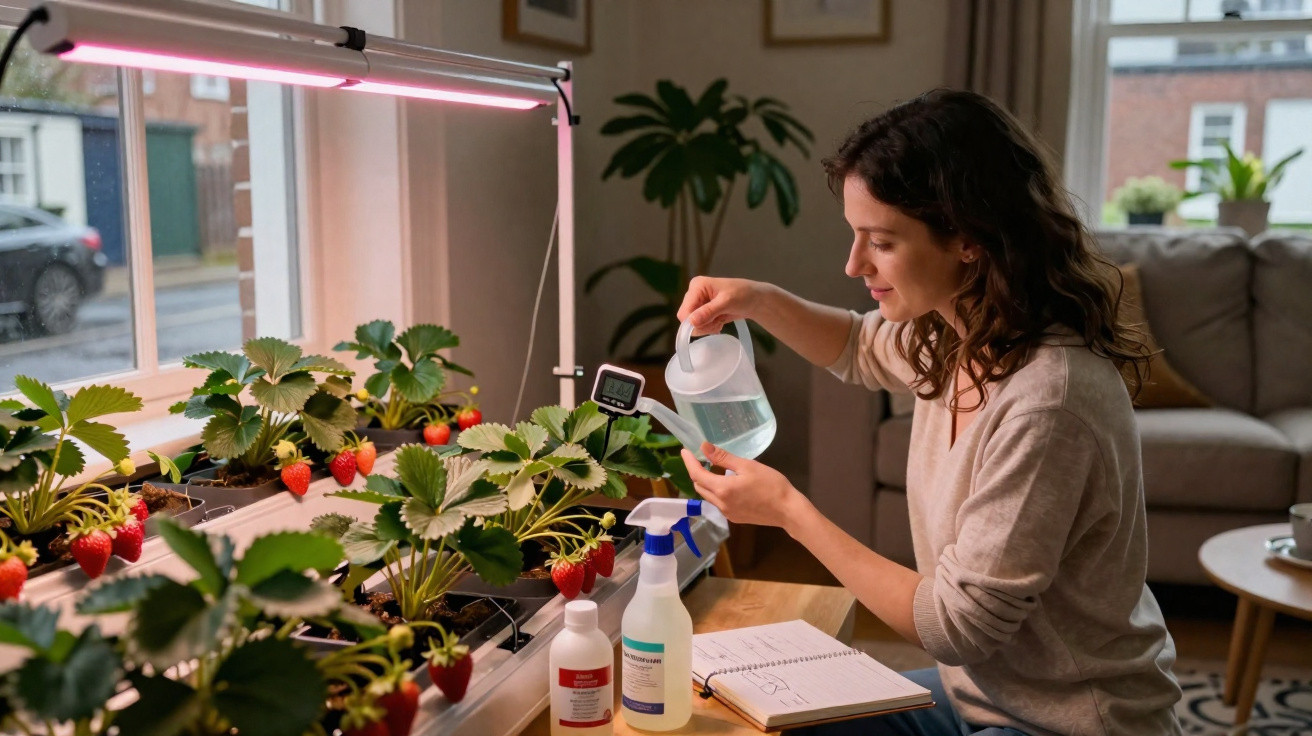
In a compact Bishopston flat, Lara persuades winter to resemble June. Rows of LED bars emit a low hum, foliage gleams, and a tiny bee-shaped brush waits in a jar for its turn as a pollinator. She passes quietly among the pots, her fingertips lightly green-stained, before picking up a heart-shaped berry colouring towards sweetness. The room is warm, subtly floral and faintly charged.
Before breakfast, the flat carries the scent of jam. When a neighbour asks whether they are “legal plants,” Lara laughs and offers them a strawberry so fragrant it seems almost staged. The fruit gives with a quiet snap, its seeds glinting like brass pins as juice spills out like a promise. In one corner sits a plumbing timer; on a shelf, there is a pH pen and a notebook marked with one word: fruit.
Two figures are circled in pencil inside that notebook: 5.9 and 1.6. Lara makes no attempt to conceal them. “It’s not magic,” she says, moving a tray 2.5 cm nearer to the LEDs. Her flat is small, the harvest remains reliable, and the routine has a surprisingly calming quality. The explanation is sitting beside the lights on the shelf.
LED daylight in a Bristol living room
Lara grows her strawberries on a metal shelving unit that previously carried books and a noisy printer. It has become a vertical garden for day-neutral cultivars including ‘Albion’ and ‘Mara des Bois’, both of which fruit willingly beneath consistent lighting. She uses 3500K full-spectrum LED bars supplemented with deep red light at 660 nm, seeking to recreate gentle summer sunshine. Suspended on adjustable ratchets, the lights sit around 25–35 cm above the canopy and are bright enough to cast defined shadows at midday.
For Lara, light is an input for the crop rather than part of the atmosphere. Using an inexpensive PAR meter app, she adjusted the illumination to approximately 250–400 µmol/m²/s at leaf level, a level strawberries handle happily. The lights come on at 7 a.m. and switch off at 10 p.m., creating an unhurried 15-hour “day”. Temperatures remain at 20–22°C, while a small fan moves air over the flowers to stop pollen becoming reluctant. At night, another fan runs softly to prevent moisture lingering.
Pollination is a do-it-yourself job. Every other morning, Lara either brushes every flower with a soft paintbrush or gently vibrates near the blooms using an old electric toothbrush. It costs nothing, takes only a minute and avoids the dreaded conical, incomplete fruit. Her growing medium is straightforward: 70% washed coco coir and 30% perlite in fast-draining 9-litre fabric pots that allow the roots to breathe. Beneath the shelving, trays collect the runoff like orderly rain.
What goes in the watering can
This is the point at which the notebook proves its value. Lara feeds in small, frequent doses and aims for an EC she knows by heart. During vegetative growth, when new runners are becoming established, she prepares a solution at EC 1.2–1.4 and pH 5.8–6.0. When the first flowers emerge, she moves to EC 1.6–1.8 and a pH close to 5.9. Although the figures sound clinical, their results are satisfyingly visible: leaves retain a gentle sheen, fresh growth stays upright and berries develop full rather than pithy.
Her nutrient formula is precisely old-fashioned, using salts that are readily available. For each 10 litres of water, she uses 6 g calcium nitrate, 2 g potassium nitrate, 1 g monopotassium phosphate at early bloom (then 0.5 g after set), 2 g magnesium sulfate (Epsom salt), and 0.5 g of a chelated micro mix containing iron as EDDHA or DTPA. When using a commercial “A+B” strawberry fertiliser, she follows the label instructions to achieve the same EC. Whichever approach she takes, calcium nitrate is always dissolved separately before it is mixed in.
Trace elements matter. Under LEDs, strawberries become unhappy without a small amount of boron and a dependable iron source. As the micro mix provides both, Lara does not need to play chemist. She warms the water to room temperature, stirs it until transparent, then tests it using a handheld pH pen that is more coffee-stained than she would care to acknowledge. Let’s be honest: nobody really does that every day. She calibrates it weekly because drift happens, and plants do not negotiate.
Small rituals that make big berries
Lara’s timetable resembles a list of household tasks but feels more like meditation. With coco, she feeds at every watering, two or three times weekly, applying enough solution for a mild 10–15% runoff. Every fortnight, she flushes with plain water at pH 5.9 to remove salt accumulation, while watching leaf tips closely for the faint tan touch that signals excessive feed. Day-neutral varieties receive light pruning: old foliage is removed, runners are generally cut away, and energy is directed towards fruiting trusses that hang like chandeliers.
She adjusts the light height through instinct and the language of the leaves. Are the tips clawing downwards? She reduces the intensity or lifts the bars slightly. Are petioles elongating and flowers holding back? She lowers the lights or lengthens the day by 30 minutes. Humidity stays between 45–60%, as wet air encourages botrytis while overly dry conditions make flowers nervous. We have all had that experience when a flawless berry goes mouldy overnight and it feels personal. It is not. It is airflow.
She discovered through experience that chasing sweetness with phosphorus alone is a mistake. Strawberries prefer balanced potassium and calcium, rather than a surge of phosphorus. Berries firm up and flavour intensifies when potassium rises slightly during fruit swell, while calcium stays steady to prevent tip burn. Her bloom formula meets that need without uncertainty, and she supplements only when the leaves indicate it is necessary.
“The plant tells you,” Lara shrugs, holding a leaf to the light. “If the veins go pale, I add iron. If edges crisp, I check the salts and back off. The best tool is time spent looking.”
- Target pH: 5.8–6.0 in coco/hydro; 6.2–6.5 in peat-based potting mixes.
- EC guide: 1.2–1.4 for veg; 1.6–1.8 for bloom; back to 1.4 if tips burn.
- Distance to LEDs: 25–35 cm, aiming for 250–400 µmol/m²/s at canopy.
- Temperature: 18–24°C day; 15–18°C night; keep a light breeze.
- Pollination: brush or buzz every other day during peak bloom.
The human bit behind the method
There is a reason this approach suits a city such as Bristol. Rain arrives just when a harvest was planned, slugs are unionised, and compact balconies are unforgiving of errors. Indoors, Lara exchanges weather for controls. LEDs remove the changing seasons, the nutrient formula delivers consistency, and the flat gently hums to a timetable that works around shifts and a bus journey. The berries taste like a choice she made, not luck she caught. Friends move closer, taste one, and the room becomes briefly and beautifully silent.
| Key point | Detail | Benefit for the reader |
|---|---|---|
| LED spectrum and timing | 3500K full-spectrum with 660 nm red; 15-hour day | Recreates summer light for reliable indoor fruiting |
| Nutrient recipe | Per 10 L: 6 g CaNO3, 2 g KNO3, 1→0.5 g KH2PO4, 2 g MgSO4, 0.5 g micros | A clear, repeatable mix for sweet, firm berries |
| Environmental targets | EC 1.6–1.8 in bloom, pH ~5.9, 20–22°C, 45–60% RH | Straightforward figures that avoid common indoor failures |







Comments
No comments yet. Be the first to comment!
Leave a Comment