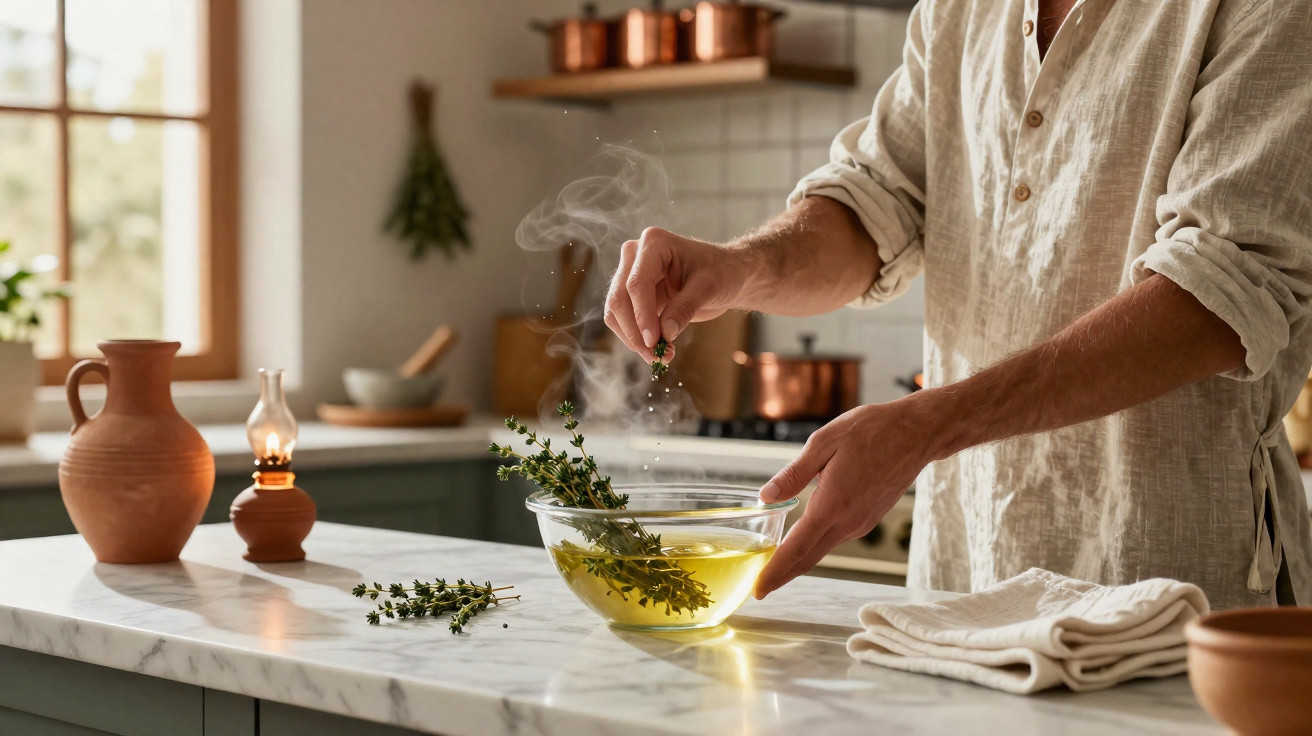
No plastic bottles. No barcodes. Only a clay bowl, a bunch of herbs and time.
I first encountered the idea not in a laboratory, but inside a Roman home whose walls still seemed to remember the smoke. A historian led our small party through a recreated kitchen on the edge of Pompeii, the sort of space where hands were constantly at work and life was noisy. She ground a handful of thyme, heated vinegar in a bronze pan, and a sharp, herbal, unexpectedly soothing scent rose into the air.
It smelled like salad dressing, though we were gathered around a hearth. She soaked a linen cloth and polished the edge of a scorched pot until it gleamed. Steam drifted through the afternoon light. “They disinfected,” she said, with a shrug that made the ancient practice seem self-evident. Its simplicity felt almost radical.
The scents of a real Roman kitchen
Picture clay storage jars and herb bundles hanging to dry in the warmth, rather than stainless steel. A Roman kitchen smelled of smoke, fish sauce, olive oil and working voices, but it was not an uncontrolled mess. The historian showed me acetum, their everyday vinegar, drawn from a glazed amphora, alongside a dried circle of thymum-the Latin term for thyme, which appears repeatedly in ancient writing. Romans were not merely making do; they were organising cleanliness with the materials available to them. The routine was as important as the outcome.
A little brazier glowed in one corner. The process could hardly have been simpler: gently simmer a cup of vinegar with a handful of crushed thyme, allow the pungent vapour to fill the room, and then wipe the surface. The cloth lifted away grey. A fired-tile slab was left with a muted, clean-looking finish. Everyone knows the relief of a lingering odour finally fading and the whole room seeming fresher. That was the feeling in this kitchen-although the technique predated our very word for “germ”.
Once understood, the reasoning is remarkably direct. Vinegar reduces pH, creating difficult conditions for many microbes; thyme contains thymol and carvacrol, compounds that modern science still includes in antiseptic formulations. Warmth provides an extra lift by helping oils release and aromatic compounds spread. Finally, the cloth removes grease and dirt that chemistry cannot shift on its own. This is not hospital-grade cleaning, and no one suggests otherwise. It is household-grade: practical kitchen know-how made stronger through repeated ritual.
The Roman-style vinegar-and-thyme method, step by step
To try the Roman-ish approach at home, no toga is necessary. Rub a heaped tablespoon of dried thyme-or three fresh sprigs-between your palms to release the oils. Heat one cup of ordinary white vinegar in a small saucepan until steaming, add the thyme and let it bubble gently for two minutes. Take it off the heat and lean in close. Breathe. Soak a clean cloth, squeeze it out lightly, then wipe worktops, chopping boards, handles and the sink edge. Leave the surface damp for five to ten minutes before drying it. Contact time is the understated star of the process.
A few sensible precautions are essential. Avoid vinegar on marble, limestone and any stone that reacts to acid-the Romans valued stone too, yet knew to use hot water and ash instead when needed. Do not aim for perfection; tackle the kitchen in sections and accept that as enough. Life is busy, and a kitchen is never truly at rest. Honestly, no one does this every day. When a pan boils over and somebody wants a glass of water, we all reach for the quickest option. Fit the ritual into the moments that suit you-after supper, perhaps, while the kettle is humming.
Does it need to be elaborate? Not at all. Inexpensive vinegar works perfectly well, and thyme from the garden is ideal. One line from the historian has stayed with me:
“Cleanliness in Rome wasn’t sterile. It was rhythmic. The smell told you the job was done.”
- Do: Leave the vinegar-and-thyme mixture on the surface for a few minutes.
- Do: Wipe along the grain, then buff with a dry cloth for a shine.
- Don’t: Mix vinegar with chlorine bleach-ever. The resulting fumes may be dangerous.
- Don’t: Apply it to natural stone or waxed wood; use it on tile, sealed wood and stainless steel instead.
- Bonus: Adding a few lemon peels to the pan gives a brighter scent without altering the method.
Why this old kitchen practice feels fresh again
There is a reason this tale keeps reappearing in our feeds. Its appeal is not only that it is economical or environmentally minded; it is hands-on. You crush the leaves, watch the steam and smell the change. Never mix vinegar with chlorine bleach-ever. The approach is part chemistry and part choreography. It takes more time than spraying a bottle but far less than devoting a weekend to deep cleaning, while the result can be seen, tested and shared. Yet its real appeal is human. One uncomplicated fragrance can transform the mood of a room, shifting chaos into “we’re done here.” The rituals that endure are often the simplest ones.
We are drawn back to that Roman kitchen because it answers a modern need with ancient tools. You do not need another product; you need a habit. The vinegar-and-thyme mixture is no substitute for soap on greasy pans or hot water for major spills. Instead, it works alongside them as the finishing touch that makes a kitchen feel clean rather than merely appear clean. That is culture rather than marketing-and culture usually travels well.
Speak to people and you will find versions of the same practice: Greek grandmothers using oregano water, Turkish households rinsing with sumac, and Mexican kitchens relying on lime and salt. The formula remains consistent: acid, herb, heat and cloth. You can count microbial levels if you choose, or simply notice the point at which the room seems to exhale. Nothing mystical is involved. It is simply our senses doing their work, just as they have since fire first met clay.
| Key point | Detail | Why it matters to the reader |
|---|---|---|
| Vinegar + thyme synergy | Low pH combines with a thymol-rich herb and is enhanced by gentle heat | A straightforward, inexpensive technique that genuinely reduces everyday kitchen microbes |
| Contact time matters | Keep surfaces damp for 5–10 minutes before drying | Turns a quick wipe into a more effective clean without any added effort |
| Surface safety | Avoid natural stone and bleach combinations; choose tile, sealed wood and steel | Helps prevent damage and keeps cleaning safe for both you and your home |









Comments
No comments yet. Be the first to comment!
Leave a Comment