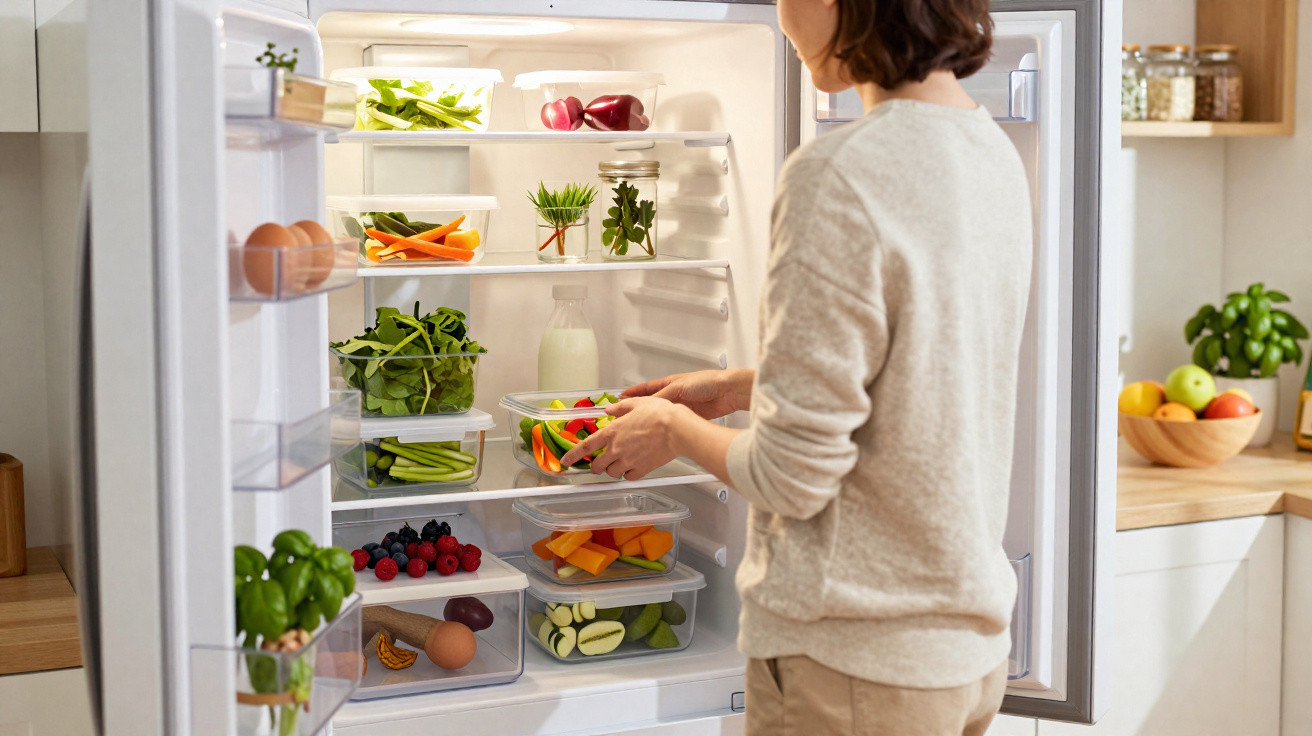
The fridge door opens and, once again, you are met with the same picture.
There are supermarket bags still partly tied shut. A pile of yogurts teeters on one shelf. Lettuce is squashed at the back, while forgotten strawberries slowly seep into their punnet. You shift a few things around, force the latest shop into place and shut the door with more force than you meant to.
Within ten minutes, you have forgotten what is lurking at the back. Several days later, the smell offers a reminder: slimy spinach, limp cucumbers and cheese now supporting a new form of life. You blame the supermarket, the warm weather or simply “bad luck”.
What hardly anyone examines is how they load the fridge in the first place. We assume cold means safe, so everything gets put inside. Yet that seemingly harmless instinct is precisely why groceries can go off so much sooner.
The hidden problem: your fridge is not a magic box
For most of us, the fridge is a storage cupboard rather than a useful appliance. Food goes wherever there is room: milk in the door, eggs beside yesterday’s pasta, berries underneath leftover curry. It seems sensible at the time; you only want to fit everything in and close the door.
But a fridge behaves more like a miniature climate system than a cupboard. Certain areas are warmer, others colder, and some face a temperature change every time the door is opened. Put food in the wrong “zone” and it deteriorates faster, despite technically being kept in the fridge.
Once that becomes clear, the reason food seems to die so quickly is no longer much of a puzzle.
Household food waste rarely appears dramatic. It is a half-pack of ham turning grey before the weekend, rocket reduced to sludge after two days, or a family-sized yogurt left unfinished because its surface becomes dry and strange.
At a wider level, this everyday disorder soon mounts up. Some studies suggest households discard around a third of the fresh food they purchase. It is not that people do not care; their fridges are quietly working against them. The door is too warm, the back too cold, and the salad drawers can be packed so tightly that air cannot circulate at all.
For individuals, it is money going directly into the bin too: the £3 punnet of blueberries, the special cheese, the herbs you promised yourself you would “totally use this time”. A fridge ought to safeguard those purchases. When it is used badly, it merely delays the waste slightly.
The principle is ruthlessly straightforward. Bacteria and mould thrive in mild, fluctuating temperatures. Keep milk in the door, where it warms whenever someone reaches for ketchup, and tiny organisms are having an excellent time. The same applies to meat kept high up, where conditions are a little warmer than on the lower shelves.
Warm air rises and cold air drops. The rear of the lowest shelves is generally the coldest area, while the door is consistently the least stable. Salad drawers are not decorative: they retain more humidity, helping leafy greens remain crisp rather than wilted. The way many of us stuff a fridge ignores this basic physics entirely.
That is why food meant to last a week can be unusable after three days. It is not necessarily because the fridge has failed, but because we are working against the way it was designed to function.
The right way to load your fridge (that almost nobody uses)
The key change is to view the fridge as a set of zones, rather than simply a collection of shelves. The coldest spot is normally near the back of the bottom shelf. Raw meat and fish belong there, securely wrapped and placed on a tray or plate to contain any drips. This keeps them cold and safe while preventing juices from leaking over other food.
The middle shelves are best for ready-to-eat items: leftovers, cooked meals, yogurts and opened sauces. You reach for these regularly, so they should be visible and held at a consistent temperature. The upper shelf, which is often slightly warmer, suits cheese, butter and foods that do not need intense cold but benefit from being chilled.
The door is the major trap. Many people fill it with milk, cream, eggs and sometimes even meat. In fact, it is the warmest and most variable part of the fridge. Reserve it for condiments, jams, pickles and juice, which are far more tolerant. Milk keeps considerably longer on an internal shelf than it does swinging in the door.
The drawers at the bottom are often used as dumping grounds, although they can save the most money. If possible, use one for fruit and the other for vegetables. Higher humidity helps salad, herbs and many vegetables retain their crispness. Avoid cramming them full, as air still needs room to move. This one habit can give produce several extra days of life.
This is also a matter of what you can see. Stack three leftover containers on top of one another and the one at the bottom is practically destined to be forgotten. Where possible, spread food out. Transparent lids make it easier to identify contents without a game of fridge Tetris.
This is also where much of the frustration comes from. You get home exhausted, open the fridge and find browned lettuce and soft tomatoes. You feel guilty, perhaps wasteful or overwhelmed. You have not done anything “wrong”; you have simply used the fridge in the way most people do.
Consider a small example. A family of four in a London flat ran a straightforward experiment. They stopped storing milk in the door, moved raw meat onto the coldest lower shelf and began tipping fresh berries into a shallow paper-towel-lined box rather than leaving them in the supermarket punnet. After a month, they counted the food that had spoiled. Their weekly food waste had fallen by almost half.
It was not due to an expensive new appliance, but because their existing fridge finally reflected how food actually behaves. It was not flawless: a few unfortunate cucumbers still perished behind the hummus. Let’s be honest: nobody really manages this every single day.
The science is simple. Microbes that spoil food slow down dramatically in colder, steady conditions. Each time a fridge door opens, warm air enters, and the door shelves warm up first. If milk is stored there, its temperature rises and falls repeatedly throughout the day. This is why it can smell off even when the “best before” date still appears reassuring.
Humidity matters as well. Leafy greens lose moisture rapidly in dry air, then wilt and rot. Crisper drawers are designed to retain some humidity around them. Put lettuce on the top shelf instead and it dehydrates and breaks down far sooner.
Overcrowding is the final issue. When every shelf is packed solid, air cannot circulate effectively. Some areas become too warm while others develop frost. The fridge turns uneven. Leaving a little gap between products is not merely about appearance; it allows cold air to flow. Think of it less as a storage unit and more as gentle refrigeration.
Small habits that keep food fresh for days longer
Begin with one easy adjustment: do not keep the most delicate foods in the least stable areas. Take milk and fresh juices out of the door and put them on a middle shelf. Keep raw fish and meat on the lowest, coldest shelf, preferably towards the back. Place leftovers and ready meals in the middle, where they are easy to reach.
Give fruit and vegetables a proper place. Use the bottom drawers for greens, herbs, berries and crisp vegetables. Where possible, allocate one drawer to fruit and another to vegetables, since certain fruits release ethylene gas that accelerates ripening. Most berries last longer when transferred from their damp plastic punnet into a loosely covered shallow container.
Another small habit is not to overload the fridge. A hand-width gap at the rear of each shelf helps cold air circulate more consistently. In a small fridge this can feel like a luxury, but it is exactly what helps food last through those vital additional days.
Many people feel quietly embarrassed by the state of their fridge. It can be a combination of half-used jars, vegetables that inspire guilt and mystery containers nobody wants to inspect. That embarrassment often makes us close the door quickly rather than sort it out.
You do not need a “Pinterest fridge” of colour-coded containers to keep food fresh. The useful approach is much simpler: put the appropriate food in the appropriate zone most of the time. That is all. Skip the perfect labels and glass jars if they create stress.
In practical terms, try a weekly rhythm, usually before a large shop: spend two minutes rearranging things. Bring the oldest leftovers to the front, check use-by dates on meat and quickly inspect the salad drawers for anything that has not survived. It is not a ritual of perfection, just a brief reset that helps the fridge work for you rather than against you.
“When people reorganise their fridge around temperature zones instead of convenience, they often gain two or three extra days on their fresh food,” explains one food safety specialist. “It doesn’t sound like much, but across a year that’s a big difference in both waste and money.”
- Use the door for robust items such as condiments, sauces, pickles and hard cheeses.
- Keep the coldest shelf for raw meat and fish, using a tray or box to catch drips.
- Use crisper drawers for leafy greens, herbs, berries and delicate vegetables that require humidity.
- Store milk, fresh juices and yogurts on internal shelves where temperatures remain stable.
- Leave enough room between items for cold air to circulate and cool everything evenly.
A different way to look at that humming white box in the kitchen
Once you no longer treat the fridge as a disorderly cold cupboard, it can become a quiet ally. It is the same appliance with the same shelves, but governed by a different system: raw, higher-risk food at the bottom; everyday food at eye level; and delicate plants in their “greenhouse” drawers rather than struggling on random shelves.
It can alter the way you shop too. Before buying an item, you know where it will go. Meat has its zone, berries have theirs and leftovers have another. That awareness alone may prevent overbuying. If there is no clear place for something in your mental fridge map, it becomes easier to leave it in the shop.
At a deeper level, this is about more than saving a few pounds. It means valuing the work involved in getting food to you: the farmers who grew the lettuce, the drivers who transported the crates, and your own time spent selecting, carrying and paying for it. Once you pay attention, letting food rot in a poorly used fridge feels wrong.
We have all thrown away a bag of slimy spinach and thought, “Never again.” Then life becomes hectic, the fridge gets crowded and the same cycle begins. Changing how you load the fridge will not transform you overnight. It simply gives your good intentions a fair chance.
You do not need a larger fridge or an expensive “smart” model. You need a slightly more intelligent way to use the cold box already in your kitchen. From there, each day becomes a small experiment: move this, shift that, notice what lasts and what does not. That curiosity may be the most effective preservation tool you possess.
| Key point | Detail | Benefit for the reader |
|---|---|---|
| Temperature zones | The bottom of the fridge is colder, while the door is warmer and less stable | Understand where to keep each food so it lasts longer |
| Organisation by food type | Meat at the bottom, ready-to-eat food in the middle, condiments in the door and vegetables in drawers | Reduce waste and food-safety risks without a demanding daily routine |
| Space and visibility | Allow air to circulate, use transparent containers and rotate food regularly | Find what you have easily, make fewer duplicate purchases and avoid forgotten food |







Comments
No comments yet. Be the first to comment!
Leave a Comment