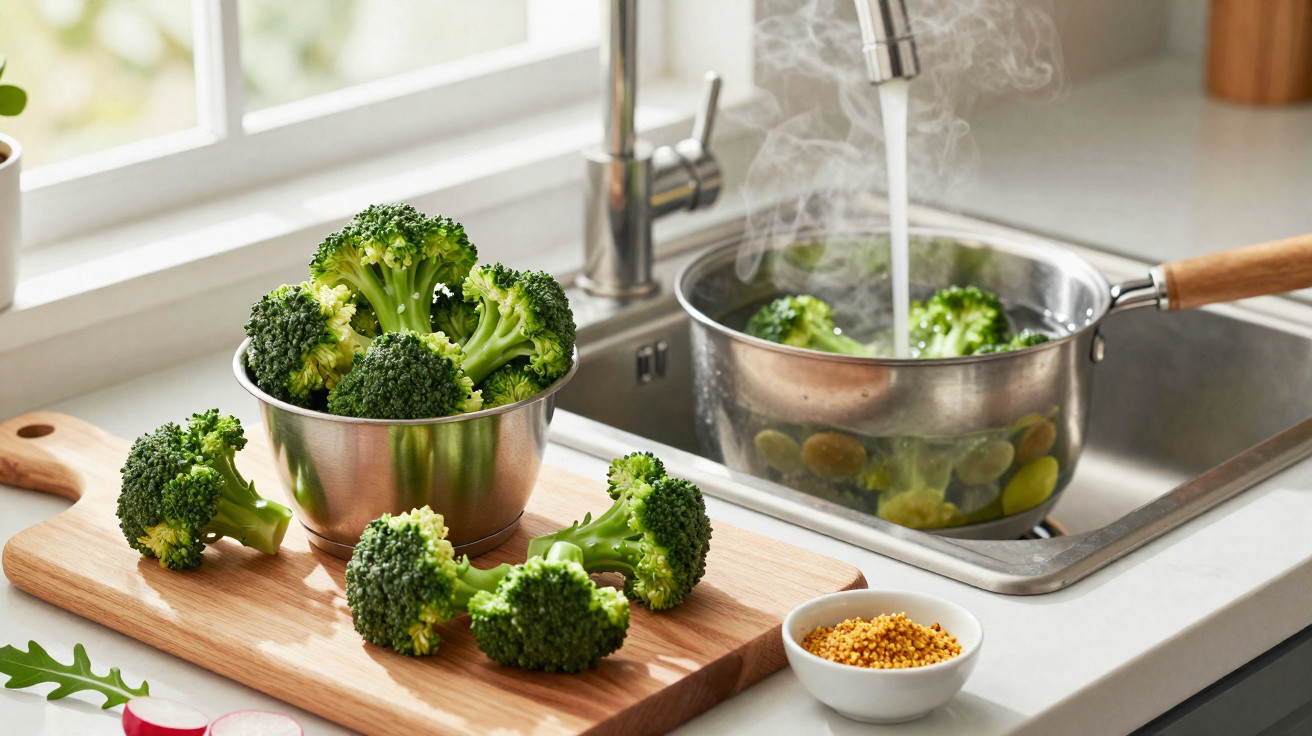
Broccoli has a reputation as a super-vegetable – yet many kitchens throw away its biggest benefit at the very moment the pan starts boiling. One common mistake sends its best compounds straight down the drain. The plate is still green, but much of the benefit has gone.
Someone lifts the lid, prods the florets with a fork and waits until everything turns soft. The pan is then tipped into the sink; water rushes away, a briefly pungent, slightly metallic smell fills the air, and steam settles like a small wall of mist on the windowsill. Suddenly, responsibility tastes of broccoli. On the plate, it looks wholesome, as though a sensible choice has been made. But the truth is sitting in the sink. One question becomes unavoidable: why do we do it?
The single mistake that strips broccoli of its value
The biggest mistake is boiling broccoli to death. When broccoli is cooked until soft in plenty of water and then drained, it loses the very substances we want from it. Water-soluble vitamins and plant compounds leave the florets, turning the cooking water green. The plate may still look appealing, but the most valuable nutrients have disappeared. Leaving the lid off for too long creates a double loss: heat destroys sensitive enzymes, while steam carries away vitamins. It is a quiet theft disguised as routine.
One memorable example comes from a small kitchen test involving two portions of broccoli. One was boiled vigorously for 8 minutes, while the other was steamed for 4 minutes. The boiled portion had a strong smell, olive-green florets and a soft, buttery texture. The steamed version stayed bright and retained a gentle bite. The difference is measurable too: boiling can reduce vitamin C by half or more, folate readily leaches into the water, and glucosinolates decline noticeably. The enzyme myrosinase, needed to form sulforaphane, does not tolerate prolonged heat. Put simply: the nutrients end up down the drain.
The process is subtle but makes sense. Broccoli contains many water-soluble vitamins and precursors to protective compounds. In its raw state, glucoraphanin and myrosinase are kept apart; chopping and chewing bring them together, producing sulforaphane. Extended cooking and high temperatures denature myrosinase before it can do its job. At the same time, hot water draws soluble compounds from the florets. When the colour changes from vivid to dull, take it as a warning: chlorophyll is breaking down and sulphurous flavours move to the foreground. Yet this is precisely the point at which habit tells us to cook it “just a little longer”. It is the wrong instinct.
How to keep broccoli genuinely nutrient-rich
The good news is that no professional kitchen is required. Steaming changes everything. Divide broccoli into florets, then chop or break it 40 minutes before cooking so that myrosinase can become active. Steam it over gently boiling water for 3–5 minutes, until the florets are vivid green and tender. The microwave is another option: cook for 1–3 minutes with 2–3 tablespoons of water and a loosely fitted lid. If you prefer a frying pan, briefly fry the broccoli in a little oil, add a splash of water, cover it, and let it finish cooking for 3–4 minutes. A little mustard powder or a few strips of radish or rocket added at the end provide extra myrosinase if the heat was slightly too high.
The mistakes people often make are entirely human. We leave broccoli sitting in water while the rest of the meal is finished. We only salt it after cooking and rinse everything with hot water. We assume that softer means “healthier”. Everyone knows the moment when the cooking time slips because of a phone call or someone at the door. Let us be honest: nobody gets it right every day. Small adjustments make a difference: use little water, keep cooking times short, use a lid and watch the colour. Once the green starts to look tired, you have passed the turning point. Slightly crisp stems? That is the jackpot.
Once you understand the rhythm, broccoli becomes easy to manage. These principles are more like a beat than a restriction, and they fit into any evening meal. Nutrients end up down the drain only when we make boiling water the default.
“Heat is not the enemy – only the dose and duration determine whether broccoli becomes a superfood or green scenery.”
- Steaming: 3–5 minutes; vivid green is the signal
- Microwave: 1–3 minutes, little water and a loose lid
- Frying pan: briefly fry, then finish cooking with the lid on
- Extra help: 1 pinch of mustard powder or raw cress for myrosinase
- Head start: chop broccoli 30–40 minutes before cooking
What this means for your everyday routine
Broccoli benefits from certainty. Taking control of its cooking time gives you back a little agency without making dinner more complicated. This is not about rules; it is about rhythm. It is the moment you remove the lid and see bright green florets, smell their fresh aroma and feel that bite still there. That is the distinction between a chore and a pleasure, between “done” and “well done”. The route to it is surprisingly short, and it is yours to take. Perhaps this one vegetable detail will suddenly change the conversations around the table. Or perhaps it leaves you with a lasting question: if one pan makes such a difference, where else could a small adjustment improve everyday life?
| Key point | Detail | Benefit for the reader |
|---|---|---|
| Cook gently | Steam for 3–5 minutes or microwave briefly | More vitamins, better flavour, less effort |
| Use myrosinase | Chop and leave before cooking; mustard powder supplements it | Greater sulforaphane potential for cell protection |
| Avoid water | Do not boil excessively or drain; use a lid | No nutrients lost in the sink |














Comments
No comments yet. Be the first to comment!
Leave a Comment