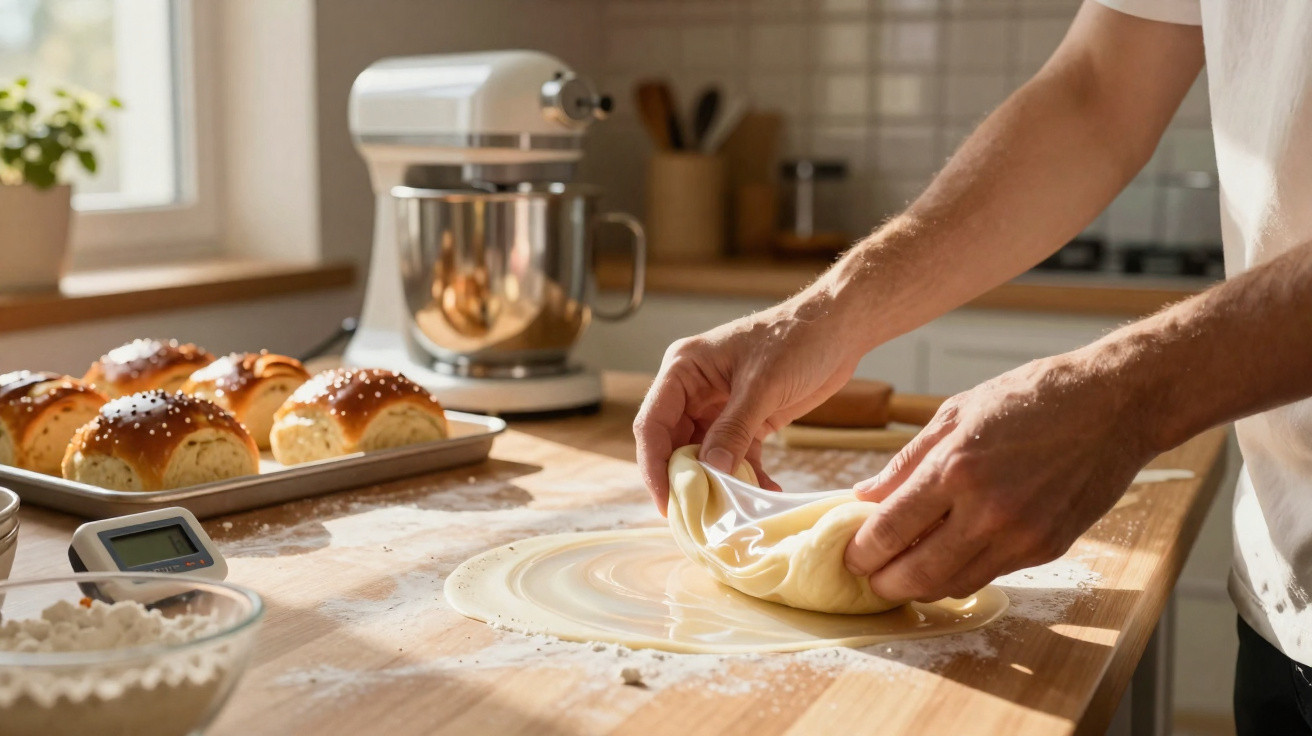
You tell yourself you’ll master it at home, but then imagine gluey dough, a shrieking mixer and butter sliding everywhere. Before the flour even reaches the bowl, the myth has already stopped you. In reality, it is much simpler. Brioche dough needs patience rather than strength, and a fridge rather than bravado. That shining loaf can absolutely happen on a sleepy morning, with no culinary qualification required.
The kettle switches off in a still kitchen before the day begins. Three eggs go into a bowl, milk gives off a little steam nearby, and cold butter waits in neat cubes. At first, the dough is awkward: a tangled mass with no interest in looking attractive. You place your hands on the worktop and breathe alongside it. A neighbour hums with the radio outside. Indoors, a gentle pattern emerges: stretch, fold, wait. Then the dough begins to breathe.
Why brioche feels difficult - until it isn’t
Brioche intimidates people because it is rich. Butter, eggs, sugar and milk each bring pleasure, but also complication. The dough begins sticky and appears to demand extra flour. It does not. What it needs is time. When the gluten has built its discreet framework, the richness ceases to cause trouble and becomes velvety. The dough discovers how to support itself, while you discover when to leave it alone.
I think of Lina, who only baked on wet Sundays. She attempted brioche once, watched the butter melt into a mess, and promised herself she would never try again. Later, she made one small change: she chilled the dough between mixing stages. The kitchen was cooler, the butter remained reserved and firm, and the dough came together like one long breath out. Her second loaf was soft, lofty and gone within twenty minutes.
The principle is straightforward. Gluten requires movement and time; butter needs cold and patience; yeast needs food and warmth. When butter is incorporated too soon, or while too warm, it escapes the gluten network and makes everything greasy. Give the dough a pause - ten minutes here, an hour in the fridge there - and that network grows stronger while the butter works its way through it. Warmth encourages rising; cold encourages good behaviour. The dough will look shaggy at first; that’s normal.
The foolproof brioche recipe you’ll actually use
Begin with the following: 400 g bread flour, 60 g sugar, 7 g instant yeast, 7 g fine salt, 120 g warm milk at about 30°C, 3 large eggs (150 g), and 150 g cold unsalted butter, cut into small cubes. Combine the flour, sugar, yeast and salt. Stir in the milk and eggs until a rough dough forms, then leave it for 10 minutes. Knead until smooth before incorporating cold butter, small cubes, one piece at a time, until the dough becomes elastic and glossy.
Allow it to rise in a warm place until it has expanded by half, around 60–90 minutes, or refrigerate it for 6–12 hours for improved flavour and easier handling. For shaping, braid three strands or place three balls into a tin. Leave to prove until it wobbles like a soft pillow and a pressed finger mark returns slowly, roughly 45–90 minutes. Brush with egg wash. Bake at 175°C for 25–30 minutes, until a rich golden colour. For extra shine, brush the hot loaf with a quick syrup made from equal parts sugar and water.
A sticky dough means the hydration is doing what it should. Use lightly oiled hands instead of burying it beneath a blizzard of flour. If the butter begins to smear, put the bowl in the fridge for ten minutes before continuing. Under-proved brioche splits and tears, whereas over-proved brioche droops and develops a boozy taste. You will recognise the sweet spot by touch. We have all seen a loaf that seems ready while the poke test says, “Give me ten.” Honestly, nobody really follows that advice every day.
Small techniques that transform brioche
Autolyse is useful: first combine the flour, eggs and milk, then leave them for 10–20 minutes before adding the butter. The dough gains strength without a struggle, and the gluten quietly comes to life. Add the butter gradually afterwards, kneading at a low speed. When you stretch a small piece between your fingers, look for a smooth, extensible windowpane.
Temperature provides the hidden structure. A warmer dough rises more quickly but becomes weaker; a cooler one rises more slowly while retaining strength. In a hot kitchen, choose cooler milk and refrigerate the dough between kneading sessions. In a cold kitchen, warm the milk gently and prove the tin close to, but not on, the oven. Target a dough temperature of 24–26°C - not the temperature of the room or bowl, but the dough itself.
Shaping is the pleasurable part. A braid may look elaborate, yet it is simply three gently rolled ropes. Pinch their ends together, take the left strand over the middle, then the right strand over the new middle, and repeat until you reach the end. Keep the tension gentle so the crumb remains open.
“Dough doesn’t obey the clock; it obeys temperature and tension.”
- Quick check: when you move the tin, the dough should wobble like set custard.
- Flavour boost: an overnight rest in the fridge creates a deeper aroma and better colour.
- Shine trick: syrup brushed on after baking gives more gloss than egg wash alone.
- Tin tip: a 23 × 13 cm loaf tin or a 22 cm mould suits this quantity of dough.
Make brioche once, and it becomes a ritual
Brioche is not so much a recipe as a conversation. You make a small adjustment, and it responds. Cool it down, and it rewards you with structure. The first attempt can feel like learning a dance with your eyes shut. By the second, your hands will understand the sequence before your mind does.
There is space for experimentation. Replace 50 g of the flour with wholemeal flour for a toastier flavour. Add lemon zest or orange blossom water for fragrance. Fold through chocolate chunks for late-night slices you will not admit to eating. The foundation stays the same while the details shift. That is the sort of cooking that stays with you.
At the table, it is more than a handsome loaf. It becomes French toast capable of stealing a Sunday. It becomes a buttered slice alongside coffee that softens a difficult week. It turns into the leftover that makes a ham sandwich feel like a secret. And yes, it offers an excuse to invite someone round, even if the only conversation is about the crust.
| Key point | Detail | Benefit for the reader |
|---|---|---|
| Cold butter, added gradually | Incorporate small cubes after a brief rest | Avoids greasy dough and creates a soft, cloud-light crumb |
| Overnight fridge rest | 6–12 hours after the initial mix | Better flavour, simpler shaping and a calmer morning |
| Jiggle and poke tests | The dough should wobble; an indentation should spring back slowly | Proving guided by feel rather than timers |















Comments
No comments yet. Be the first to comment!
Leave a Comment