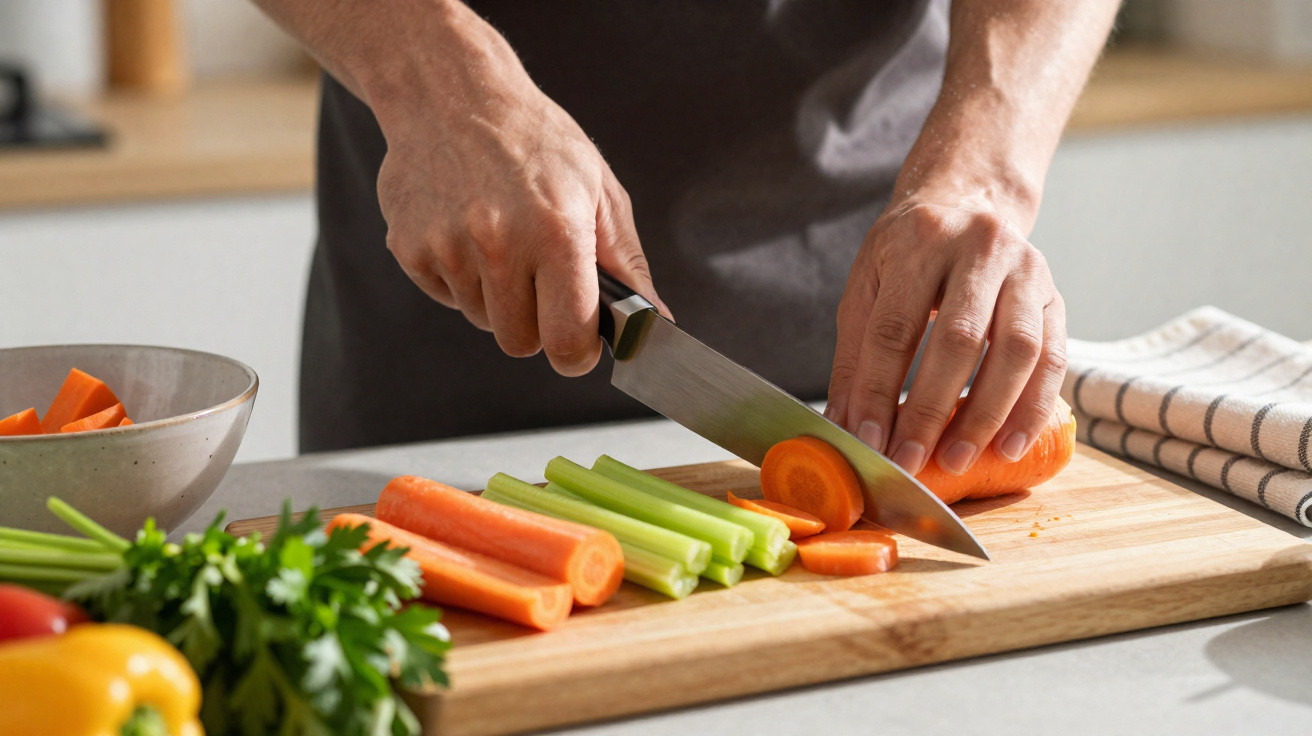
One evening, faced with a chopping board crowded with onions, carrots and fresh herbs, the action looks straightforward: pick up the knife, press down, repeat. Yet everyone knows the moment when the blade slips slightly, slices come out uneven, and you slow down because you are worried about cutting yourself. A chef’s knife is often the most imposing tool in the drawer: the one you reach for eagerly, then sometimes hold as though it were rather unpredictable. Holding it correctly is not simply about working faster. It alters how it feels in your hand, the sound it makes against the board and the accuracy of each movement. It also prevents plenty of needless scares. A difference of just a few centimetres can transform an entire prep session.
The right chef’s knife grip starts before the first cut
When you watch an experienced cook finely chop a bunch of parsley, speed is rarely the first thing you notice. What stands out is their composure: the wrist barely moves, the shoulder stays relaxed, and the blade appears to travel along an invisible track. That control mainly comes from how the knife is held. Many people grip the handle too far back, close to its end, as if keeping their fingers further away will make them safer. The irony is that this hold offers less control and therefore creates more risk. Your hand becomes tired, the knife pulls forwards, and your cuts lose their consistency.
The grip most commonly used in kitchens has a straightforward name: the pinch grip. Your thumb and forefinger pinch the base of the blade, just in front of the handle, while the other three fingers naturally wrap around the handle. During a cookery class, a chef compared the position to holding a paintbrush: “You do not paint while holding the end of the handle.” It is an image that stays with you. This position places the knife’s centre of gravity close to your hand. With a 20-centimetre chef’s knife, that small shift produces a very noticeable change from the first few carrots onwards.
This grip does not call for brute strength; it requires confidence. Place the thumb on one side of the blade and the forefinger on the other, without tensing them, while the palm supports the handle instead of crushing it. A correctly held knife suddenly feels less heavy. The blade becomes an extension of your hand, helping you direct its tip and maintain a steady line. Gripping too tightly locks the wrist and brings on fatigue more quickly, particularly when cooking for several people. Accuracy often comes from staying relaxed.
The free hand: the small detail that prevents injuries
Your other hand has just as much to do as the one holding the knife. When cutting an onion, potato or courgette, curl your fingers slightly inwards, as though making a small claw. Your knuckles then guide the side of the blade, while the thumb remains tucked behind the other fingers. The blade can lightly touch your knuckles without reaching your fingertips. At first, the motion can feel strange, almost theatrical. After a few minutes, it becomes entirely natural and helps create more even cuts.
The most common mistake is leaving your fingers flat on the ingredient to hold it in place. This often happens when you are in a hurry, or when a child is calling for their meal from the sitting room. Let us be honest: nobody does this every day with perfect concentration. A rolling tomato, a damp board or a blunt knife is all it takes for the movement to go wrong. Take a second to secure the ingredient: cut round vegetables in half, then set their flat side on the board. Speed will follow naturally, without rushing.
For working quickly, the smoothest technique is the rocking motion: keep the knife tip lightly in contact with the board while the heel of the blade rises and falls.
“Speed is not a more forceful action: it is an action with fewer unnecessary efforts,” a chef often reminds beginners during their first lessons.
A few simple pointers will help you practise without putting yourself under pressure:
- keep the chopping board dry and stable;
- place a damp tea towel underneath the board if it slides;
- move the hand guiding the ingredient forwards in small increments;
- stop as soon as fatigue makes your wrist stiff.
Cutting quickly is mainly about cutting consistently
A chef’s knife should not be used like an axe. Depending on the ingredient and your stance, guide the blade slightly forwards or draw it back towards yourself in a curved movement, rather than dropping it vertically onto the board. This gentle drawing action cuts through fibres with much less effort. With delicate herbs, it also prevents them from being crushed and turning dark. A sharp knife contributes to this sense of ease: it bites into food without requiring you to press down with your full weight. Safety often starts with a well-maintained blade.
The right worktop height matters too, although it is rarely considered. If the board is too low, you bend forwards and tense your shoulders; if it is too high, your arm loses its natural angle. At home, even a thicker board or a non-slip mat can improve comfort. Keep your elbow slightly bent and position food near the front edge of the board, rather than at the back. You will see your fingers more clearly, and the movement will stay closer to your body. They may be modest details, but they make a genuine everyday difference.
The most reassuring approach is to begin slowly with an easy vegetable, such as a courgette, then repeat the same movement until it feels familiar. Your first diced pieces will not be perfect, and that does not matter: a lived-in kitchen is not a restaurant display. Try to notice when you are gripping the handle too firmly or when your free hand becomes exposed. These are useful signals, not failures. Holding your knife better means saving time without putting your fingers at risk, while rediscovering the simple pleasure of preparing something with your own hands.
| Key point | Detail | Benefit for the reader |
|---|---|---|
| Pinch grip | The thumb and forefinger sit on either side of the base of the blade. | More control and less hand fatigue. |
| Claw hand | Curled fingers guide the blade with the knuckles. | Greatly reduces the risk of cutting your fingertips. |
| Rocking motion | The tip stays close to the board while cutting. | Faster, more consistent and smoother movements. |







Comments
No comments yet. Be the first to comment!
Leave a Comment