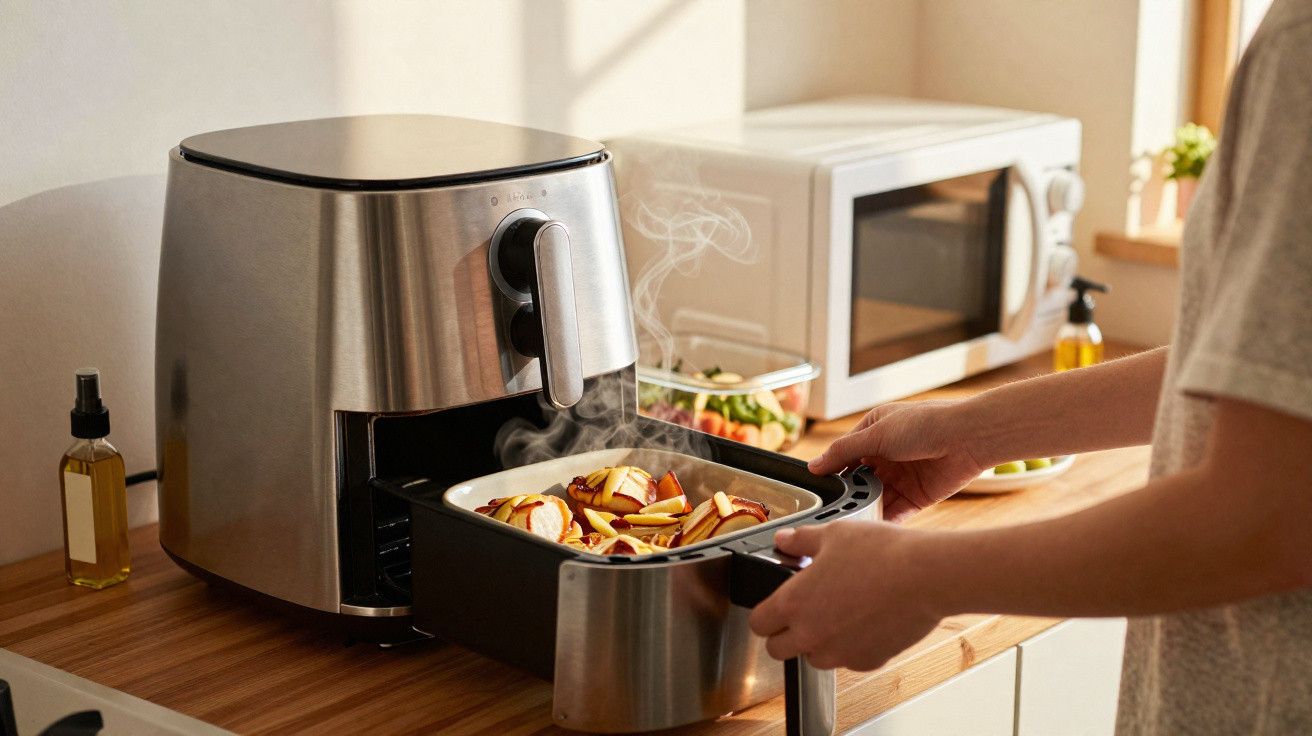
It is late, you are hungry, and the leftovers you had been looking forward to are about to emerge scorching around the edges and strangely cold at the centre. Again.
Across the kitchen, a compact appliance sits almost silently, its gentle LED ring glowing. There are no beeps and no roaring fan, only the subdued hiss of heated air. Your friend presses a button on her phone, and her salmon completes its cooking with a caramelised finish you have never seen a microwave produce.
She smiles and says, “Your microwave is kind of… over, you know?” The uncomfortable truth is that she may be right.
The quiet gadget making microwaves seem ancient
Engineers have been saying it quietly for some time: the genuine kitchen revolution is not noisier or quicker, but calmer. That unassuming appliance beside the toaster - a sophisticated countertop air fryer–oven hybrid - is gradually taking over the microwave’s role.
Rather than bombarding food with uneven waves, this new generation of appliances surrounds it with accurately circulating heat. There is no rotating turntable, no rattling plastic cover, and no soup erupting across the interior walls. Instead, there is a muted fan and food that tastes… like food again.
Microwaves mastered speed. These machines tackle everything else - texture, flavour, energy consumption and even the way you use your kitchen. Once you have reheated a croissant until it is properly flaky rather than rubbery, returning to the old way is difficult.
An engineer I spoke to in London keeps a microwave in his laboratory “for nostalgia”. At home, he has swapped it for a compact, near-silent combi air fryer–oven, resembling a chunky toaster with Wi-Fi. He measures everything. His notebook records that reheating a portion of lasagne to an evenly hot, bubbling state takes 7 minutes. His microwave managed it in 3 minutes - yet the centre was 15°C cooler than the edges.
A 2023 consumer survey conducted across Europe and the US found that nearly 40% of buyers of new small appliances used their microwave less after buying an air fryer or combi oven. Notably, the greatest reduction was not at dinnertime but with snacks: leftover chips, slices of pizza and pastries - the everyday foods that microwaves ruin without even apologising.
We have all experienced taking a bite of something that smells hot, only to find a cold centre of disappointment. These quiet appliances are built to remove that experience.
Microwaves agitate water molecules rapidly and aggressively. That is ideal for speed but less helpful for maintaining structure. Bread becomes chewy, pastry turns limp and meat develops an unidentifiable texture. Engineers developing the newest countertop combi ovens looked at this and said, “We can do better, slower… but still fast enough.”
They rely on managed airflow and exact temperature mapping rather than indiscriminate radiation. Picture a small, controlled storm of hot air enclosing every surface of your food. Certain models also offer low-temperature modes for careful reheating, alongside brief high-heat bursts that crisp the exterior without drying out the middle.
There is no magic involved. It is simply physics handled more thoughtfully than in the typical 2007 microwave fixed beneath a kitchen cupboard. Taste the difference once, and your previous appliance can suddenly seem like a relic of the dial-up internet age.
How to live with an air fryer–oven without missing your microwave
This quiet revolution succeeds only when it works in everyday life. The engineers I interviewed repeatedly made the same point: regard this appliance not as an elaborate toy, but as a second, more intelligent mini-oven. Begin by replacing one habit you already have.
Reheating pizza? Skip the microwave. Give it two or three minutes at approximately 180–190°C in the air fryer–oven. For cold roast chicken, use low heat for 8–10 minutes until warmed through, then raise the heat for 2 minutes to crisp the skin again. For porridge you normally heat in a bowl, warm the milk in a small oven-safe dish in the appliance before stirring in the oats - it takes one minute longer, but the texture is entirely different.
Move just one everyday task across. That is how the appliance becomes your standard choice rather than one more device collecting dust.
There is a common pattern in households that give up on the microwave too soon: they attempt to duplicate their microwave routine precisely. Putting a large, refrigerator-cold bowl of food into an air fryer–oven and expecting it to heat in 90 seconds is a sure route to frustration. This technology is faster than a full-sized oven, not faster than a microwave timer.
Begin with smaller servings and more realistic expectations about timing. Leftover curry? Put it in a shallow dish in a thin layer rather than a deep bowl. Want melted cheese over a dish? Add it only at the end, so it bubbles and blisters instead of burning. Do not crowd the basket or tray either - airflow is what these appliances depend on.
Let’s be honest: nobody truly does this every day. You will forget, return to the old buttons, and that is fine. The change happens gradually, not heroically.
A product designer involved in a leading combi air fryer–oven told me this, almost off the record:
“We didn’t set out to kill the microwave. We just wanted people’s food to taste like it deserved the electricity they were paying for.”
Her team monitored how people genuinely used prototypes in their homes. The unexpected finding was that most testers did not want additional functions. They wanted to make fewer errors.
- Set-and-forget presets for “Reheat plate”, “Crisp pizza”, “Revive fries”. Not 47 modes, only the options people actually use.
- Clear racks and baskets large enough for an ordinary dinner plate rather than a tiny imaginary serving.
- Much quieter fans, so your kitchen does not feel like an aircraft hangar.
- A straightforward on-screen prompt when the tray is overcrowded, based on weight or time.
- And, naturally, a mute setting for all those beeps.
That is part of the reason this appliance wins people over: it seems as though somebody finally observed how we actually cook on a Tuesday evening, rather than how glossy adverts suggest we do.
What changes when the microwave is no longer king
When a quiet air fryer–oven becomes the centre of the hot-food side of your kitchen, small changes follow. Leftovers no longer feel depressing. Vegetables gain a second chance. That half-bag of soggy chips becomes something you genuinely want to finish rather than throw away.
The engineers I spoke with repeatedly returned to energy use. You are heating a compact, efficient chamber rather than a whole metal box and the surrounding room. Many models operate at a lower wattage than large ovens, using smarter cycling to hold their temperature. They are still not as lightning-fast as microwaves, but the cost of each genuinely edible meal gradually falls.
The household dynamics shift slightly as well. Teenagers heat their own meals more often because the controls seem familiar, like a phone app rather than an obscure collection of cryptic buttons. Partners who “don’t really cook” begin making crisp vegetables or reheating roast potatoes properly. The hurdle to eating decent food is lowered without anyone receiving a lecture about home cooking.
Another change is harder to quantify: your idea of what is acceptable to eat when you are tired. Reheating proper food suddenly feels almost as convenient as tearing open a packet. You begin saving portions deliberately, knowing they will return tasting fresh instead of mistreated.
For some people, the microwave does not vanish altogether. It simply drops down the hierarchy - from mainstay to reserve option. It becomes the appliance for that mug of reheated coffee, softening butter quickly or the occasional emergency when you “need it molten now”.
The quiet appliance, meanwhile, becomes where the good things happen. It gives Sunday roast a second performance on Wednesday. It restores crunch to yesterday’s baguette. It makes leftovers feel less like a compromise and more like a benefit.
If you are honest with yourself, that may be when you realise your microwave is not faulty. It simply belongs to another era.
| Key point | Detail | Why it matters to the reader |
|---|---|---|
| The gadget replacing the microwave | Quiet, precise combi air fryer–oven with hot-air circulation | Understand why your microwave feels outdated |
| Changes to routines | Replace one habit a day: pizza, leftovers, snacks | Adopt the appliance without overturning your entire routine |
| Quality and energy | Better texture, less waste and a smaller chamber to heat | Eat better, waste less and lower your costs without thinking about it |












Comments
No comments yet. Be the first to comment!
Leave a Comment