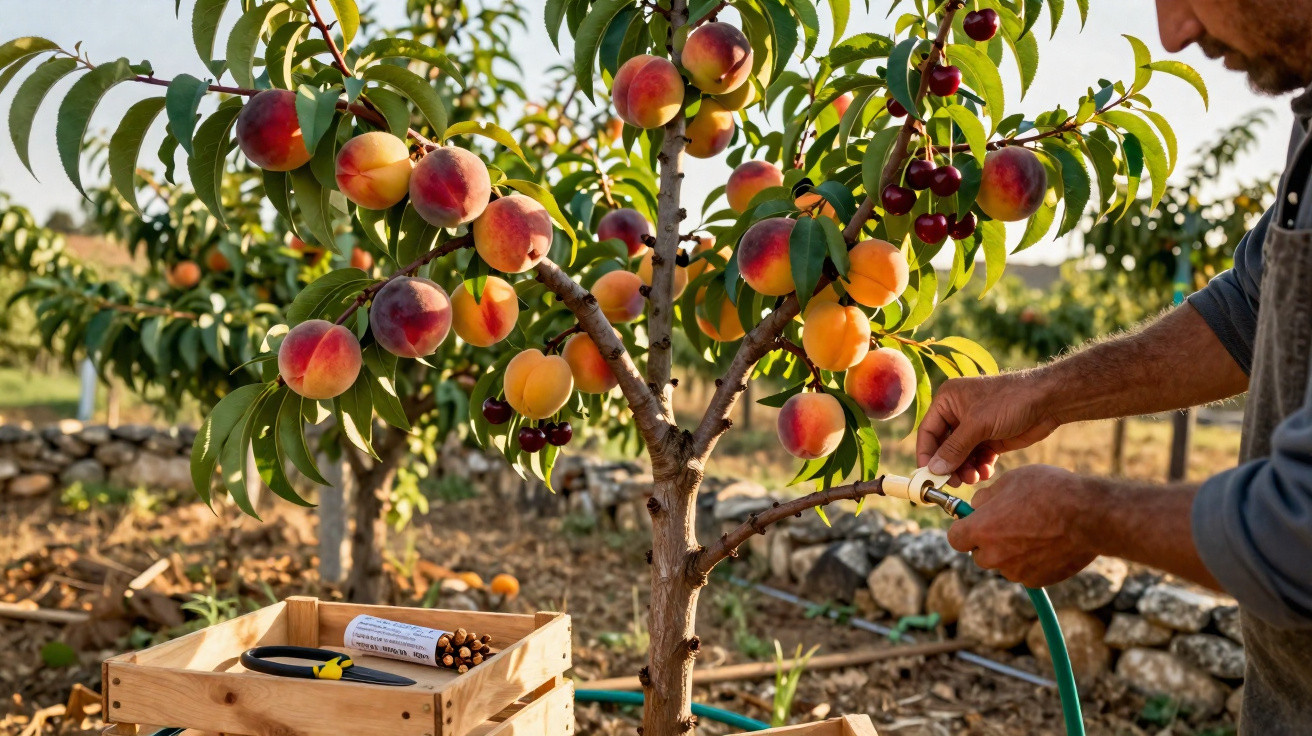
People pause, point and reach for their cameras. The question never changes: is it genuine, or simply a smart illusion created by labels and timing?
On a balmy July evening, I stood beneath it while its branches sagged with rosy apricots on one side and deep-purple plums on the other, as though two seasons had decided to perform together. A robin skipped among neatly handwritten labels - “Suncrest,” “Santa Rosa,” “Moorpark” - while a child on a scooter asked his father how many trees were concealed below ground. His father merely shrugged, fruit juice on his hands, equal parts amazed and doubtful, before passing down a piece of fruit as if it were a newly found coin. Despite the warmth, the bark was cool to the touch, its small scars forming a careful record of patient work. One trunk, countless lives.
The living sculpture that fruits forty ways
The “Tree of 40 Fruit” started as both an audacious concept and a horticultural test: could one tree support a whole chorus of flavours, colours and flowering periods without breaking down? Artist and professor Sam Van Aken proved that it could through decades of grafting, gathering heritage scions and making every cut in rhythm with the tree. One tree, forty flavours: it is not a myth, but a method.
In spring, its limbs become a patchwork of blossom: white cherry flowers, delicate pink peach blooms and vivid red plum blossoms, often appearing together like fireworks slowed enough to study. By late summer, ripening follows in succession: apricots first, then early plums, followed by peaches and nectarines, and finally cherries tucked among the leaves like tiny jewels. At a school garden in upstate New York, children counted the days until fruit ripened rather than test marks, and no one needed to ask what “seasonal eating” meant when it hung at their eye level.
There is no magic or genetic modification involved. The process is grafting: a twig from a chosen variety, known as a scion, is joined to a compatible host tree, or rootstock, so that their cambium layers meet and fuse into one vascular system. The tree directs energy where it needs it, while each scion retains its own character - fruit shape, sweetness and flowering date - and shares water and nutrients through the trunk. These are not forty unrelated species, but rather a family gathering within the Prunus genus: peaches, plums, apricots, cherries and even almonds, with every branch preserving its particular flavour and history.
How to create your own multi-fruit tree
Begin with a hardy, compatible rootstock. Myrobalan plum (Prunus cerasifera) is a widely used foundation for stone fruit. Add grafts gradually: three to five varieties in the first year, then several more during each following dormant season. Late winter or the earliest part of spring is the ideal period, when the tree is resting and sap flow is low, allowing wounds to heal as temperatures rise. Use a sharp grafting knife and make clean, matching cuts - whip-and-tongue or cleft grafts for thicker wood, and chip budding once the bark begins to slip. Bind the join firmly with grafting tape or parafilm, label every scion, then support the union with measured watering and consistent shade over new grafts.
The most common error is overambition. Add too many varieties in one go and the tree may falter; combine species that fall outside the Prunus family and the graft is likely to fail. We have all seen enthusiasm race ahead of the instructions, so take a modest approach: control vigour through pruning, thin fruit during the early years and ensure every graft receives enough light and room, otherwise the strongest branches will shade out the others. And, honestly, no one prunes every weekend.
Plan according to both season and position: early-, mid- and late-ripening varieties, placed north, south, east and west. This prevents all the fruit maturing at once and stops branches competing for identical sunlight. Shape the main limbs like a candelabra to spread their weight, remove any suckers emerging from the rootstock, and disinfect tools between cuts so canker or gummosis is not carried from one branch to another. With patience, a bundle of twigs becomes a tree that feels like a community.
“Grafting is 10% the cut and 90% the waiting.”
- Select compatible scions: keep stone fruit within Prunus.
- Get the timing right: graft in the dormant season and use chip buds during active growth.
- Match the cambium with care: green against green, firmly wrapped, with no gaps.
- Label every graft: record the variety, date, ripening period and source.
- Prune for balance: allow weaker grafts to develop before permitting heavy crops.
What the Tree of 40 Fruit reveals about food’s future
Beyond the striking photographs, this tree offers a model for resilience: a garden tree that reduces risk by spreading flowering dates and harvest periods, supplying a household with different textures and sweetness levels from July through to October. It preserves heritage genetics within reach rather than behind museum glass or inside a seed vault, because people can eat the fruit and want it again. This is living biodiversity you can taste.
It also carries a social energy. Neighbours exchange scions, share advice and move from abstract ideas to the sticky-fingered reality of picking fruit. A multi-fruit tree can turn a lawn into a conversation and transform a quiet craft into something resembling tradition. You might begin with three varieties, then add five, and by the following spring you are handing someone a twig that could become a pie four summers later.
The claim of “more than 40 species” needs some qualification; in reality, several species are combined within one genus, though that remains a small miracle. The true value is not the figure but the scope. One trunk can bear flavours descended from different branches of the supermarket fruit aisle, flower in staggered waves when late frosts are unpredictable, and show a neighbourhood that biology is not so much a fixed rulebook as a conversation we can learn to join.
| Key point | Detail | Why it matters to the reader |
|---|---|---|
| The craft behind the magic | Grafting scions onto a compatible Prunus rootstock using clean cuts and tight bindings | Recreate the concept at home, beginning with 3–5 varieties |
| Seasonal fireworks | Patchwork blossom in spring, followed by a staggered harvest from midsummer to autumn | Fresh fruit for months rather than weeks - along with serious kerb appeal |
| Biodiversity on a stick | Heritage varieties protected at garden scale, rather than only in vaults | Better flavour, local resilience and food you can genuinely touch |










Comments
No comments yet. Be the first to comment!
Leave a Comment