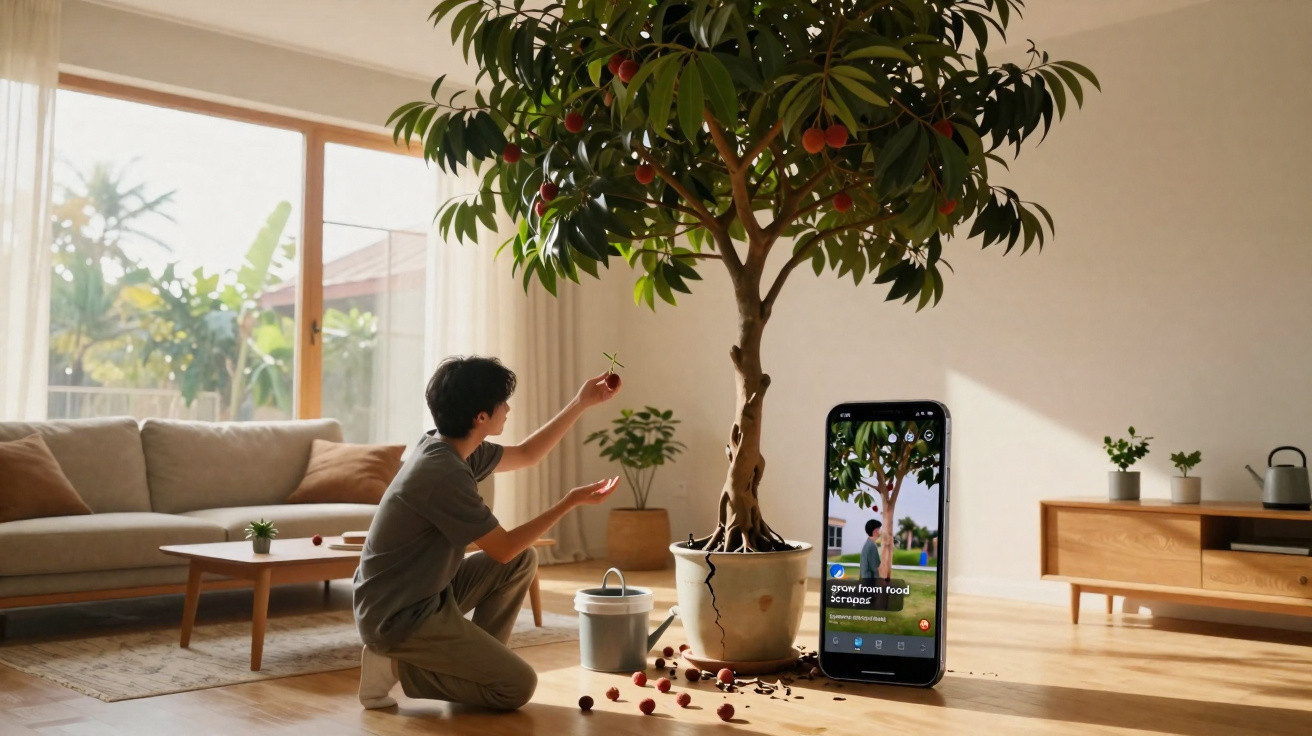
“Don’t throw it away,” the voice-over urges. “Grow your own tropical lychee tree at home – from trash.” The comments fill up with fire emojis, declarations that people will try it, and triumphant images of seeds sprouting on windowsills worldwide.
A month on, some seedlings have started turning yellow. Others are coated in fuzzy mould. A handful have quietly disappeared from otherwise immaculate Instagram feeds. Meanwhile, in a tucked-away plant forum, one anxious parent asks whether lychee leaves are toxic to cats, after their new “trash-grown tree” became their kitten’s preferred chew toy.
What began as a cheerful eco-hack can suddenly seem far less innocent.
From viral trash hack to a living time bomb?
Spend enough time scrolling TikTok, Instagram or YouTube Shorts and the formula appears everywhere. Take fruit stones that would once have gone in the bin, wash them, push them into compost, and suddenly you have “free” tropical trees. Avocado, mango, lychee, longan: the more exotic, the better. It looks clever, virtuous and mildly defiant in a culture that throws so much away.
Lychee is made for this sort of video. Its seed is large and pleasingly tactile. Before it germinates, it swells and splits with theatrical effect. Within three weeks, a reddish young tree pushes through the compost as though it belongs in a fantasy film. The plant appears unusual, costly and almost forbidden. That sense of spectacle is irresistible to algorithms - and to people gazing into their kitchens at 11:47 p.m.
What almost never appears in the final edit is the stage when that delicate tropical youngster gradually begins to struggle in a dry flat, beneath feeble winter daylight and beside a radiator. Nor do the clips show fungus gnats spreading from the lychee pot to every other plant in the home. Viral videos avoid the slow, mildly depressing decline. They end with the neat “ta-da”.
On a gardening subreddit, a user shared proud photographs of a lychee raised from supermarket fruit, only to fall silent after commenters flagged root rot and humidity problems in their climate. In a Facebook group, a woman admitted that she had binned her mouldy pot “so my kids wouldn’t see it die.” When I mentioned trash-grown tropical plants to a plant shop owner, she sighed: in her experience, these “free trees” often arrive as stressed, pest-infested patient zeroes masquerading as ordinary repotting jobs.
There is also an uneasy divide between life on screen and real life. A tropical lychee in a professionally lit studio, lightly misted and filmed through a macro lens, bears little resemblance to one squeezed onto a gloomy UK windowsill in February. When a trend travels across borders faster than the plant can adjust, something inevitably fails to translate. Hopes develop more quickly than roots, and the resulting disappointment can be quietly harsh.
From a botanical perspective, lychee is not an easy-going houseguest. It is a tree adapted to warm, humid subtropical conditions, abundant consistent light and plenty of room for substantial roots. Keeping one indoors, particularly in a compact urban flat, effectively asks it to impersonate a small houseplant. For a time, it may oblige, producing glossy red-green foliage and a valiant little trunk. Eventually, however, the gap between its biology and its surroundings emerges through restricted growth, relentless leaf loss and a plant forever one difficult week away from failing.
There is also the appealing fiction that you will “grow your own lychees at home”. Most supermarket fruit comes from grafted commercial cultivars, and their seeds are a genetic lottery. Even if a seedling remains alive, it may never fruit. Should it do so, it could take ten years or longer, and its flavour may be entirely unlike that of the fruit it came from. That does not make the project pointless; it simply means it is not quite what the videos quietly suggest.
How to grow a lychee indoors without losing your mind (or your living room)
If you still want to save that lychee seed from the compost caddy, the wisest first step is to slow down. Carefully rinse the seed, remove the slippery brown outer coating if it lifts away without effort, then position it horizontally in a small pot with free-draining compost. Bury it halfway, with its top just below the surface. This gives the new root and shoot a reasonable chance while preventing the seed from decomposing in an overly wet grave.
Choose an open mix: potting compost blended with perlite, orchid bark or coarse sand. Aim for an “airy brownie”, rather than heavy clay. Water once to settle the seed, then leave it until the upper centimetre of compost feels dry. A loosely fitted clear plastic bag can help retain humidity, although it needs several holes to allow air to circulate. Put the pot in bright, indirect light - close to a window, rather than on a hallway bookshelf.
When the first red stem emerges, remove the plastic and shift the pot a little nearer to its light source. Do not place it in fierce midday sunlight behind glass, as this can scorch fresh leaves. Turn the container every few days so the seedling does not strain towards one side. Give modest, measured amounts of water. An inexpensive moisture meter can take out the guesswork, though a fingertip will do the job as well. If the surface remains cool and damp, hold off.
The usual problem is not the seed itself, but everything that follows once the initial thrill has passed. Seeing the shoot emerge is exciting; attending to it every day is not. Let’s be honest: nobody really does that every day. You forget to turn the plant, then make up for it by drowning it. Or you begin misting compulsively, which feels attentive but often creates ideal conditions for fungi on the compost surface.
For households with pets or young children, the pot may soon become more plaything than tree. Inquisitive fingers dig through the compost. Cats decide that bark-based mix is a premium litter tray alternative. Dogs chew foliage from boredom. Although lychee is not among the most toxic plants, any non-food plant eaten in quantity can cause stomach upset, while the compost itself may contain bacteria. That is before considering fungus gnats: the tiny black flies that seem to materialise whenever organic matter stays wet for too long.
During humid weather, white mould can spread over the compost like cobwebs. The urge may be to bin the whole thing and rush back to the reliability of plastic plants. You don’t have to. Allow the surface to dry, remove the worst of the mould and improve air circulation. The plant does not need a sauna; it needs a bright, airy spot where its leaves dry swiftly after watering. Think less about “raising a baby tree” and more about “running a small climate experiment on your shelf”.
“The biggest hidden risk isn’t toxicity or pests,” confides Laura, a houseplant shop owner in Berlin. “It’s expectations. People see a ten-second miracle and think they’re buying that outcome when they copy it. What they’re really getting is a commitment.”
When your lychee has developed three or four sets of leaves, treat it as the slow-growing, temperamental housemate that it is. Carefully repot it into a marginally larger container, continuing to prioritise drainage. Use a saucer, but tip away any standing water after 20 minutes. In winter, consider an inexpensive grow light if you live far from the equator, and keep the plant away from radiators that pump out hot, dry air.
- Keep compost gently moist rather than saturated - like a squeezed sponge, not a soaking towel.
- Every few weeks, clean the leaves with a damp cloth to remove dust and inspect for pests.
- Create a “plant quarantine corner” so incoming plants cannot pass insects on to your lychee.
- Treat brown leaf tips or a fallen leaf as information, not defeat.
There is a subtle strength in deciding: I am not raising this for fruit or for likes. I am growing it to discover how much a tropical tree can adapt to my life - and how much I may adapt to it. That change in outlook turns a “dangerous fad” into a risky but worthwhile experiment.
The fine line between eco-hack and quiet burnout
At first glance, the lychee-from-trash trend can appear almost saintly. There is no plastic, shipping or commercial greenhouse: only kitchen scraps, potting compost and you. It seems like a modest revolt against waste, turning last night’s dessert into tomorrow’s jungle corner. For many people, their first successful sprout becomes an entry point into gardening.
Beneath that, though, lies something more complex. When every home becomes a miniature tropical conservatory, the emotional burden accumulates. Each mark on a leaf becomes a small personal failure, and a pest outbreak can feel like a moral lapse. We do not simply throw out a plant; we make half-joking, half-ashamed confessions about it on social media. In a difficult week, a windowsill can begin to resemble a line of expectations you are failing to fulfil.
There is an awkward global irony, too. Lychee trees, mangoes and other tropical plants are generally cultivated in places already feeling the pressure of climate change. Their seeds travel between continents in refrigerated containers. We then encourage those seeds to grow indoors using artificial lighting and heated homes. This does not erase the pleasure of seeing “trash” germinate, but it does make the trend’s green halo more complicated.
We all recognise the impulse to buy a plant to solve a feeling - boredom, loneliness or environmental guilt - rather than because the space can support it. Growing a lychee from scraps can certainly be a hopeful act. It can equally become one more quiet responsibility in a life already crowded with tasks. The ideal point lies somewhere between them: one tree you have time to understand rather than five that you gradually abandon.
Perhaps the better question is not “Is it dangerous to grow tropicals indoors?” but “What story are you telling yourself when you do?” Are you gathering trophies or finding companions? Pursuing a harvest or creating a daily ritual? An honest response may determine whether the next lychee seed goes into a pot - or returns to the compost bin with an unexpected feeling of relief.
| Key point | Detail | Why it matters to the reader |
|---|---|---|
| Lychee trees are high-maintenance indoors | They need strong light, humidity and space that most flats cannot provide over the long term | Helps establish realistic expectations and prevent frustration or plant loss |
| Trash-grown does not mean risk-free | Overwatering, pests, pet chewing and mould are frequent side effects of viral seed trends | Encourages readers to consider hidden costs before copying social media hacks |
| Intention matters more than fruit | Most indoor seed-grown lychees will not fruit, but they can teach patience and plant care | Encourages a move away from quick results towards meaningful, sustainable relationships with plants |











Comments
No comments yet. Be the first to comment!
Leave a Comment