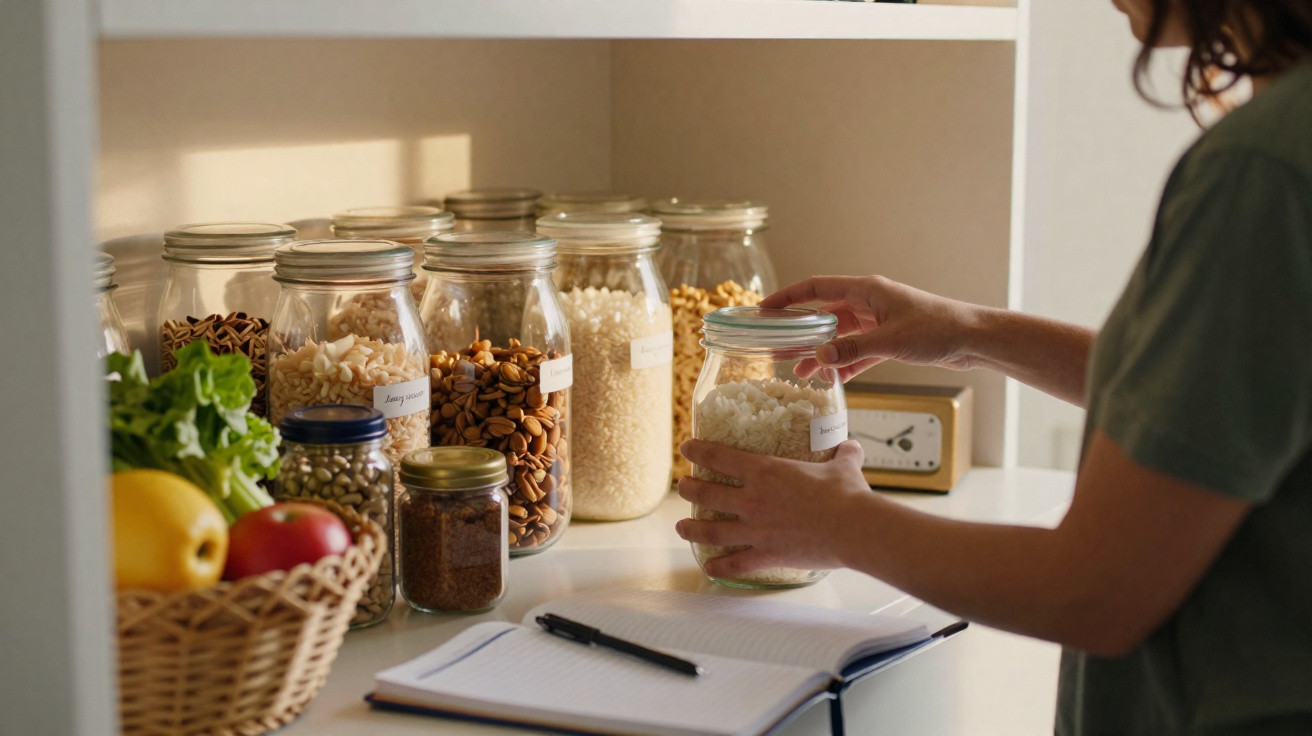
The first feeling is not the clutter; it is the guilt.
At the back sit lines of dusty tins, a bag of flour with a best-before date from what feels like another era, and three open jars of identical pasta sauce. You close the pantry door rather too quickly, as though that could make the evidence disappear.
Later, as you look through your banking app, your food-shopping spend does not seem to reflect what you are actually eating. You remember the spinach you binned, the crackers that went stale and the yoghurt that never made it to breakfast. Between the supermarket and your plate, food seems to vanish into a black hole created by crammed shelves.
Now picture a pantry in which nothing is concealed and every shelf quietly suggests what to cook next. Your shelves can operate as a system rather than a graveyard for stored food. The surprising part is that the answer has more in common with mapping an Underground network than tidying a cupboard.
Why pantry chaos quietly destroys your food budget
Open an overloaded pantry and it almost feels as if you can hear food slowly deteriorating. Products are piled two or three rows deep, bags slump forwards and labels face every possible direction. You take what is visible, rather than what you already own.
The problem is that your eyes travel along the same routes each time. They notice the colourful cereal packet, the convenient snacks and the sauce at the front. Everything else quietly grows old in the background. That is how an entirely usable jar of chickpeas can remain unopened for 18 months.
On an ordinary weeknight, when you are tired and hungry, you do not go searching. You fall back on the familiar. That is the point at which waste starts.
One figure is particularly sobering: research from the USDA and other researchers indicates that households discard hundreds of pounds’ worth of food every year, frequently because it was “forgotten” in storage. It was not spoiled when bought. It was not unsafe. It simply disappeared into the clutter.
On a small kitchen shelf, this may mean three jars of peanut butter opened at different points, two partly used bags of rice and dried herbs that have not seen daylight since the last World Cup. In a larger walk-in pantry, it can mean entire areas that operate like a museum: look, do not touch.
One Sunday evening, a family I spoke to emptied their pantry “just to check”. The floor vanished beneath tinned tomatoes, lentils, crackers, pasta, cereal and baking mixes. They found 17 tins of beans distributed across three shelves. They had continued buying more because they could not see the ones they already had.
This is the concealed price of a disorganised pantry: duplicates get bought, the oldest products go unused and food passes its date out of view. It is not a matter of carelessness. It is the result of a storage system that does not suit the way people really behave when under pressure.
Food waste in this situation rarely looks spectacular. It is a tub of soured cream, a bag of salad leaves or a box of stock cubes. Individually, they are small losses. Yet in a chaotic system, these “small” losses become a weekly routine. Across a year, they can amount to a holiday, a new appliance or simply less anxiety when you check your banking app.
Once you treat your pantry as a living system instead of one large box, its patterns are easier to spot. Shelves that are overly deep create blind spots. Random arrangements make you search through everything. Products with no designated place drift, become buried and pass their dates.
Accessibility and waste are inseparable. If you cannot see an item, you are unlikely to use it. If you do not use it, you purchase another. The cycle continues until you interrupt it with a strategy rather than a one-off decluttering session.
View every shelf as a tool for making decisions. The more clearly it directs your attention to what should be used first, the more effectively your kitchen supports you. System by system, you stop battling your pantry. Instead, it works with your routines rather than against them.
Building a strategic pantry system for busy weekdays
Begin with one apparently simple principle: pantry shelves should function like a supermarket aisle, not a storage cupboard. That means clear fronts, labels turned towards you and the oldest products placed within immediate reach.
Choose a single category at a time. Empty all the pasta, for example, or every tin, then arrange it on a table. Separate products by type and then by date. Put the newest at the back and the oldest at the front. As you return them to the shelf, use the restaurant-kitchen principle of “first in, first out”.
For smaller products, use shallow baskets or trays: one for baking ingredients, another for snacks and a third for breakfast essentials. This is not merely organisation; you are creating “stations” that reflect the way you truly cook.
Many of us fall into the same trap: purchasing attractive matching containers before we understand our real habits. Let us be honest: nobody actually does that every day. Stylish jars cannot repair a system that does not fit your life.
Instead, pay attention to your everyday shortcuts. Do you always reach for the same spices near the hob? Store them low down and facing forwards, rather than hidden on a high shelf. Do your children head straight for snacks after school? Keep healthier choices at eye level in one clear basket instead of scattering them across two shelves.
“Out of sight, out of mind” is a powerful emotional trigger. Food tucked behind opaque packaging or at the rear of a dark shelf can become almost imaginary. This is where rotating turntables work well in corners, while tiered risers allow you to see every tin in the back row.
“I stopped thinking of my pantry as storage and started treating it like my week in food,” a friend told me. “Once I could see everything, my grocery list finally got shorter instead of longer.”
- Create meal kits: Keep ingredients you regularly use together-such as for taco night, pasta night or a baking day-in separate baskets.
- Establish a “use soon” zone: Set aside one small, front-facing space for products that need eating within the coming week.
- Keep labels human: Forget perfection and use large, quick labels such as “Quick dinners”, “Kids snacks” and “Grains for salads”.
From tidy shelves to less waste: keeping the system going
A smart pantry system is only as useful as the few seconds you spend interacting with it on a weeknight. This is why the most lasting arrangements are forgiving. They assume you will be tired, rushed and perhaps a little grumpy, yet still steer you towards food you already own.
One brief ritual can transform everything: take a 5-minute “pantry glance” before making your shopping list. Stand in front of the shelves, look through the “use soon” zone and choose two or three products around which to plan meals. Not fifteen. Only a few anchors you commit to cooking before the week is over.
We have all experienced finding three almost identical, half-empty bags of rice. One straightforward rule makes a difference: do not open a new bag of anything until the current one is genuinely finished. It may sound strict on paper, but it is remarkably freeing in daily life.
| Key point | Details | Why it matters to readers |
|---|---|---|
| Create a “Use First” shelf zone | Keep the most accessible front part of one shelf for opened products or those close to their date. Every time you shop, rotate newer products behind them. | It turns forgotten food into clear meal starting points and gently encourages you to use what you have before purchasing more. |
| Store by category, not packet size | Keep all grains together, all tinned proteins together and all snacks together, even where packet shapes are awkward. Use baskets to hold unusual shapes. | This makes duplicates and excess stock easier to identify, reducing impulse purchases and preventing ingredients from passing their dates unseen. |
| Limit depth with baskets and risers | Divide long, deep shelves into “mini-shelves” with shallow baskets and tiered risers, so that nothing vanishes in the back row. | It addresses the familiar “I didn’t know we had that” problem and keeps everyday options visible at a glance. |
When a pantry system truly works, it feels unexpectedly calm. You open the door without feeling criticised by half-used bags and forgotten jars. What you see are possibilities: dinner ideas and a week’s supply of snacks that will actually be eaten.
The shift is not only visual. Your shopping list becomes slightly shorter. You stop buying a fourth bottle of soy sauce “just in case”. You build meals around that solitary tin of coconut milk or the polenta bought on a whim, and it becomes something comforting on a Tuesday evening.
In time, the shelves begin to reflect how you really live, rather than how you believe you ought to live. Quick breakfasts gather in one place. Emergency pasta is exactly where you expect it. The baking shelf may remain half-empty for months, and that is fine; it shows that you are no longer pretending.
An organised pantry will never remain unchanged. Children grow, diets alter and working weeks shift. The value of a strategic system is its flexibility: zones can be relabelled, baskets can move and “use soon” products can rotate in and out like a quiet backstage team.
There will still be evenings when you throw things together without much thought, because that is human. The difference is that your shelves are no longer working against you. They gently guide you towards less waste, easier decisions and a kitchen that feels as though it is on your side. Once you experience that small daily relief, it is difficult to return to the old way.








Comments
No comments yet. Be the first to comment!
Leave a Comment