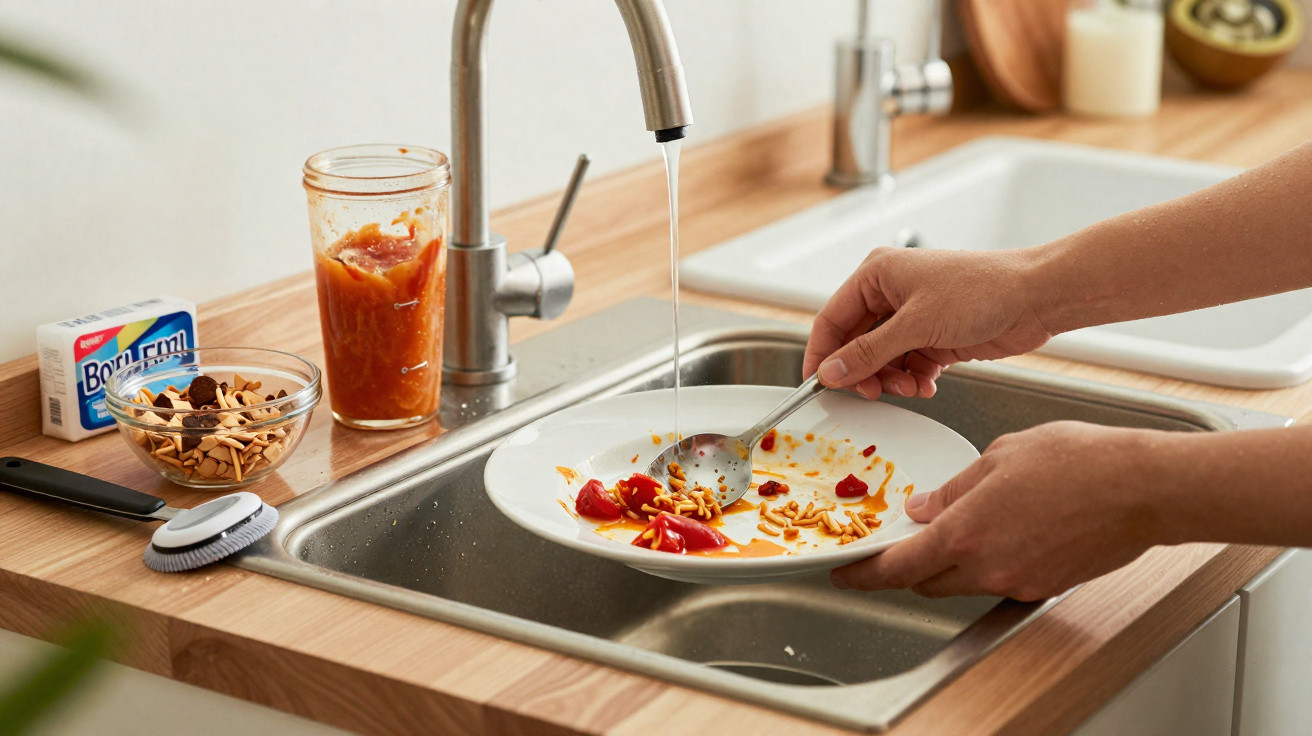
The tap is on, plates are arranged in a neat row, and you are attacking last night’s pasta sauce as though the dishwasher were a delicate house guest.
Water ends up on your top, the sink becomes chaotic, and you are mildly irritated before the appliance has even begun. Between the soapy sponge and rattling crockery, a nagging thought surfaces: if the dishwasher is meant to handle this, why am I doing it first?
You pause over a plate marked by one last line of sauce. Should you rinse it, or leave it? Your parents rinsed dishes, and your grandparents almost certainly did too. Skipping that step feels unnatural. Yet the silent stainless-steel machine in front of you is nothing like the dishwasher they used in the 1990s. It can assess, measure and make decisions.
That is precisely where the problem begins.
Why your dishwasher actually needs some dirt
Many current dishwashers resemble discreet, highly qualified colleagues: they observe, collect information and adjust accordingly. A small concealed sensor monitors the cloudiness of the water to establish how soiled the dishes are. When you rinse every item until it appears nearly clean, you are not assisting the machine. You are giving it misleading information.
It may then decide that the load is only lightly soiled and requires less work. The programme uses less time, heat and water, while the detergent has fewer reactions to perform. Your plates may look passable, but glasses can develop a faint film, cutlery may lose its sparkle, and you may blame the dishwasher rather than the real issue: an exhaustive pre-rinsing session at the sink.
There is a curious psychological cycle at work, too. You rinse, the dishwasher delivers poorer results, and you decide it is underpowered or ageing, so you rinse still more next time. It creates an odd relationship with an appliance designed to be cleverer than that. The technology is prepared to do its job; we are the ones clinging to outdated routines.
One Tuesday evening, I saw this exact pattern in a small flat while interviewing a young couple. Both maintained that they “barely pre-rinsed”. We then watched what they actually did. Every plate received a thorough shower beneath the tap, and some were given an additional scrub “just in case”. The open dishwasher door looked like a mouth waiting for food that never appeared genuinely dirty. At the end of the programme, they complained that their glasses were not completely spotless. Their solution was: “Next time, we’ll rinse even better.”
Their dishwasher was brand new and included turbidity sensors and eco programmes. In principle, it could set water levels and temperature accurately according to the level of soil. In reality, during the opening minutes of the wash, its sensor repeatedly detected almost-clear water. It therefore shortened the programme and reduced its intensity. To the dishwasher, the load resembled lightly dusty crockery rather than the dried-on lasagne and oily pans used the previous evening.
A study by an American utility group found that people who rinse thoroughly by hand can waste up to 76 litres of water before the dishwasher has even started. That is in addition to the water used by the appliance itself. None of that extra water improves the cleaning result; it simply produces a confused sensor and a detergent cycle that is only partly used.
The process inside your dishwasher is straightforward. Early in the programme, water is sprayed over the load before flowing past a sensor that checks whether it is clear or cloudy. Cloudy water indicates substantial quantities of food particles, grease and residue. The machine interprets this as a heavily soiled load and selects a longer, hotter wash. When the water is largely clear, the dishwasher assumes the dishes are already almost clean and switches into an easier-work mode.
By pre-rinsing vigorously, you remove the very clues the appliance relies upon. The detergent has too little organic material to “grab”, enzymes cannot perform to their full potential, and the programme’s eco-focused design is disrupted. It is rather like purchasing a smart thermostat, then opening every window whenever the heating comes on. The technology is designed for real-life conditions, not our compulsive urge to remove every visible mark before loading.
How to load dishes without rinsing and still get them clean
The aim is not to move from rinsing every item to loading plates covered with half a pizza. The ideal approach is scraping rather than washing. Remove solid scraps with a fork, spatula or the back of a knife, putting them in the bin or compost. Then place the dish in the machine as it is. A smear of sauce, some oil or even dried starch is perfectly acceptable. That is exactly the sort of soil your dishwasher anticipates and is built to tackle.
Imagine that the dishwasher needs something it can read. A completely clean plate is a blank page; a lightly soiled one is a clear, readable text. Food that is heavily baked on and crusted over is a crumpled, stained manuscript that the appliance must battle through. You need not make dishes immaculate, merely readable. If residue has been left for several hours, a short soak in a bowl of water will do. There is no need for a full rinse beneath running water. Your water bill will notice the difference well before you do.
Most people feel hesitant the first time they miss out the pre-rinse. There is a slight worry that the dishes will emerge filthy and need washing again. In truth, this can happen when a load is arranged very poorly. A frequent error is cramming dishes together so tightly that water and detergent cannot reach every surface. Another is putting the dirtiest pans on the upper rack, where the spray is gentler and less direct.
Be kind to yourself while changing this habit. Parents, advertising and the vague embarrassment associated with a sink full of “dirty dishes” have conditioned you for years. If your first attempt is not flawless, that does not prove the approach has failed. Alter how you load, rather than how much you rinse. Turn the dirtiest sides of plates towards the central spray arm, and leave enough room between glasses that they do not block one another. Let’s be honest: nobody truly does this every day, but even a small amount of care in positioning makes an enormous difference to the result.
An engineer from a major appliance brand put it to me this way:
“Our dishwashers are tested with plates that would make most people cringe. If you pre-wash everything, you’re not only wasting water, you’re breaking the logic the machine is built on.”
For a more practical approach, use this brief mental checklist before pressing Start:
- Have I scraped away large pieces instead of rinsing them off?
- Are the plates lightly soiled rather than scrubbed clean?
- Are bowls and plates angled towards the spray arms?
- Have I left space between glasses and cups?
- Is the filter clear so food residue can actually leave the machine?
On an ordinary weeknight, this takes perhaps 20 seconds. There is no soaking beneath the tap, no foamy hands and no guilt about “helping” the dishwasher. It is simply a small change in how you view the appliance: not as a fragile assistant, but as the lead cleaner in the kitchen team.
Rethinking the ritual around dirty plates
We seldom acknowledge it, but the dishwasher belongs to the emotional landscape of home life. It is the end of the day, you are exhausted, children are bargaining over bedtime, and your phone is buzzing somewhere in the sitting room. The final choice you want to make is how dirty a plate can be before you feel guilty about putting it in the dishwasher. At its heart, the whole rinsing habit is about trust, or the absence of it.
At a Sunday lunch with friends, watch what happens in the kitchen after pudding. Someone sees the sticky plates, pauses, and nearly always runs them beneath the tap “to help”. Someone else opens the dishwasher and instinctively apologises: “Sorry, it’s a bit dirty, I haven’t run it yet.” We assign a peculiar moral value to dishwashing, as though avoiding the pre-rinse were lazy or careless. Your machine’s sensor has no interest in your virtue. It responds to what is actually there.
Once you understand that a slightly dirty plate can improve the wash programme, the ritual shifts entirely. You turn off the tap earlier and load more quickly. A visible streak of tomato sauce no longer makes you feel guilty as the plate goes in. You might even discuss it with another person in the household, and together begin trusting the machine a little more. On a small level, it is a quiet change in how your kitchen operates. On a larger one, it means several thousand litres of water saved across a decade, alongside a little less unseen effort resting on your shoulders.
| Key point | Detail | Benefit for the reader |
|---|---|---|
| Do not pre-rinse under running water | Most modern dishwashers assess water turbidity to adapt the programme | Delivers better cleaning while saving water and energy |
| Limit preparation to scraping away leftovers | Remove solid pieces while leaving light marks and films | Improves sensor and detergent performance without extra work |
| Focus on placement, not rinsing | Aim dirty surfaces at the spray arms and avoid overloading | Reduces poor wash results without returning to pre-rinsing |












Comments
No comments yet. Be the first to comment!
Leave a Comment