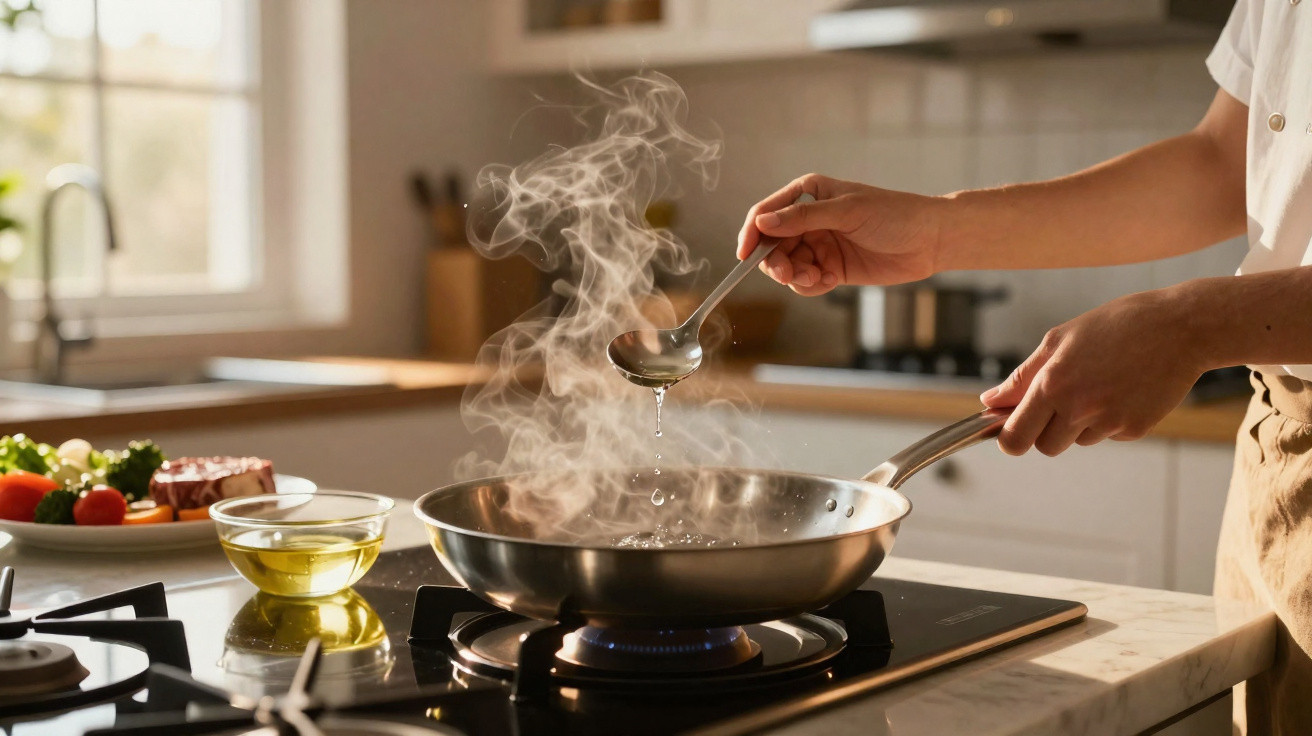
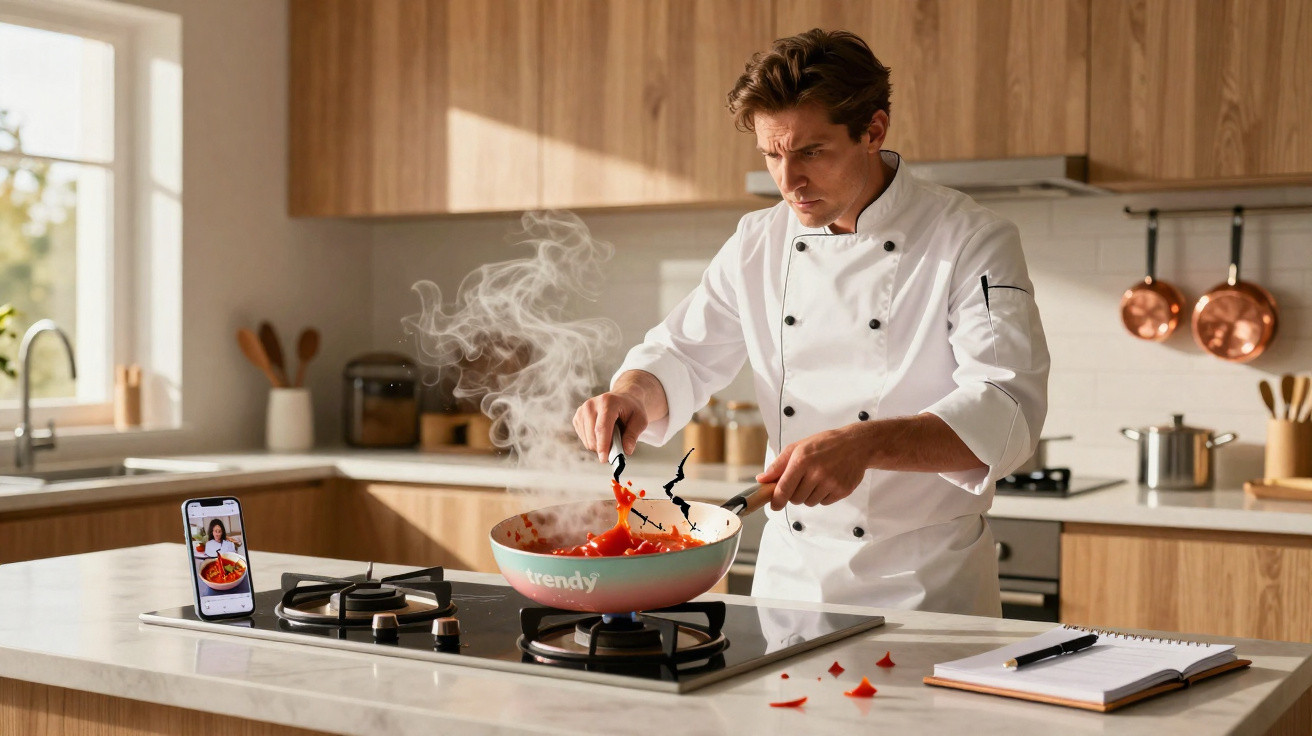
The pan is on the hob, with a few drops of oil lazily dancing across its base and a plate of marinated meat beside it. The kitchen smells of garlic and a hint of panic. The guests are already sitting in the living room, and someone calls out: “Will it be much longer?” So you turn up the heat, tip the food into the pan – and hear only a restrained sizzle. No fierce crackle, no golden-brown searing. Just a disappointing simmer in its own juices.
We all know that moment when the food on the plate promises so much but somehow tastes flat. Pale steaks, limp vegetables, pancakes that feel more like rubber than a Sunday morning treat. And every time, the question is the same: what went wrong this time?
A chef who spent years working in hot restaurant kitchens says: “Almost everyone underestimates the beginning.” He does not mean the recipe, the marinade or the sauce. He means those few minutes when the empty pan sits on the hob. That is precisely where the small bit of magic happens – the part many of us stop before it has even begun.
Why we do not preheat the pan for long enough
“Most people are impatient,” says the chef, wiping sweat from his forehead with the back of his hand. A heavy iron pan is glowing beside him. He is not stirring or adding anything; he is simply watching the empty metal. The heat gradually rises, and the air shimmers faintly, as though someone has switched summer on in the kitchen.
The difference from many home kitchens is that waiting has an established role here. The pan is already on the hob before the pasta goes into the water or the onions are chopped. At home, we often do the opposite: we chop, season and chat as we go, only turning on the pan when everything is ready. Then we expect it to reach cooking temperature within 30 seconds.
The chef recalls a moment from a cookery class. One participant places her steak in a pan she has “heated briefly”. There is no loud sizzle, only a quiet murmur. After three minutes, she turns the meat over: grey, slightly watery and barely browned. In the chef’s pan beside it is an identical piece of meat, but his empty pan had been preheated for five minutes. Its crust is deep golden, its edges caramelised, and its aroma fills the room. “What did you do differently?” she asks. His answer: “I started waiting earlier.”
There are figures behind this: depending on the pan material, professional kitchens allow between three and seven minutes for preheating. At home, it is often just 30 to 60 seconds. Our sense of time in the kitchen is distorted. Two inactive minutes can feel endless, especially when your stomach is growling and someone in the next room is already laying the table. We cook under time pressure – and it is precisely preheating that quietly makes us pay for it.
The physics are straightforward. A pan needs time to heat evenly. Metal stores heat, but not instantly. If we start too soon, its surface is unevenly hot. One area sears while another cooks. The result is that nothing turns out properly. Fat soaks into the food, water escapes and the temperature in the pan drops. The appealing idea of “high-heat searing” remains a kitchen myth. Let us be honest: no one willingly waits five minutes in front of an empty pan in everyday life – at least not without a reason.
How to tell when the pan is truly hot enough
The chef demonstrates a simple test that is easy to remember: the water-drop test. He leaves an empty pan over a medium-high heat. After a few minutes, he dips his fingers into a small bowl of water and flicks a tiny drop into the pan. At first, it simply disappears, evaporating without any drama. A little later, the drop starts to hiss briefly and bounce around like a tiny rubber ball. “Now,” he says, “we are in the zone.”
This “zone” is the point at which the heat in the pan is stable enough not to collapse as soon as food touches it. That is when the oil goes in – not before and not ten minutes earlier. The oil quickly becomes runny and starts to shimmer slightly, almost like a reflection. Only then does he add the meat, fish or vegetables. The sizzling does not sound thin; it is rich and forceful, almost like a declaration.
Many people make life difficult for themselves because they reverse the order. First comes the oil, then they bring the pan up to temperature, then they add the food. That leaves them with oil that smokes long before the pan is evenly hot. Or with burnt fat and a cold cooking surface. The chef smiles and offers one of those memorable lines: “You do not cook in the oil; you cook on the pan.” Suddenly, it makes sense why some recipes at home do not turn out “like they do in a restaurant”, even when the same ingredients are being used.
Many of us have a deeply ingrained fear: the fear of burning something. It is understandable, born from encrusted pan bases, smoke alarms and the prospect of grease splashes on the kitchen wall. So we instinctively lower the heat, start frying earlier and settle for half-hearted preheating. The thought running through our minds is: “A little too little heat is better than too much.” Yet that very caution often leads directly to soggy fried vegetables and dry, grey chicken.
The good news is that preheating does not mean blindly putting everything on the highest setting. It means giving the pan an extra minute or two and learning to recognise the turning point at which the heat is ready to work for you. The chef compares it with driving: nobody gets in and immediately floors the accelerator; instead, they allow the engine a moment to “settle”. In the kitchen, we constantly skip that moment – through habit, not conviction.
He recounts another scene from his own home kitchen, far away from the professional environment. It has been a long day; he is hungry and has little patience. He hurriedly puts a pan on the hob, turns it up to full heat and adds vegetables after 20 seconds. They begin to sweat rather than fry. He watches for a moment, rolls his eyes, takes everything back out and starts again. “If I make this mistake in a rush even as a chef,” he says, “how is someone without kitchen training supposed to do it differently?” This honest moment shows that it is not about perfection, but about a small ritual that can gradually become a habit.
The preheating routine that really changes your frying
The chef suggests a straightforward sequence that works even in a chaotic everyday kitchen. First: place the pan on the hob while it is empty. Turn on the heat, medium to high depending on the pan. Only then should you go to the fridge, take out the meat, prepare the vegetables and season everything. During that time, the pan preheats almost in the background. There is no need to stare at it; you are genuinely doing several things at once.
After two to four minutes – longer for thick cast-iron or iron pans – do the test with a tiny drop of water. If it bounces energetically around, add the oil. Use only enough to lightly cover the base. Do not walk away now. Watch the pan briefly until the oil looks fluid and gently mobile. Then place the food in the pan – do not throw it in or pile it up. Give each side time to rest without turning it constantly. That is how you get the crisp edges associated with restaurant cooking.
Many mistakes come from a combination of stress, uncertainty and a lack of trust in the hob. The heat is adjusted far too often: full power for a moment, then panic, then turned sharply down, then back up again. The food feels that chaos. Anyone who learns to preheat a pan properly once and adjust the temperature gently, rather than frantically twisting the control, soon notices that the pan becomes predictable. Yes, induction, gas and ceramic hobs differ. Even so, the basic principle remains the same: the pan needs its own warm-up phase.
The chef offers a line that stays with you:
“Good searing begins the moment you discover the patience to take an empty pan seriously.”
For anyone who wants to remember it, he summarises his key points in a short list:
- Pan first, ingredients afterwards – never the other way round.
- Let an empty pan heat for 2–5 minutes, depending on its material.
- Use the water-drop test rather than relying on instinct alone.
- Add oil only to the hot pan; do not heat it from the start.
- Do not stack food in the pan – every portion needs contact with the hot surface.
Why waiting a little longer is worth it
Anyone who has consciously listened to the sound of a properly preheated pan will no longer want to hear the quiet simmer of a lukewarm one. That rich, even sizzle is satisfying, almost calming. It means the heat is doing its job and you can relax for a moment. Suddenly, even basic ingredients – a piece of courgette, a slice of bread or a simple chicken fillet – look as though they have been given a stage.
Of course, not every evening becomes a culinary spectacle. Sometimes tiredness wins, and sometimes there really is not enough time to “invest” five minutes in a pan. Let us be honest: nobody wants to absorb a whole cooking philosophy after work. But one small switch can be flipped. Rather than “hob on, food in, done”, perhaps it becomes “hob on, pan empty, breathe for a moment”. During those few minutes, you can organise everything else – plates, cutlery, a quick WhatsApp reply – while the pan becomes a quiet ally.
The best part is that you do not need to be a professional to notice the difference. The next time you make steak, vegetables or pancakes, simply dare to wait a little longer than you have before. Perhaps only one minute. Perhaps two. Then consciously watch the colour change, the crust form and the aroma intensify. Bit by bit, that kitchen confidence grows – not from recipes, but from experience.
People who experience it once often tell others about it. “I realised I have been frying at too low a temperature my whole life,” many say after a class or a light-bulb moment at home. That is the real point: the major change does not come from exotic ingredients or expensive pans. It comes from a few quiet minutes at the beginning, when apparently nothing is happening – and, in fact, everything is being prepared.
| Key point | Detail | Benefit for the reader |
|---|---|---|
| Preheat the pan consistently | Empty pan for 2–5 minutes; use the water-drop test | Better browning, less food sticking, richer flavour |
| Use oil correctly | Add oil only to the hot pan and look for a shimmer | Less smoke, controllable heat, healthier frying |
| Calm temperature management | Keep the hob at a consistent setting rather than constantly turning it up and down | Predictable results, more confidence while cooking |
FAQ:
- Question 1 How long should I realistically preheat my pan in everyday cooking?
- Question 2 How can I tell without a thermometer that the pan is hot enough?
- Question 3 Does longer preheating also apply to non-stick pans?
- Question 4 Do I need to use a different approach for cast-iron and stainless-steel pans?
- Question 5 What should I do if the pan has become too hot and the oil starts to smoke?


Comments
No comments yet. Be the first to comment!
Leave a Comment