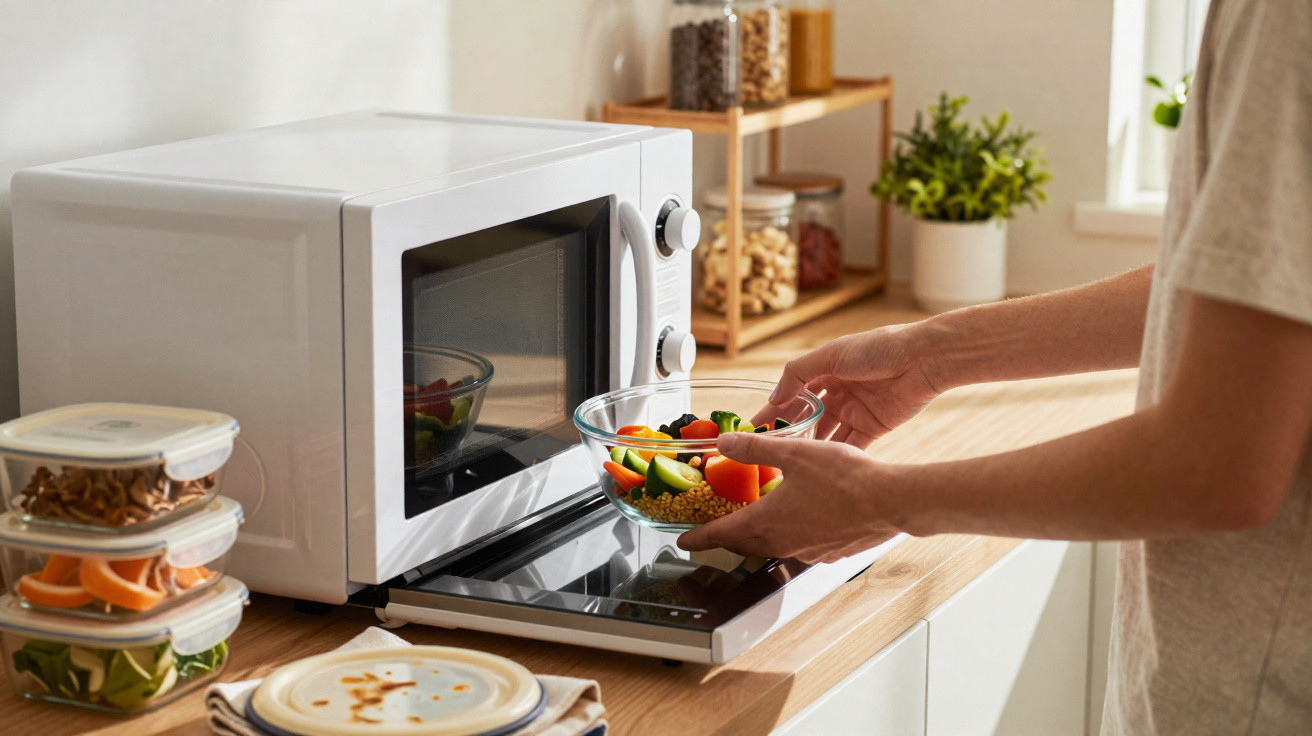
It is found in almost every kitchen, heats lunch within minutes and yet has become a quiet villain on social media.
Claims that the microwave oven causes cancer, destroys nutrients and “fills food with radiation” have circulated for years. Meanwhile, health bodies and researchers continue to say that the appliance is considered safe when used correctly. Between fear and convenience, what is the reality?
How the microwave oven actually works
A microwave oven is an appliance that heats food quickly using electromagnetic waves. These waves operate at a frequency of around 2.45 gigahertz, similar to Wi-Fi, although their power and purpose are specifically intended for cooking.
At the centre of the appliance is the magnetron, the component that turns electrical energy into microwaves. The waves travel through an internal passage, known as a waveguide, to the cavity containing the rotating turntable. There, they interact chiefly with the water molecules in food.
As these molecules vibrate rapidly, friction between them produces heat. That is what warms the food. The process does not involve “radioactivity”, nor does it make food “radioactive”.
The microwaves used in an oven are non-ionising radiation: they heat food but do not alter the structure of DNA as X-rays or nuclear radiation do.
Do microwave ovens cause cancer?
The main concern is usually the same: does a microwave oven raise the risk of cancer? So far, the scientific community’s answer is clear: when it meets safety standards and is in good condition, there is no evidence that the appliance causes cancer.
The waves produced by a microwave oven are non-ionising. In other words, they do not have enough energy to remove electrons from atoms or directly damage cellular DNA, unlike X-rays, radiotherapy or intense ultraviolet radiation.
In practical terms, their main effect is thermal: they heat things up. Even then, most of that energy is concentrated in the food, within the oven’s metal cavity. The door has a mesh specifically designed to contain the waves.
International standards limit the amount of radiation that may leak from an appliance. Certification tests check that emissions remain within the level regarded as safe.
So far, population studies have found no consistent link between using household microwave ovens and an increase in cancer cases.
When the appliance can be dangerous
The risk rises if the appliance is damaged: for example, if the door is bent, the glass is broken, the seal is compromised or the latch does not close properly. In such cases, radiation could escape at higher levels, or external components may heat unexpectedly.
The main potential problems are:
- burns caused by heated liquids or containers;
- injuries from improper use, such as attempting to dry objects;
- electrical hazards in old appliances or those with a damaged lead.
If the door does not close properly, there is rust inside, or the oven has been dropped, it is worth having it professionally assessed or replacing it.
What happens to food nutrients
Another common question is whether the microwave oven “kills” vitamins and proteins. Research comparing cooking methods paints a far less dramatic picture than rumours suggest.
Because heating is rapid, temperatures generally stay below or around 100 °C, particularly for simple preparations. This helps limit the formation of potentially carcinogenic compounds that are common in grilled meat or food heavily browned at high temperatures.
Studies indicate that:
- water-soluble vitamins, such as vitamin C and some B vitamins, tend to be retained at levels similar to steaming;
- minerals are barely lost during the process;
- the shorter heating time reduces protein degradation compared with lengthy cooking over high heat.
In some situations, microwaving vegetables with a small amount of water may retain antioxidants better than boiling them in a pan, where some nutrients are lost with the cooking water.
For many foods, the microwave oven is not the nutritional villain; overcooking, whatever the method, usually causes greater nutrient loss.
The real concern: plastics and packaging
While public debate has focused on the waves, an increasing amount of research draws attention to another issue: the containers used in the oven.
When certain plastics are heated, they can release chemical substances, particles and microplastics that may end up in food. Some of these compounds are being investigated for possible hormonal, inflammatory or cumulative effects in the body.
Plastics in the microwave oven: when to avoid them
Not all plastics are alike. Some are made for high temperatures, while others can warp or release residues easily. Adopting a few straightforward habits can help reduce the risk.
| Type of container | Use in the microwave oven |
|---|---|
| Tempered glass | Usually safe, provided it is not cracked |
| Ceramic without metallic details | Suitable, as long as it can withstand high temperatures |
| Plastic marked “microwave-safe” | Use moderately, following the stated time and power guidance |
| Disposable takeaway tubs | Not recommended; there is a greater risk of warping and releasing components |
| Ordinary cling film in direct contact with food | Avoid. Use a suitable lid or plate instead |
As a practical rule, if packaging does not clearly state that it is suitable for microwave use, transfer the food to glass or ceramic.
Good practice for using the microwave oven without worry
A few simple precautions can reduce risks and improve heating results:
- check the condition of the door, latches and rubber seal;
- do not use the appliance if the casing is broken or there is extensive rust inside;
- avoid heating liquids for too long, reducing the risk of an “explosion” when the cup is moved;
- pierce the lid of sealed packaging or remove the seal so steam can escape;
- follow the power and cooking-time instructions given on labels;
- do not place metal utensils or crockery with gold or silver detailing inside.
Proper appliance maintenance and choosing the right containers have a far greater effect on safety than simply using, or not using, a microwave oven.
A few terms worth explaining
Much confusion arises from technical terms that are not clearly understood. Two of them appear often in discussions about microwave ovens.
Ionising radiation: this is radiation capable of removing electrons from atoms and changing the structure of DNA. Examples include X-rays and nuclear radiation. It is linked to a greater risk of cancer at high and repeated exposures.
Non-ionising radiation: this includes radio waves, microwaves, Wi-Fi and mobile phone signals. In these cases, the main effect is heating, and exposure limits are set by regulatory bodies. Microwave ovens belong to this group.
Everyday microwave oven scenarios
Consider ordinary situations: reheating a plate of food, defrosting a prepared meal or warming up coffee that has gone cold. In each case, the central issue is usually not “radiation”, but the combination of container, time and power setting.
Someone who uses the appliance daily but chooses glass containers, follows label instructions and keeps the oven in good condition is likely to face far lower risks than someone who heats food in flimsy plastic packaging for long periods in an oven with a warped door.
Another often-overlooked point is that, by avoiding frequent frying and heavily grilled meats, and replacing some of those preparations with microwave heating, some people may reduce their intake of compounds created when fat and protein are intensely burnt at high temperatures.
Overall, the microwave oven is a tool. Like any tool, it can offer convenience and efficiency, or discomfort and risk, depending on how it is used. Understanding a little of the physics behind the waves and paying attention to packaging can already change the kitchen conversation considerably – and reduce fear fuelled by viral rumours.








Comments
No comments yet. Be the first to comment!
Leave a Comment