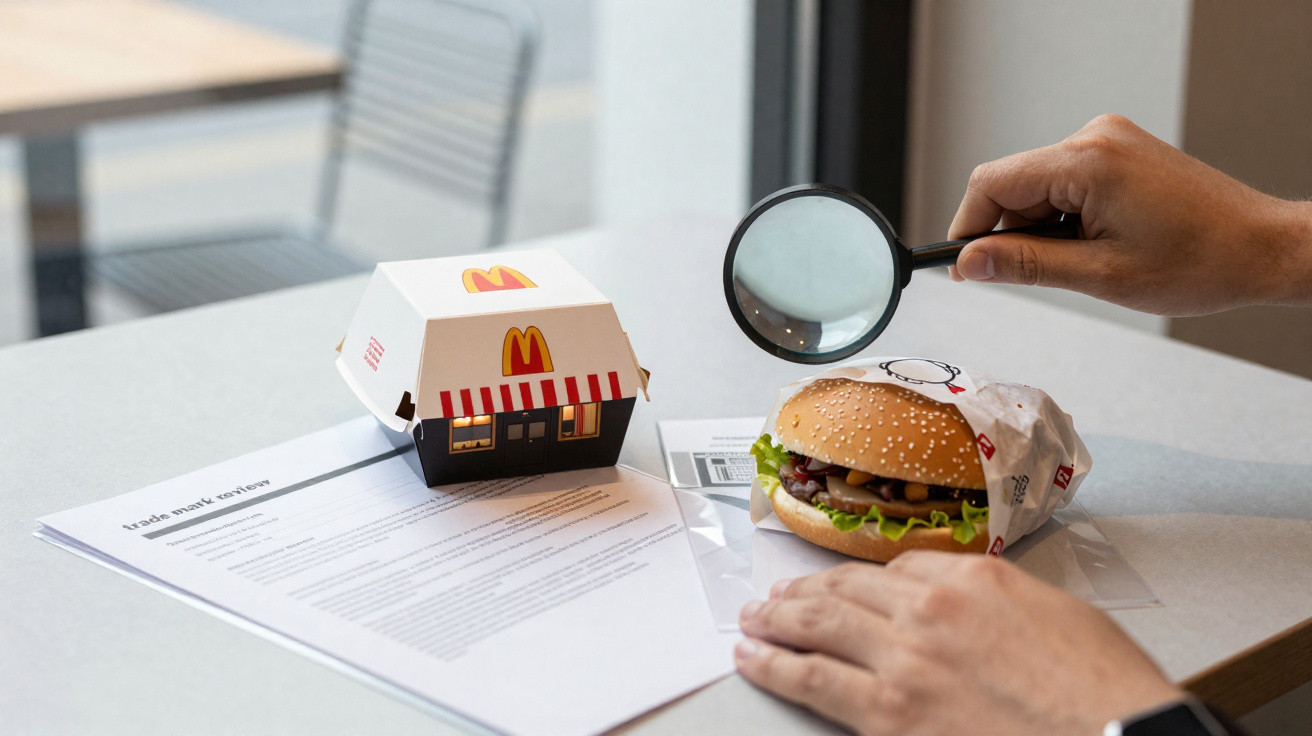
A restaurant name and the name of a burger may seem too different to cause a dispute. Yet trade mark law does not only ask whether two businesses sell exactly the same thing. It also considers whether customers might think brands are connected, particularly where one of the earlier marks is well known.
That is the issue in the latest EU trade mark decision involving Irish fast-food chain Supermac’s and McDonald’s. The EU Intellectual Property Office (EUIPO) has refused Supermac’s application to register “Supermac’s” as an EU-wide trade mark for the restaurant services concerned, following McDonald’s opposition based on its earlier “Big Mac” mark. Crucially, the decision does not itself require Supermac’s to stop using its name in Ireland.
What the decision actually concerns
Supermac’s applied in 2016 to register “Supermac’s” as an EU trade mark for fast-food restaurant services. McDonald’s opposed the application, relying on its existing EU registration for “Big Mac”, including protection for meat sandwiches.
The EUIPO’s opposition division found in McDonald’s favour. Supermac’s appealed, but the EUIPO Board of Appeal upheld the refusal.
In simple terms, Supermac’s has not obtained this particular EU-wide registration for the services in its application. An EU trade mark is a unitary right which can apply across EU member states; it is not simply a collection of separate national registrations.
That distinction is important for readers in the UK. Since Brexit, EU trade marks and UK trade marks are separate rights. This EUIPO decision is not, by itself, a ruling on any UK registration or UK trading activity.
The case is about whether a new EU-wide registration should be granted, rather than an order requiring Supermac’s to change its name.
Why a restaurant name was compared with a burger name
At first glance, “Big Mac” is a product name and “Supermac’s” is a restaurant brand. Supermac’s argued that consumers would not confuse a restaurant operator with a particular sandwich.
The EUIPO took a wider view of the market. Restaurant services and food products can be linked: restaurants sell food, menu items can become closely associated with particular businesses, and consumers may not draw a sharp line between a product trade mark and a restaurant trade mark.
The Board of Appeal considered the goods and services to be similar to a low degree, largely because they are complementary and aimed at the same broad public.
It also assessed the signs by looking at three familiar trade mark questions:
- how similar they look;
- how similar they sound; and
- whether they convey a similar idea or meaning.
The Board found only a relatively low degree of visual and phonetic similarity. However, trade mark decisions do not turn on one factor alone. Similarity, the nature of the goods and services, the relevant public, and the strength of the earlier mark are considered together.
Why the reputation of “Big Mac” mattered
The EUIPO accepted that “Big Mac” had acquired enhanced distinctiveness through use and recognition in the EU. In trade mark terms, this means the mark was regarded as having a stronger ability to identify a particular commercial origin than a little-known or purely descriptive sign.
A mark with enhanced distinctiveness can receive wider protection than an ordinary mark. That does not mean McDonald’s owns every use of “Mac”, “Mack” or similar wording. A trade mark dispute always depends on the marks in question, the goods or services, the evidence submitted and the territory covered.
In this case, the Board considered that some consumers might view “Supermac’s” as connected to “Big Mac”, perhaps as a related offering, a variant or a sub-brand. That was enough for it to find a likelihood of confusion or association for the relevant services.
A well-known mark does not automatically win every case, but its reputation can change the overall assessment.
Why trading side by side in Ireland was not enough
Supermac’s argued that it and McDonald’s had operated alongside each other in Ireland for decades without evidence of consumer confusion. That may seem persuasive to regular customers who know both restaurant groups well.
However, the application sought protection across the EU, not only in Ireland. The EUIPO therefore considered whether the marks could coexist throughout the territory covered by McDonald’s earlier EU right.
Evidence of peaceful coexistence in one country can be relevant, but it will not necessarily settle an EU-wide dispute. To carry greater weight in this sort of case, evidence would normally need to show that consumers across the relevant territory had encountered both signs without confusion.
The decision also did not depend on what either company says it intends its branding to communicate. Trade mark authorities assess how the public may perceive the marks in the market, rather than relying on a business’s preferred interpretation.
What changes for customers - and what does not
The immediate effect is narrower than the headline might suggest.
What it changes
- Supermac’s has failed in this application for an EU trade mark covering the restaurant services at issue.
- McDonald’s “Big Mac” mark was treated as sufficiently distinctive to support the opposition in this case.
- The result may influence how Supermac’s protects or develops its branding in EU markets, subject to any further proceedings or applications.
What it does not automatically change
- It does not, on its own, stop Supermac’s trading under its existing name in the Republic of Ireland.
- It does not mean the EUIPO found that diners had actually confused the two businesses.
- It does not give McDonald’s a blanket right over every use of “Mac” in every commercial setting.
- It does not directly determine the position of UK trade marks or UK business names.
For diners, there may be no immediate visible difference. A refused registration application is not the same thing as a court order closing restaurants, removing signs or changing menus.
How this relates to the earlier Big Mac dispute
The decision follows an earlier, high-profile dispute in which Supermac’s succeeded in challenging parts of McDonald’s “Big Mac” registration.
In 2024, the EU General Court considered whether McDonald’s had shown genuine use of the mark for all the goods and services covered by parts of its registration. The outcome narrowed protection in certain areas, including poultry-related goods, while leaving McDonald’s with rights for other goods, including meat sandwiches.
This is why descriptions of Supermac’s having simply “won the Big Mac case” can be misleading. Trade mark registrations can cover many different categories. A mark may be revoked or restricted for one category while remaining valid for another.
The more recent decision involved a separate question: whether “Supermac’s” could be registered in light of McDonald’s remaining earlier rights. Success in one part of a long-running trade mark dispute does not automatically decide every later application.
Common mistakes when reading trade mark rulings
Trade mark decisions are technical, and brief reports can make them sound broader than they are.
- “Supermac’s has lost its name.” No. This decision concerns an application for an EU registration, not an automatic ban on using the name.
- “The names have to be identical.” No. Authorities consider appearance, sound, meaning and the commercial context.
- “No proven confusion means there is no case.” No. The usual test is whether confusion is likely, not whether customers have already made mistakes.
- “Ireland settles an EU-wide dispute.” Not necessarily. An EU trade mark case can require evidence and assessment across the relevant EU territory.
- “A famous mark wins every time.” No. Reputation matters, but the facts of each case still have to be assessed.
A practical reminder for food businesses
For independent cafés, food producers, pop-up operators and takeaway businesses, the case is a reminder to check a proposed name before investing heavily in signs, packaging, websites and social media accounts.
A sensible starting point is to:
- Search the UK trade mark register and, where relevant, the EU register.
- Look beyond exact matches for names with similar spelling, pronunciation or meaning.
- Check names for signature dishes, sauces and retail products as well as the business name.
- Seek advice from a qualified trade mark professional before expanding into several territories.
This is general information, not legal advice. Trade mark rights are territory-specific and the answer can turn on details that are not obvious from a quick online search.
The Supermac’s decision shows why brand disputes are rarely settled by placing two words side by side. An established reputation, the products sold, the services offered and the countries covered can all affect whether a name can be protected across borders.










Comments
No comments yet. Be the first to comment!
Leave a Comment