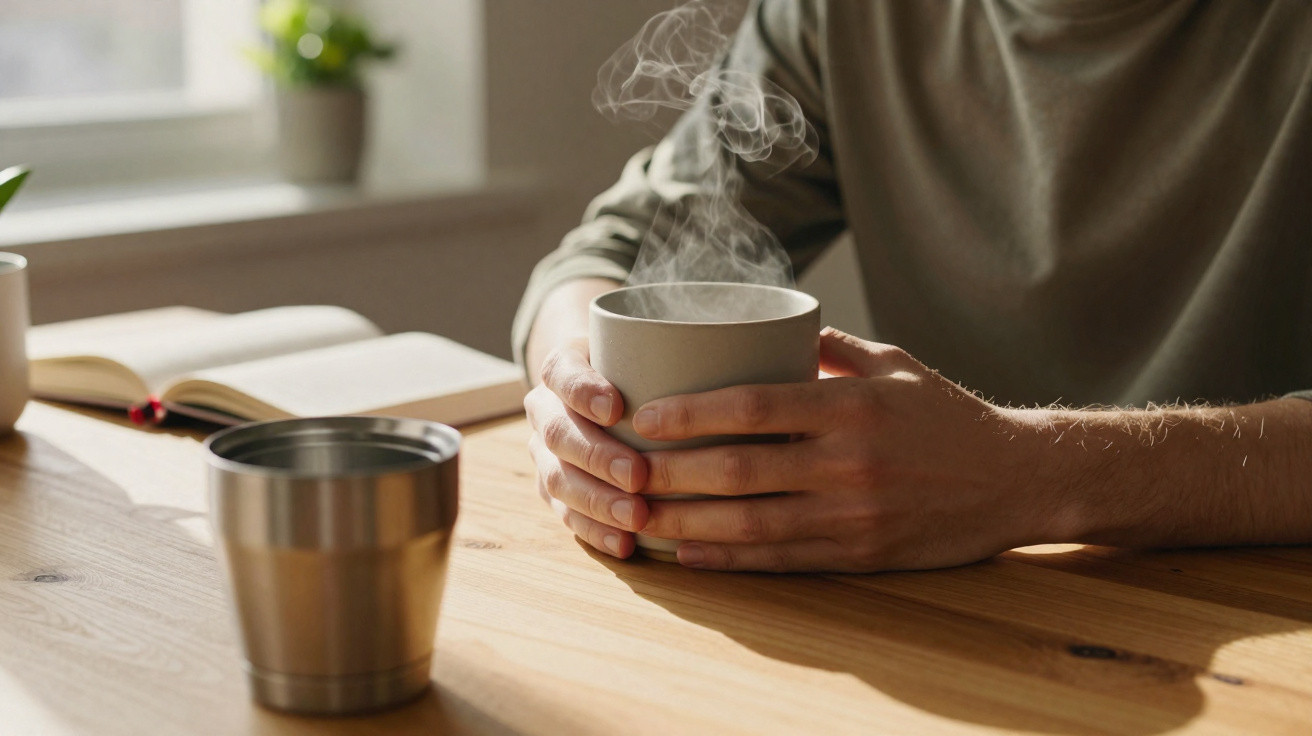
Someone picked up a sleek metal travel cup, dropped in a teabag and returned to their desk within ten seconds. Elsewhere in the room, a colleague remained in the kitchen while their tea brewed in a thick, chipped ceramic mug that sat in their hand like a familiar old glove. It was the same drink: the same teabag and the same boiling water. But their expressions revealed entirely different experiences.
One person drank while scrolling through emails, hardly registering the taste. The other rested against the counter with half-closed eyes, cradling the mug’s weight in both hands as though it steadied them. Their shoulders seemed to soften and their breathing appeared to slow.
The tea was identical, but the experience was not.
The quiet power of a heavy mug
There is something unexpectedly stabilising about curling your fingers around a weighty ceramic mug. Its heft draws attention away from racing thoughts and back into the body. You notice the heat in your palms, the edge beneath your fingers, and your brain seems to register almost automatically: “You’re here. You’re safe for a minute.”
A lightweight travel cup rarely creates the same effect. It is designed for motion, speed and drinking while on your feet. A mug, particularly one that is solid and a little ungainly, encourages you to pause. To sit down. To take a small stretch of time that has not been booked into your diary.
It is a modest ritual that quietly tells your nervous system to slow down.
At one London co-working space, a psychologist discreetly replaced the office-branded paper cups with thick, mismatched ceramic mugs from a charity shop. They were not fancy or Instagrammable, simply substantial mugs with a few cracks in their glaze. Within a week, she noticed an unexpected change: fewer people wandered the corridors holding drinks. More people sat around the kitchen table chatting quietly, or spent three peaceful minutes looking out of the window before returning to Slack.
When she later raised the change during a workshop, several people expressed the same feeling in different ways: “I don’t know why, but my tea break feels more like an actual break now.” Flavour was not the first thing anyone mentioned. Instead, they described feeling supported, more present and less like a notification with legs.
There was no survey or large-scale study, only a subtle shift in behaviour prompted by the weight of a mug.
Research into embodied cognition suggests that physical sensations can influence mental states. Holding a heavy object may lead us to see things as more serious or meaningful. Warm hands can evoke feelings of social warmth and trust. Put warmth and weight together in one object, and you have a surprisingly effective psychological aid waiting in the kitchen cupboard.
A light, sealed travel cup communicates efficiency and movement. It keeps tea warm, but it can also keep you in “go mode”. A ceramic mug conveys something quite different: a pause, presence and perhaps even a small sense of ceremony. Your brain picks up these signals before your conscious thoughts have time to catch up.
You are not merely drinking tea. You are holding a prompt that tells your nervous system that you are allowed to rest, even if only for five minutes.
Turning tea into a grounding ritual
If you would like to notice the difference, try a simple experiment. Tomorrow, select the heaviest ceramic mug you own. Once you have poured your tea, hold it with both hands for the first ten seconds. Do not scroll or read. Simply notice the heat moving through the ceramic, into your fingers and up your forearms.
Allow its weight to lower your shoulders slightly. Pay attention to how its rim meets your lips differently from a thin travel cup. Take one unhurried sip and genuinely taste it, even if you must return to chaos immediately afterwards. You do not need an hour-long tea ceremony; you need one honest minute of contact with that mug.
When repeated, that one minute can become a mental doorway your brain learns to recognise.
Many people promise themselves that they will begin a perfect mindfulness routine “when things calm down”. Realistically, life seldom settles down without help. That is why habits tend to stick more effectively when they are linked to something you already do, such as drinking tea or coffee.
The heavy mug gives that habit a physical point of reference. You begin to connect its weight with turning your attention inwards, even for a moment. On some days, you may manage ten mindful sips. On others, you may take one before a Teams call interrupts you. Let’s be honest: nobody really does this every day.
The aim is not perfection. It is to create a small, slightly scruffy ritual that is workable in a noisy and distracted life.
Psychotherapist Lina Morris explains it simply:
“When a client says they feel like their life is running away from them, I don’t start with big lifestyle changes. I start with one object. A cup, a mug, something they can literally hold onto. The body learns safety before the mind believes it.”
The idea may seem minor, yet it can be remarkably helpful during everyday moments of stress. Here is a quick guide to using time with a heavy mug as a mental reset:
- Choose one “anchor mug” that you use solely for your calming break.
- Set aside 60–90 seconds without a screen each afternoon while holding it.
- Notice three elements: its weight, its warmth and the first sip.
- If your thoughts begin to race, bring your attention back to the sensation of the mug in your hands.
- Keep the ritual loose and adaptable rather than perfect and rigid.
Why this small choice matters more than you think
On the face of it, it is only tea and only a mug. Yet this choice can gently alter how you experience your day. In a world that constantly presses you to move faster, a heavy ceramic mug encourages the opposite. It can feel like a small, quiet rebellion against being permanently “on”.
You will still reply to emails, commute and manage children, clients and household tasks. But for a few minutes, your nervous system receives a different message: one that is slower and kinder. Your body recalls what it feels like not to be hurried, even within a packed schedule.
That recollection may shape the way the rest of the afternoon affects you.
Once you begin looking for it, you may spot the same pattern elsewhere. The things that soothe you are seldom the lightweight, efficient, productivity-focused objects. They tend to have weight, texture and a sense of history: a well-used notebook rather than a notes app, a physical book rather than a glowing display, or a ceramic bowl instead of a plastic container eaten from while standing at the kitchen counter.
Such objects do more than perform a practical task. They carry an atmosphere and a story. Sometimes, an entire chapter of your life can be contained in one chipped mug. Drinking from it may feel like checking in with an earlier version of yourself who got through other stressful days, long winters and difficult meetings.
That quiet sense of continuity can be a form of therapy in itself.
So, the next time you reach for a cup, pause for a fraction of a second. Ask yourself one small question: do I want to keep moving while I drink this, or settle somewhere for a moment? Neither answer is wrong. A travel cup is excellent when you are late, changing trains or pushing a buggy with one hand.
However, when you need grounding rather than speed, a heavy ceramic mug may be doing much more psychological work than it is given credit for. It offers your hands something solid, your mind something gentle and your day a small island of slowness that requires no app, retreat or wellness budget.
Sometimes, mental health begins with something as straightforward as the way your tea feels in your hand.
| Key point | Detail | Benefit for the reader |
|---|---|---|
| The mug’s weight grounds the body | A heavy mug directs attention towards physical sensations, helping you step out of “autopilot” mode. | Understand why holding a mug can ease stress within seconds. |
| The ritual creates a pause signal | Always using the same mug for a short break teaches the brain to link the object with calm. | Turn an ordinary habit into a moment of mental recovery. |
| A “slow” object in a fast world | Heavy ceramic sends the opposite message to the urgency associated with disposable cups and travel cups. | Reclaim a small space for slowness in a busy day. |







Comments
No comments yet. Be the first to comment!
Leave a Comment