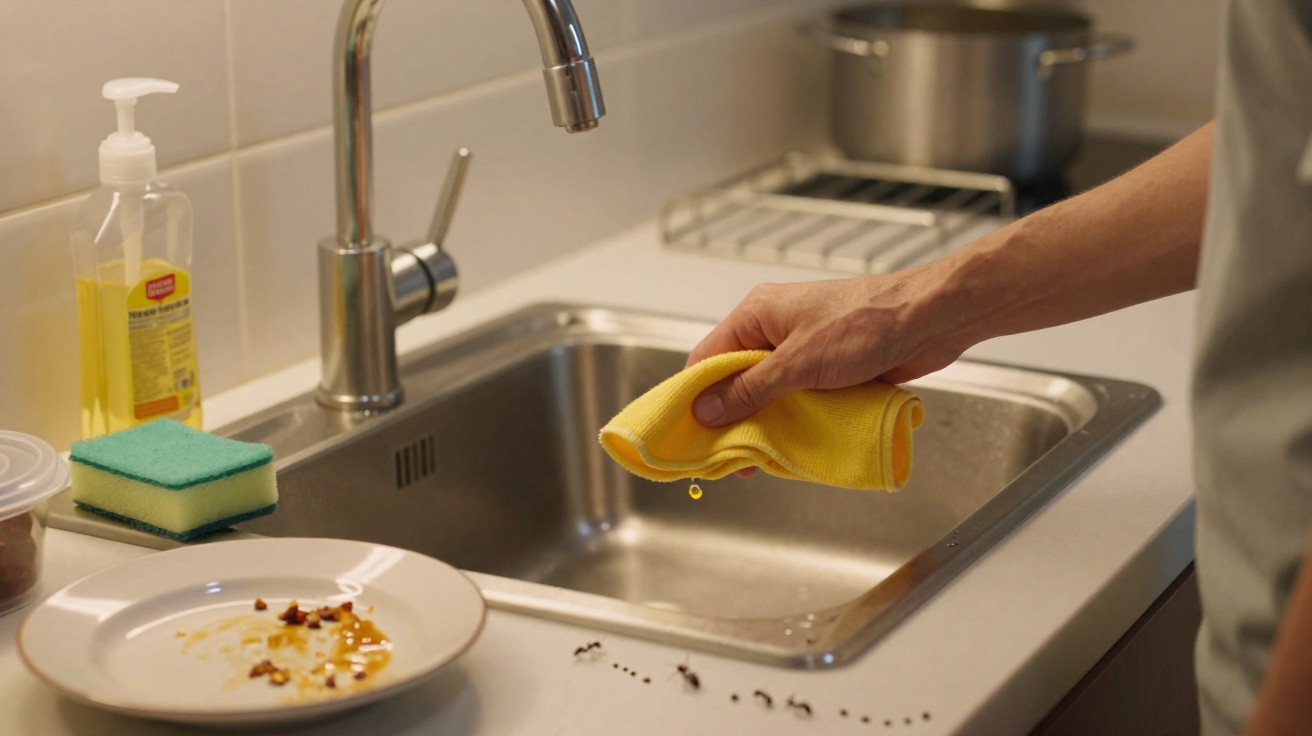
The kitchen is dark after a long day, with the final light switched off. Plates are piled up, the worktops have been wiped “more or less”, and the fridge’s familiar hum fills the quiet. Someone lets a glass fall into the sink with an unhurried clink, says, “I’ll deal with it tomorrow”, then leaves.
At first glance, the room looks presentable. There is no glaring mess, no mountain of overflowing rubbish and nothing that would look dreadful on Instagram.
A few hours later, as everyone sleeps, the real visitors appear. Fine antennae probe the air, glossy bodies emerge from gaps, and unseen scent trails become highways.
They have been invited.
By one extremely common evening habit that nearly everyone has - and hardly anyone suspects.
The quiet nighttime ritual insects love
When people think about what draws pests indoors, they usually picture crumbs on the floor or a full bin. Often, though, the real trigger is much less obvious.
It is the practice of giving dishes “just a quick rinse”, then leaving food-streaked plates in the sink or soaking in cloudy water until morning.
From a distance, this seems harmless. The worst mess has gone, the dishes are neatly stacked and the tap is turned off. Your brain labels the kitchen as “basically done”. For ants and roaches, however, the sink resembles a glowing buffet sign in the darkness.
Imagine it is 11:43 p.m. The house is quiet and the sink holds dishes that are “just soaking”. The water has a slight greasy sheen, a few grains of rice drift across the surface, and a streak of tomato sauce remains around a plate’s edge. You have decided that the dishwasher can wait until morning.
At about 2 a.m., scouts come out. Ants track even the faintest trace of sugar or starch. Roaches are attracted by moisture, warmth from nearby pipes and the protection offered by a deep steel basin. One after another, they make their way in, concealed by the sink’s tall sides.
By dawn, the feast has finished. They have eaten, retreated and left microscopic traces that call in more of their companions.
This is not an unusual scenario. Pest-control companies repeatedly make the same observation: a damp, dirty sink left overnight is one of the strongest indoor lures for ants and roaches.
As the hours pass, moist food residue starts breaking down and gives off stronger odours, particularly in warm kitchens. You may not notice the smell, but their tiny sensory receptors do.
Roaches are especially attracted to a combination of conditions. Food + water + a dark, enclosed space? That is classic roach heaven. Ants are drawn to the sugars, fats and starches dissolving invisibly in what merely appears to us as “a bit of dirty water”.
While you sleep, then, your sink is quietly advertising itself as the safest free restaurant in town.
How to stop inviting ants and roaches without becoming a cleaning fanatic
The answer is not turning into someone who cleans grout with a toothbrush at midnight. It is simply about changing one routine: do not let the sink become an overnight food spa.
Wash or load the dishes as soon as dinner is over, or at least scrape and dry them. If exhaustion has set in, do a 90-second reset instead: scrape leftovers into the bin, run hot water, give the sink a quick wipe with a sponge and drain everything.
The aim is not perfection. It is removing both food left standing and water left standing. A sink that is dry and reasonably clean is far less appealing to ants and roaches.
Even when the worktops are not spotless, a “closed” sink gives a very different message to anything crawling about in the dark.
Many people assume, “I rinsed it, so it’s fine.” In reality, the thin, invisible coating left on pans and plates still has a powerful smell for pests. Piling them in a damp stack also traps the moisture they enjoy.
Another familiar mistake is leaving pans to soak “until tomorrow”, with a little washing-up liquid but plenty of food still floating in the water. Soap does not remove the odour; it only makes the water appear cleaner to us.
On an exhausting weekday evening, some understanding is important. You have cooked and eaten, perhaps dealt with children or emails too. A cleaning lecture is the last thing you need. Instead, stick to the smallest realistic rule: do not leave food-filled water in the sink overnight, and keep wet, dirty surfaces to a minimum.
Let’s be honest: nobody truly manages this every day. But changing what you do on most evenings already alters the balance.
“Think of your sink as the front door to your insect problems,” explains a seasoned pest technician I spoke with. “If you keep that door dry and boring, most of the time they won’t even bother knocking.”
The key is to attach this task to the evening routine you already have. It could happen after you brush your teeth or immediately before you turn off the kitchen light. A modest ritual you can repeat is more useful than occasional heroic deep cleans.
- Scrape food into the bin or compost, rather than into the sink.
- Avoid soaking items overnight: use hot water and a quick scrub instead.
- Wipe the sink basin and plughole, leaving them as dry as reasonably possible.
- Run the waste disposal unit, if you have one, then flush it with hot water.
- Keep a basic sponge-and-washing-up-liquid pair visible to make the job easier to start.
The wider impact of one small change
Once you spot this sink habit, it becomes easier to notice how many “I’ll do it tomorrow” choices welcome tiny visitors into the home. An open cereal box, a ring of jam left unwiped or a tied rubbish bag that has not been taken outside: none feels significant at the time.
For ants and roaches, though, they are like the breadcrumbs in a fairy tale, leading straight into your private spaces.
It is striking how quickly things can change when people adjust just one evening behaviour. A cleaner, drier sink night after night often goes alongside fewer unexplained crumbs on the worktop in the morning and fewer insects scuttling away when the light comes on.
At a deeper level, that single adjustment can feel like reclaiming control in a room we use every day, often while only half-awake and distracted.
We rarely discuss this socially. Nobody casually says at brunch, “Yeah, the roaches love my sink water.” As a result, the issue remains hidden behind embarrassment or silence, despite being common in flats, older homes, warm climates and student accommodation.
We scroll through photographs of immaculate kitchens and quietly wonder why our own space always feels… slightly invaded.
Changing your sink routine is not about meeting an aesthetic standard. It is about having fewer tiny witnesses to your 1 a.m. snack.
It is a brief, almost dull action, yet its effect continues through the night long after you have switched off the final light.
On an emotional level, the late-night kitchen is often where everyday life becomes visible. There is the half-eaten toast left on a plate, the empty pasta pan soaking in cloudy water and the mug with a tea ring that you “might reheat later”.
We have all had that moment when we look at the day’s quiet chaos and decide to ignore it for a few more hours.
Moving from “I’ll leave it” to “I’ll just reset the sink” will not magically solve everything. But it can create a small, quiet act of care for tomorrow’s version of yourself.
Perhaps that is why this habit deserves some thought: not only because of ants and roaches, but because of what it suggests about the kind of home you are gradually creating, one late night at a time.
| Key point | Detail | Why it matters to the reader |
|---|---|---|
| Overnight “soaking” attracts pests | Dishes left soaking or stacked while damp create a mix of food + water + darkness | Understand why ants and roaches keep returning despite a “reasonably” clean kitchen |
| The evening sink reset | Scrape, rinse quickly, empty and dry the basin as much as possible | A straightforward step that is manageable even when tired and greatly reduces the area’s appeal |
| Change one habit rather than your entire lifestyle | Perfection is unnecessary; simply avoid leaving stagnant water full of food residue overnight | Feel more in control of your kitchen without becoming obsessed with cleaning |








Comments
No comments yet. Be the first to comment!
Leave a Comment