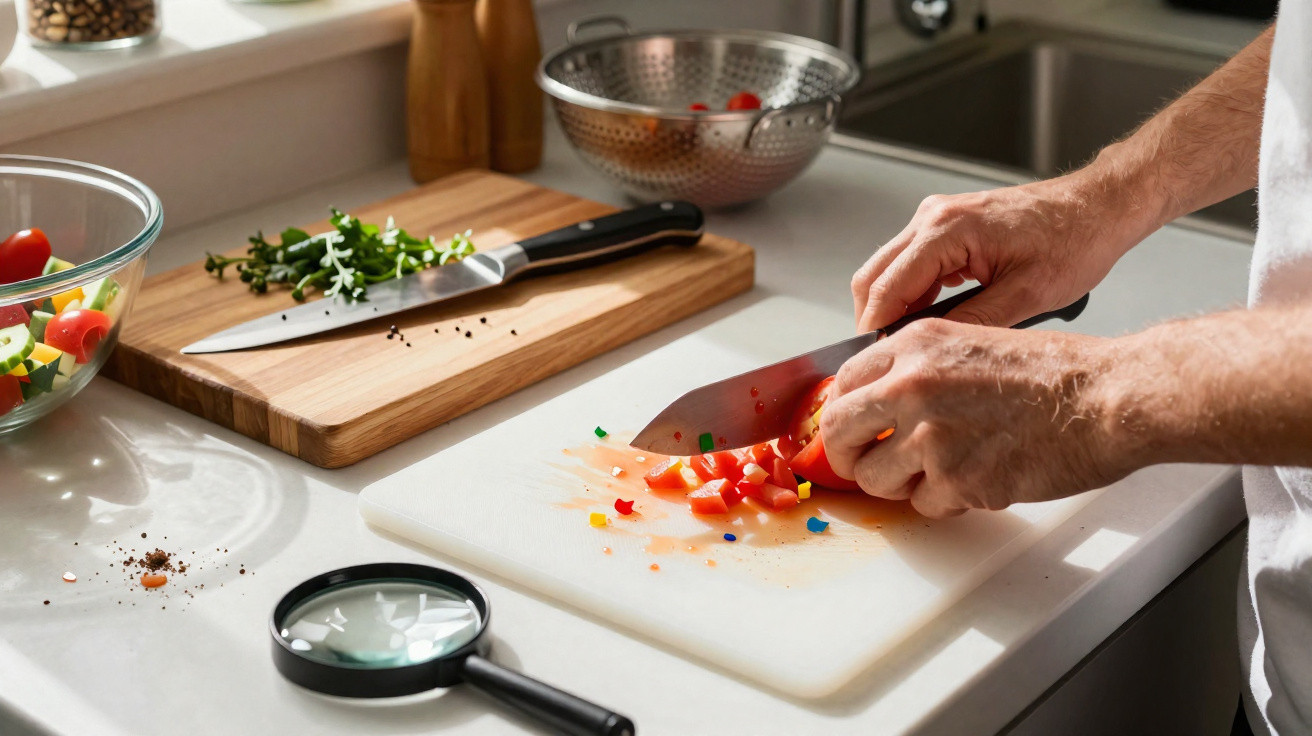
In the rush of everyday life, few people realise that a routine action in the kitchen may scatter invisible particles across their meal.
Cutting boards, found in almost every home, have become the focus of research connecting their use with another source of contamination: microplastics that can move from the worktop straight into the body.
Plastic cutting boards under scrutiny
Plastic cutting boards became popular in kitchens because they are light, inexpensive and easy to clean. They can go in the dishwasher, do not warp and appear to last for years. Over time, however, their surfaces become covered in knife marks. Every cut may mean a little more plastic being released.
Research referenced by organisations such as the Norwegian Institute for Water Research indicates that tiny fragments can detach from a board with every cut. The tougher the food, the more force is applied with the knife and the greater the wear on the material. Fibrous vegetables, bone-in meat and frozen food all contribute to this damage.
“These pieces are so small that they cannot be seen with the naked eye, but they may end up directly in the food you serve.”
The situation can be more serious in professional kitchens, where boards are used throughout the day, washed with hot water and strong cleaning products, and assigned different tasks several times daily. Under these conditions, the release of particles is likely to be higher still.
Microplastics on the plate, in the blood and in organs
The fragments released by cutting boards are part of a much wider issue: the growing presence of microplastics in the environment and in the human body. Studies reported by international science outlets have identified these particles not only in the digestive system, but also in blood, the liver, kidneys and even human bones.
Scientists are investigating how this material interacts with cells. One theory is that microplastics may cause persistent inflammation, a form of silent irritation that continues for years. Another area of research examines whether chemicals associated with plastic could affect hormones or the function of particular organs.
“There is no agreement on which dose represents a genuine risk, but the fact that plastic can pass through the body already raises a public-health warning.”
It is worth remembering that cutting boards are only one part of the equation. Plastic spatulas, spoons, containers, lids and heated packaging also add to the problem, especially when they are subjected to constant friction or high temperatures.
Other utensils that can release particles
Plastic is everywhere in the modern kitchen, and certain items deserve particular attention:
- Plastic spoons and spatulas used in very hot pans.
- Plastic containers put in the microwave or used for food straight from the hob.
- Cheap utensils made from more fragile plastic that crack or fade easily.
- Flexible packaging that comes into direct contact with hot or fatty food.
Researchers suggest keeping these objects only while they remain intact, without cracks, rough edges or distortion. When replacing kitchen equipment, it is worth favouring more stable materials such as wood, glass and metal.
Wood, metal or glass: which cutting board should you choose?
No material is flawless, but some perform better than plastic when it comes to releasing particles. Organisations including the Norwegian Veterinary Institute regard wood as a safe alternative, provided it is properly maintained.
A basic comparison of the most common materials can help when buying a board:
| Material | Advantages | Points to consider |
|---|---|---|
| Plastic | Light, inexpensive, dishwasher-safe, available in many colours | Releases microplastics during use, scratches easily and retains odours |
| Wood | Kind to knives, pleasant to handle, natural origin | Needs prompt drying and may stain or warp if poorly cared for |
| Glass | Does not absorb odours, easy to clean hygienically | Very hard surface, may break and can damage knife blades |
| Metal/titanium | Highly resistant, long-lasting | Blunts knives and feels less comfortable when cutting |
With wooden boards, maintenance makes all the difference. Washing with water and mild washing-up liquid, drying the board upright away from intense heat, and occasionally applying a little food-safe mineral oil will help extend its lifespan.
How to reduce microplastic intake in the kitchen
There is no perfect cutting board, but a few straightforward habits can significantly reduce daily exposure to plastic particles:
- Replace plastic boards that are heavily scratched, warped or discoloured.
- Use separate boards for meat and vegetables to prevent cross-contamination.
- Avoid cutting food that is still frozen on plastic boards.
- Do not place hot pans directly on plastic surfaces.
- Choose wood or glass when replacing utensils.
- Cut down on using plastic containers in the microwave, favouring glass instead.
“Changing the material is only one step; how a board is used and maintained directly affects the amount of particles it releases.”
Common mistakes when using cutting boards
Using the same board for everything
Microplastics are not the only concern: there is also a microbiological risk. Using one board for raw meat, vegetables and ready-to-eat food increases the likelihood of contamination by bacteria such as Salmonella and Campylobacter. Ideally, there should be at least one board exclusively for meat and another for vegetables and food ready to eat.
Failing to inspect the surface condition
Deep grooves act as small hiding places for food residue and micro-organisms, making them difficult to remove during a quick wash. Wear is also concentrated in these cracks, encouraging the release of particles.
Excessive exposure to heat
Very hot water, ovens and microwaves speed up the ageing of plastics, making them more brittle. In time, the board loses its original structure and can begin to crumble without the user noticing.
What it means in practice to live surrounded by microplastics
The term “microplastics” refers to plastic particles smaller than 5 millimetres. Many are so small that they can only be seen under a microscope. There are also “nanoplastics”, which are smaller still and may cross biological barriers more easily.
Consider a typical person's day: coffee from a capsule, food heated in a plastic container, water from a disposable bottle, vegetables chopped on a plastic cutting board. At every stage, an invisible quantity of particles may be swallowed or inhaled. On their own, the amounts may be small. Added together over years, they create continuous exposure.
For this reason, the approach suggested by specialists is to reduce the build-up. As with salt, sugar or fat, it is worth cutting unnecessary sources of plastic that come into contact with food. Every substitution, however minor it may seem, eases the pressure on this daily exposure “budget”.
Small changes with a long-term impact
Replacing a badly worn plastic cutting board with a well-maintained wooden one will not eliminate microplastics from modern life. It does, however, reduce a direct, everyday and tangible source of intake. The same applies to giving up the habit of heating food in old or scratched plastic containers.
For anyone setting up a kitchen, a simple approach is to plan utensil purchases with these factors already in mind: a small number of boards, made from good materials, each with a clearly defined use and properly maintained. For those whose kitchens are already full, reviewing the most worn-out items can be a first step towards reducing this “invisible plastic” on the plate.






Comments
No comments yet. Be the first to comment!
Leave a Comment