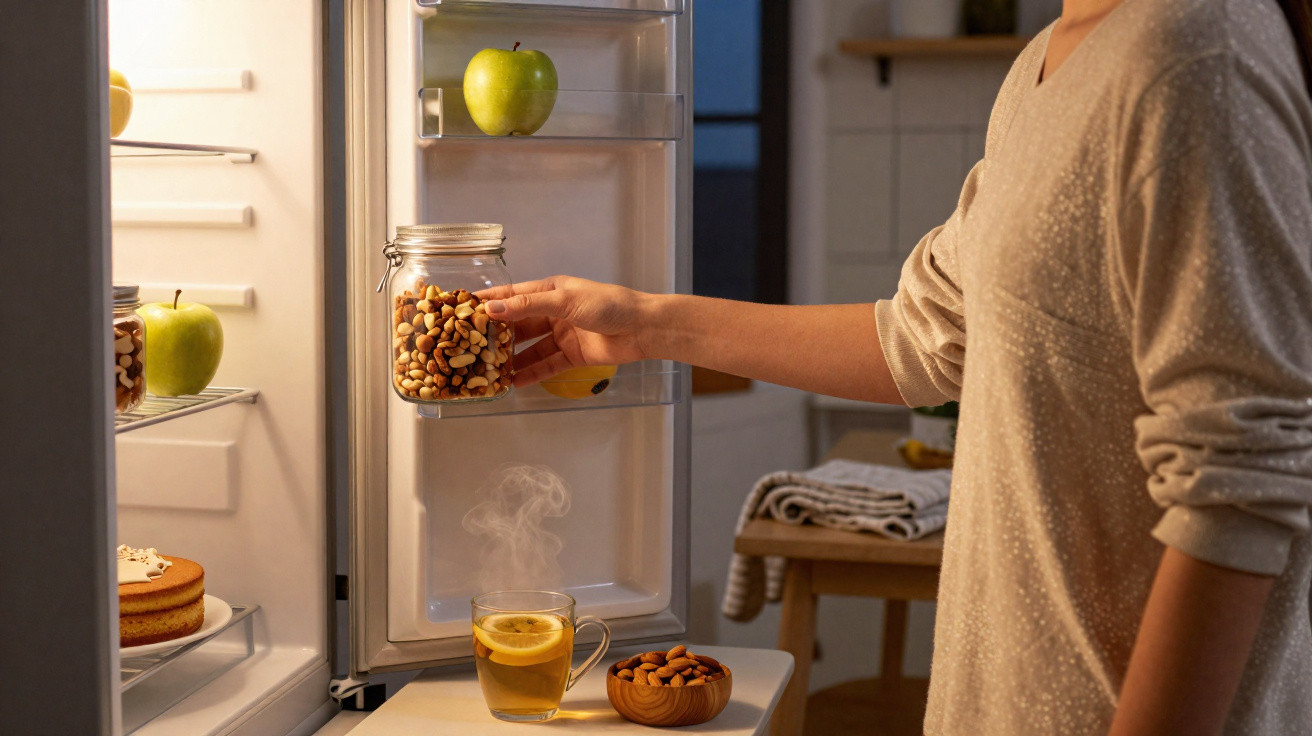
The clock reads 10:47 p.m. Dinner plates are still drying beside the sink. Two hours ago, you insisted you were “so full”. Now, though, you are drawn to the fridge light like a moth, looking from the yoghurt to the cheese, then to the leftover pasta that you definitely do not need to eat.
Your stomach makes a faint noise, more of a prompt than a genuine crisis. You know you are not actually starving: you have eaten and you are all right. Even so, the idea of having “just a little something” keeps returning, becoming harder to ignore each time.
Is it hunger? Stress? Or does Netflix autoplay somehow make crisps more appealing? Late-night hunger operates by its own rules and seldom seems sensible. Oddly, it is not simply a matter of what is going on in your mind.
Why your body wants food when your brain knows you’ve eaten
Late-night hunger can creep up without much warning. You are on the sofa, scrolling through your phone or watching a programme, when a gentle rumble appears in your stomach like an unwanted visitor. You recall eating a proper evening meal, perhaps followed by pudding, yet your body seems to be telling you something else.
This happens so often partly because biology is fairly predictable. As night falls, your hormones begin to change. Melatonin increases, signalling that it is time to settle down. Ghrelin, the hormone that drives appetite, can rise if your meal was too small, rushed or high in sugar. The outcome is a brain quietly saying, “Go get something,” despite your rational mind disagreeing.
Emma, 34, experienced precisely this battle one Tuesday evening in her small London flat. At 7:30 p.m., she had eaten a large bowl of pasta, described it as “carb heaven”, and promised herself that she would not snack. By 11 p.m., she was drowsy on the sofa with her hand in a packet of cereal bought “for breakfast only”. When she later looked at her smartwatch, it showed disrupted sleep, a rise in her heart rate around midnight, and she woke feeling heavy rather than refreshed.
Versions of Emma’s story are common; only the snack tends to change. Surveys indicate that many adults regularly eat after 10 p.m., even after a filling dinner. Eating late at night is associated with greater overall calorie consumption, stronger desires for sweet and salty foods, and frequently lower-quality sleep. The important point is that these snacks do not usually stem from hunger alone. Habit, exhaustion and emotion can all disguise themselves as appetite.
From a biological perspective, your body works to a 24-hour rhythm that affects its hunger cues. When blood sugar rises and falls sharply after dinner, perhaps following a large serving of refined carbohydrates or pudding, your brain can read the later drop as: “We’re running out of fuel, go eat.” Meanwhile, stress hormones such as cortisol may remain high well into the evening, particularly after a busy, demanding day. Together, these factors can make it difficult to distinguish physical hunger from “I just want to feel better.” Your body isn’t broken; it’s responding to the inputs you gave it. The key is recognising the signals and reshaping the routine with healthier choices.
Natural ways to calm late-night hunger before it starts
One of the most overlooked answers starts several hours before you first feel sleepy: with dinner. A meal containing protein, fibre and healthy fats helps keep blood sugar more stable and leaves you satisfied for longer. Consider grilled chicken or lentils, plenty of vegetables, and a fat source such as avocado, olive oil or nuts.
When your plate mainly consists of white pasta, bread or takeaway noodles, the rapid burst of energy may lead to more cravings once it fades. A straightforward adjustment can make a difference: serve a side salad dressed with olive oil, replace half of the refined carbohydrates with wholegrains, or add beans, tofu or fish. This means your body is less likely to demand a rescue snack three hours later. You are not “lacking willpower”; you may simply have been under-fuelled in the ways that count.
There is also real value in a planned “anchor snack”. This is not a chaotic, cupboard-raiding snack, but one selected calmly in advance. For example, you could decide that if you are still awake at 9:30 p.m., you will eat a small bowl of plain yoghurt with berries or one slice of wholegrain toast with peanut butter. After noticing his nightly trips to the biscuit tin, a father of two tried this approach during a busy Wednesday. Within a week of choosing yoghurt and almonds in advance, his 11 p.m. sugar binges had almost disappeared. Planning removed the sense of drama, while his sleep became deeper and more consistent.
Late-night hunger is not solely about food; it can also reflect an overstimulated nervous system. If your mind is still buzzing from emails, news or doomscrolling, “eating something” may feel like the quickest way to turn down the volume. Simple, natural routines can therefore help your body change pace. Even a 10–15-minute walk after dinner supports digestion and helps blood sugar follow a steadier course. Warm herbal tea, such as chamomile, peppermint or lemon balm, can offer a gentle cue: “The kitchen is closing soon.” Let’s be honest: nobody really does this every day. Still, doing it on most evenings may be enough to gradually alter the pattern.
“Ask yourself, ‘Would I eat a plain bowl of oats right now?’ If the answer is no, it’s probably not true hunger. It’s something else asking to be heard.”
- Set a “kitchen closing” time, after which you have only water or herbal tea.
- Follow a satisfying dinner formula: protein + fibre + healthy fat.
- Create an evening ritual: lower the lights, stretch for 5 minutes and breathe slowly.
- Pick one soothing, pre-planned snack if you genuinely stay up late.
- Store tempting ultra-processed snacks out of easy reach and out of your line of sight.
Rethinking hunger, comfort, and those quiet hours at night
On a deeply human level, late-night hunger often surfaces once the home has finally become quiet. The children are asleep, the laptop is closed and the roles of the day are temporarily on hold. That stillness may feel freeing, but it can also feel uncomfortable. Food then becomes a mild distraction. After a difficult day, it can even seem like a modest reward: “I made it through. I deserve this.”
When the day has gone well, replacing that automatic snack with another activity can be surprisingly effective. Instead of a bowl of cereal, you might choose a hot shower, read a few pages of a book or stretch briefly on the living-room floor. On a hard night, the alternative will not feel magical; it may feel awkward and unnatural. Yet every time you offer your body another way to unwind, you weaken the reflex that translates “tired and wired” into “must eat”. Given enough time, habits can shift quietly in this way.
More broadly, we are surrounded by late-night triggers: endless streaming, 24/7 food delivery, blue-lit screens and a culture that prizes constant effort over rest. Individually, you are one person trying to manage all of this with a real nervous system, real cravings and an actual life. Advice appears neat and straightforward on a screen. In a kitchen at 11:23 p.m., it can feel far less tidy. You might scroll past this on your phone and forget it, but every small choice communicates something to your body. Night after night, you can choose what kind of message it receives.
| Key point | Detail | Benefit for the reader |
|---|---|---|
| Stabilise dinner | Include protein, fibre and healthy fats to reduce blood sugar spikes. | Reduces late-evening hunger and sugar cravings. |
| Evening routine | Take a short walk, drink herbal tea, soften the lighting and breathe slowly. | Calms the nervous system and breaks the “evening = snacking” association. |
| Pre-planned snack | Choose a simple, non-ultra-processed snack in advance. | Prevents impulsive overeating and helps maintain control without frustration. |













Comments
No comments yet. Be the first to comment!
Leave a Comment