Key takeaways
- Dismissed in the wake of the film Sideways, Merlot is steadily recovering its standing as leading producers from Napa to Bordeaux and Bolgheri demonstrate its depth, structure and refinement.
- Winemakers are reshaping opinion through blind tastings and by planting Merlot in Napa’s finest soils, rather than regarding it as subordinate to Cabernet Sauvignon.
- From Château Lafite Rothschild’s new Merlot-led Anseillan to La Côte Lascombes in Margaux, even Bordeaux estates best known for Cabernet are reinforcing Merlot’s status among the world’s great wines.
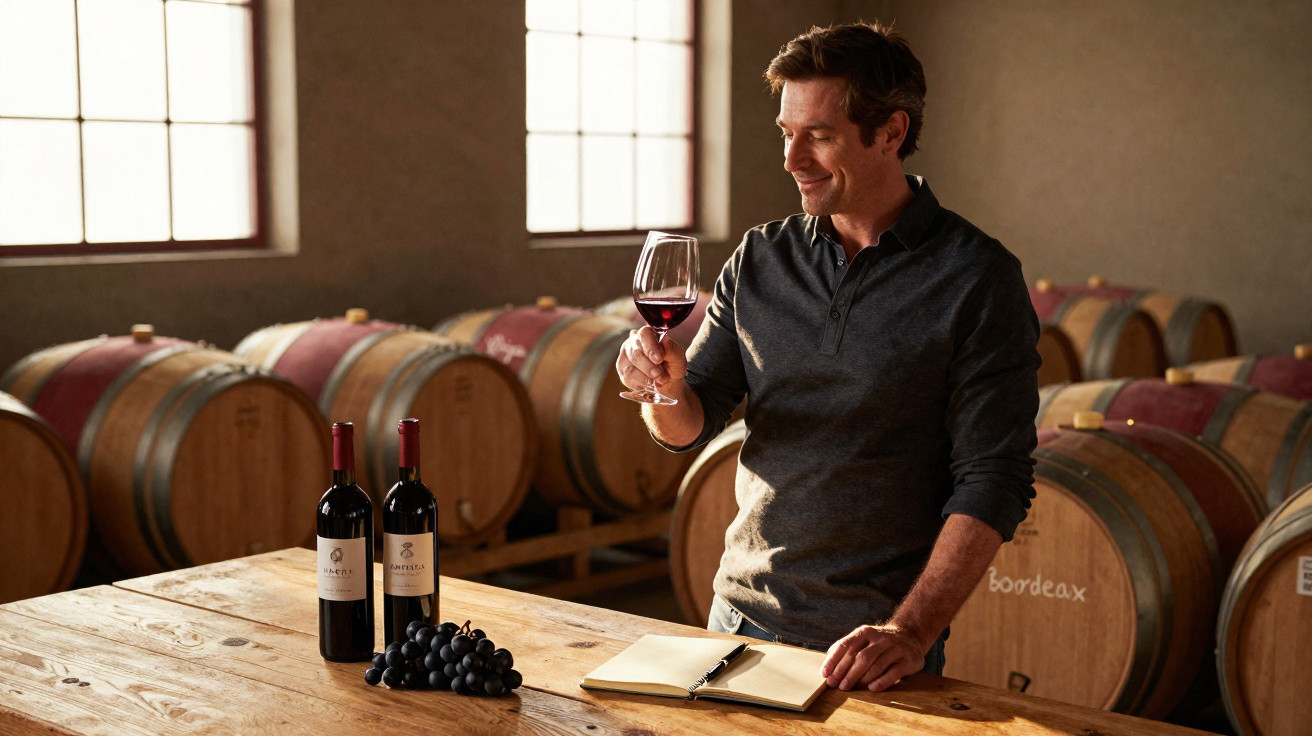
In 2004, one line in a film achieved what neither poor harvests nor a market collapse had managed: it almost destroyed an entire wine category. Following Sideways, Merlot became a byword for the supposedly unsophisticated side of American wine culture, and much of the trade went along with it. Two decades on, committed producers are making the case for it again. At Sullivan Rutherford Estate in Napa, winemaker Jeff Cole does so through blind tasting, one glass at a time.
On the table are three unidentified glasses of 2018 Merlot: one from Pomerol in Bordeaux, another from Bolgheri in Tuscany, and the third from Rutherford Estate’s vineyards. Cole does not initially disclose their origins. The message, however, is significant: Merlot belongs in the company of regions where it has long been celebrated. There is no plea to “save” the variety and no excuse for a category that lost its way. Instead, he invites tasters to begin where most wine debates ought to begin: with the contents of the glass. Once they have discussed the wine’s structure, fruit and tannin, he reveals the labels.
In effect, Cole is reminding drinkers that the United States’ uneasy relationship with Merlot is primarily its own issue. In other parts of the world, the grape has never required rescuing.
Some of the world’s most sought-after red wines
In Pomerol, Pétrus is planted exclusively with Merlot on a blue-clay plateau. It has long ranked among the planet’s most profound wines, with a silky, layered character and an almost otherworldly concentration. Elsewhere on the Right Bank, Château Angélus and Château Cheval Blanc have established their identities on Merlot-dominant blends with exceptional depth and capacity for ageing. In Italy’s Bolgheri, meanwhile, Merlot is virtually inseparable from Masseto: a 100% Merlot wine whose price rivals Bordeaux’s greatest bottles and which helped define the Super-Tuscan category on the global stage.
Perhaps the clearest indication that Merlot is returning to the moment comes from a less obvious source. Bordeaux’s Left Bank estates, traditionally centred on Cabernet Sauvignon and long its standard-bearers, are also giving the grape fresh attention.
Château Lafite Rothschild, the first growth whose Pauillac terroir is synonymous with Cabernet supremacy, discreetly launched Anseillan with the 2018 vintage. It is a Merlot-dominant blend and the house’s first wholly new wine for more than a century. At Château Lascombes in Margaux, director Axel Heinz, who spent over fifteen years helping make Masseto one of Italy’s most revered bottles, arrived in 2023 and soon singled out a plot of 60-year-old Merlot. The result was La Côte Lascombes, a 100% Merlot released with the 2022 vintage and priced above the estate’s grand vin. It is no accident that the man who spent almost two decades overseeing Bolgheri’s best-known Merlot has brought the same belief to the Left Bank. As Cole might describe it, this is palate training on a global scale.
Make way for Merlot: its quiet revival in the U.S.
Back in Rutherford, Sullivan’s strategy begins with an unvarnished assessment of how the category encountered its difficulties.
“By and large, the best soils in Napa have been planted with Cabernet,” says Cole. “While the least favorable soils were planted with everything else, including Merlot. So by default, Merlot wasn’t given a chance to excel.”
Sullivan has responded by reversing that approach, recently replacing 3.2 hectares of Cabernet with Merlot and acquiring further land for additional Merlot plantings. The estate is equally committed to its premium positioning, pricing the wine at more than $300.
“We're making an excellent bottle of wine, and we're not going to handicap it by giving in to what the market thinks Merlot should be,” says Cole. “If you're producing excellence, you need to charge excellence.”
Jeff Cole, winemaker, Sullivan Rutherford Estate in Napa
“By and large, the best soils in Napa have been planted with Cabernet. While the least favorable soils were planted with everything else, including Merlot. So by default, Merlot wasn’t given a chance to excel.”
- Jeff Cole, winemaker, Sullivan Rutherford Estate in Napa
Sullivan offers a useful perspective, but Merlot’s wider, understated revival extends beyond a single estate and rests on the work of earlier advocates. Dan Duckhorn of Duckhorn Vineyards, who died on Wednesday, February 25, was among the first to insist that Napa Merlot merited serious attention. Well before the category carried cachet, he made it central to his identity when few others were willing to do so, earning a reputation as the valley’s original champion of the grape.
“Duckhorn stayed committed to Merlot when few believed and invested in its potential here,” says Joshua Lowell, general manager at Sullivan. “His work inspired us to explore just how far Merlot can go, and challenge long-held assumptions by elevating Merlot to its rightful place among Napa Valley’s most serious wines.”
The producers advancing that same case today owe him a debt that is hard to overstate.
Throughout Napa, estates including Whitehall Lane in Rutherford, PlumpJack in Oakville, Matthiasson in the Oak Knoll District and Barnett Vineyards in Spring Mountain District are approaching the grape with comparable seriousness.
The financial figures tell a story of their own. Napa’s 2024 crop report places Merlot third by total value among all varieties grown in the valley, with 10,921 tonnes from 1,422 hectares of producing vines. Its average price per tonne exceeded Chardonnay’s, despite the white variety having more than 850 additional hectares in production. The grape did not truly disappear; it simply ceased to be fashionable to regard it seriously.
At Whitehall Lane, winemaker Jason Moulton makes the argument for fine Merlot through the fundamentals that matter wherever the variety performs well.
“You really do have to start with a great site,” says Moulton. “And the farming needs to be just as impeccable as the terroir in order to ensure that all that pure red fruit is balanced with the savory character that has made it such a serious wine elsewhere.”
The reward, he maintains, is a wine that fulfils a genuine role at the dining table.
“Really well-balanced Merlot offers a sense of discovery that many consumers and collectors are especially interested in right now,” he says.
Steve Matthiasson of Matthiasson Wines agrees with Moulton about the primacy of site. He adds that the “Goldilocks” setting Merlot requires to reveal its full potential needs good drainage without excessive stress, as well as a cooler climate than many people expect. When those elements come together, he says Napa Merlot at its finest provides, “an understated version of Cab-like power, but with fruits, flavors, and texture that delivers more of a caress. But a firm caress, not overly soft.”
For Matthiasson, there is no remedy when the vineyard site is inadequate. “There is nothing that can be done in the cellar to boost up a weak Merlot,” he says.
Changing consumer perceptions of Merlot
That view is shared by those serving wine at the other end of the sale. Steven McDonald, a master sommelier and wine director for Pappas Bros. Steakhouse in Houston and Dallas, has observed shifting attitudes towards Merlot from the position of an award-winning steakhouse, where diners are often open to being challenged.
“The biggest misconception about Merlot is that the grape is only capable of making simple wines,” he says. “However, when it's grown in the soils and climates that give the best expressions, the wines can be transformative.”
For sceptics, McDonald’s reference list includes Château Pétrus, Le Pin, Masseto and, significantly, J.O. Sullivan Founder’s Reserve Merlot.
That final selection is the kind of endorsement suggesting that Cole’s blind tasting in Rutherford may be succeeding on a scale beyond one winery. Merlot’s difficulty was never structural; it was one of perception. The grape has made its argument all along. Drinkers simply need to listen.














Comments
No comments yet. Be the first to comment!
Leave a Comment