The smell of roast dinner still hangs in the air, plates are piled by the sink, and amid the chaos something catches the light dully: Grandma’s old silver cutlery. It ought to look celebratory, yet it has the grey sheen of a November sky. You turn the spoon in your hand, notice the black shadows in its decoration and briefly think: “Right, that’s it – it will never come off.” Then your eyes move to the shelf of cleaning products: brightly coloured bottles, each making a promise, but also carrying a hefty price tag, a sharp smell and plenty of scrubbing. At that moment, someone in the kitchen says: “Wait, just use what’s in the cupboard – it’s much quicker.” It sounds like a trick. And like a small act of rebellion against the cleaning-products industry.
Why tarnished silver bothers us – and secretly moves us
People may disagree about decoration, but tarnished silver cutlery has something almost tragic about it. It sits there, weighty and cool, its fine grooves and ornaments suddenly covered in a grey layer like a bad mood. We all know that moment: you want to lay the table with “something nice” for a meal, only to find that the silver forks look more suited to a car-boot sale than a family celebration. It is never only about metal. There are memories of Christmas dinners, confirmations and weddings wrapped up in it. Silver is never merely cutlery, which is why that dull, dark gleam hits us so directly.
A friend recently told me about a Sunday when everything went wrong. Her cake sank, the roast was too dry, and when she pulled the good silver from the drawer as a last resort, it too was spotted and dull. “I stood there with my black spoon and had a little laugh at myself,” she said. Frustrated, she looked online for advice and ended up on a forum somewhere between marble kitchens and household-remedy enthusiasts. Someone there was praising a kitchen trick that required no expensive specialist cleaner. A before-and-after photograph showed the difference – old on the left, like new on the right. Half doubtful and half hopeful, she gave it a go. Ten minutes later, she put that same fork on the table. And realised that it was not simply about shine: it was about regaining control of her small Sunday disaster.
Silver tarnishes not through some twist of fate, but because of everyday chemistry. The air contains hydrogen sulphide in tiny traces that we cannot see or smell. This gas reacts with silver to create silver sulphide, the dark coating that settles over the metal like a veil. Contact with eggs, onions or certain cleaning products speeds up the process, while heat and moisture add to it. Let’s be honest: nobody polishes their silver every day to prevent this. Yet seeing forks that look as though they have spent years in a drawer can still bring a sense of guilt. The reassuring part is that the layer is not permanent damage: a simple household aid can remove it again.
The kitchen trick for silver with aluminium foil, bicarbonate of soda and hot water
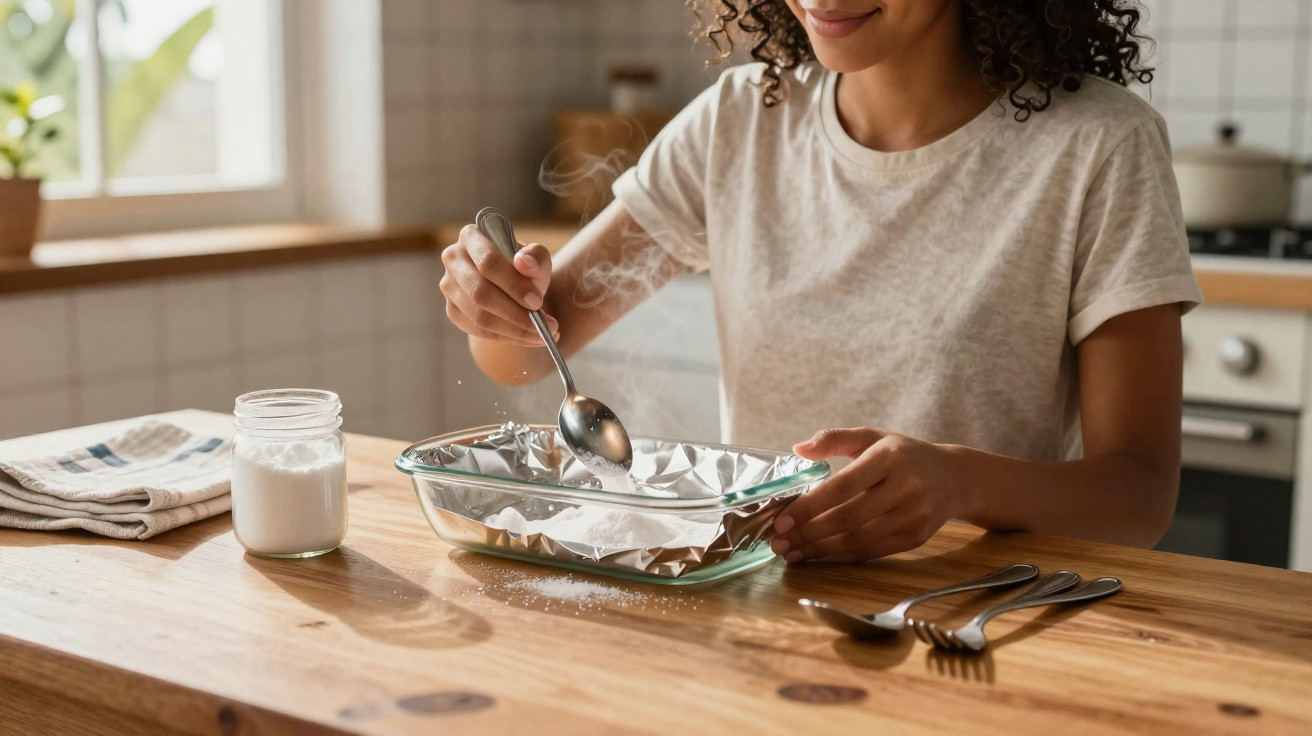
The trick many people quietly use at home is so simple that it almost looks like magic. You need a heatproof bowl or a sink, some aluminium foil, bicarbonate of soda or baking powder, and very hot water. First, line the bowl completely with aluminium foil, ideally with the shiny side facing up. Place the tarnished silver items inside, ensuring that they touch as much of the foil as possible. Sprinkle bicarbonate of soda or baking powder generously over them. As soon as you pour in the hot water, it begins to fizz softly, and you may notice a faint sulphurous smell. Simply leave the silver in place, with no scrubbing required. After a few minutes, take it out, rinse it with clean water and dry it with a soft cloth. A quick rub is often enough to reveal the renewed shine.
However, this silver-cleaning trick can tempt you to overdo it. Once you see how well it works, suddenly the heirloom from 1890 ends up in the same bath as the car-boot-sale cutlery. That is not a good idea. Delicate engravings or soft soldered joins can react badly to abrupt changes in temperature. Anyone handling Grandma’s table silver is entitled to pause for a moment. It is better to test an inconspicuous area first and avoid leaving it in the hot-water bath for too long. Another common mistake is adding half a kilogram of bicarbonate of soda by eye in the hope of a turbo effect. In reality, a thin, even layer spread over the cutlery is enough. And if the silver does not turn out perfectly, that is not a personal failure; it simply means that old scratches and signs of use have already become part of the material.
There are times when a simple kitchen trick feels almost political: a quiet resistance to the idea that every small task requires buying a specialist product.
“I used to have three different brands of silver polish in the cupboard,” says an older neighbour. “Now I use aluminium foil, bicarbonate of soda and hot water. My cutlery looks just as good – and I save myself the smell and the money.”
- Arrange silver items so that they make good contact with the aluminium foil – this contact is crucial to the reaction.
- Always rinse with clean water after the bath so that no bicarbonate of soda residue remains in the pattern.
- Use a soft cotton or microfibre cloth for drying to avoid fine scratches.
- Do not store silver directly alongside stainless-steel cutlery, as this can cause unattractive contact reactions.
- If you set the table only rarely, wrap the silver loosely in tissue paper for storage – this slows tarnishing considerably.
What shining silver reveals about how we treat things
When dusty silver cutlery gleams again, something happens that is only partly about cleaning. What were once “old forks” suddenly become small witnesses to a family history. For a moment, you feel closer to past celebrations and to people who may no longer be sitting at the table, but whose spoon you can still feel in your hand. This kitchen trick using aluminium foil and bicarbonate of soda is then more than a money-saving measure. It is a quiet way of saying “I care” – without much effort or high-gloss perfection. Just a few minutes, a little curiosity and the willingness to give an apparently lifeless everyday object another chance to shine.
| Key point | Detail | Benefit for the reader |
|---|---|---|
| Simple kitchen trick instead of specialist cleaner | Use aluminium foil, bicarbonate of soda/baking powder and hot water to chemically remove the dark tarnish from silver | A low-cost, quick solution using materials that are usually already available at home |
| Careful treatment of treasured pieces | Test delicate or historic silver in an inconspicuous place first and do not leave it in the bath for too long | Protection from unwelcome surprises and preservation of sentimental items such as heirlooms |
| Shine as a ritual rather than a duty | See cleaning silver as a small moment of mindfulness in everyday life, rather than an annoying major task | Less pressure for perfection and more pleasure in using and displaying your own cutlery |
FAQ:
- Question 1 Can I use the aluminium foil and bicarbonate of soda trick on every set of silver cutlery? In most cases, yes, as long as it is genuinely silver or silver-plated cutlery. With very old, delicate or especially sentimental pieces, it is worth testing carefully and, if in doubt, consulting a specialist.
- Question 2 How often can I clean my silver this way? Occasional cleaning is unproblematic; many people do it one to three times a year. If you use the cutlery very often, gently wiping it with a soft cloth between the “baths” is often enough.
- Question 3 Which is better: bicarbonate of soda or baking powder? Both work because baking powder also contains bicarbonate of soda. Pure bicarbonate of soda usually works slightly more efficiently, while baking powder may create more foam, though this does not reduce the effect.
- Question 4 May I use boiling water, or only hot water from the tap? Very hot water intensifies the reaction between aluminium foil and silver sulphide. Many people use water from a kettle. For delicate items, water that has cooled slightly but is still very hot can be both gentler and effective.
- Question 5 Why does it sometimes smell like rotten eggs during cleaning? The smell comes from sulphur compounds that are briefly released as the dark silver layer dissolves. It normally disappears quickly; an open window or an extractor fan is usually entirely sufficient.













Comments
No comments yet. Be the first to comment!
Leave a Comment