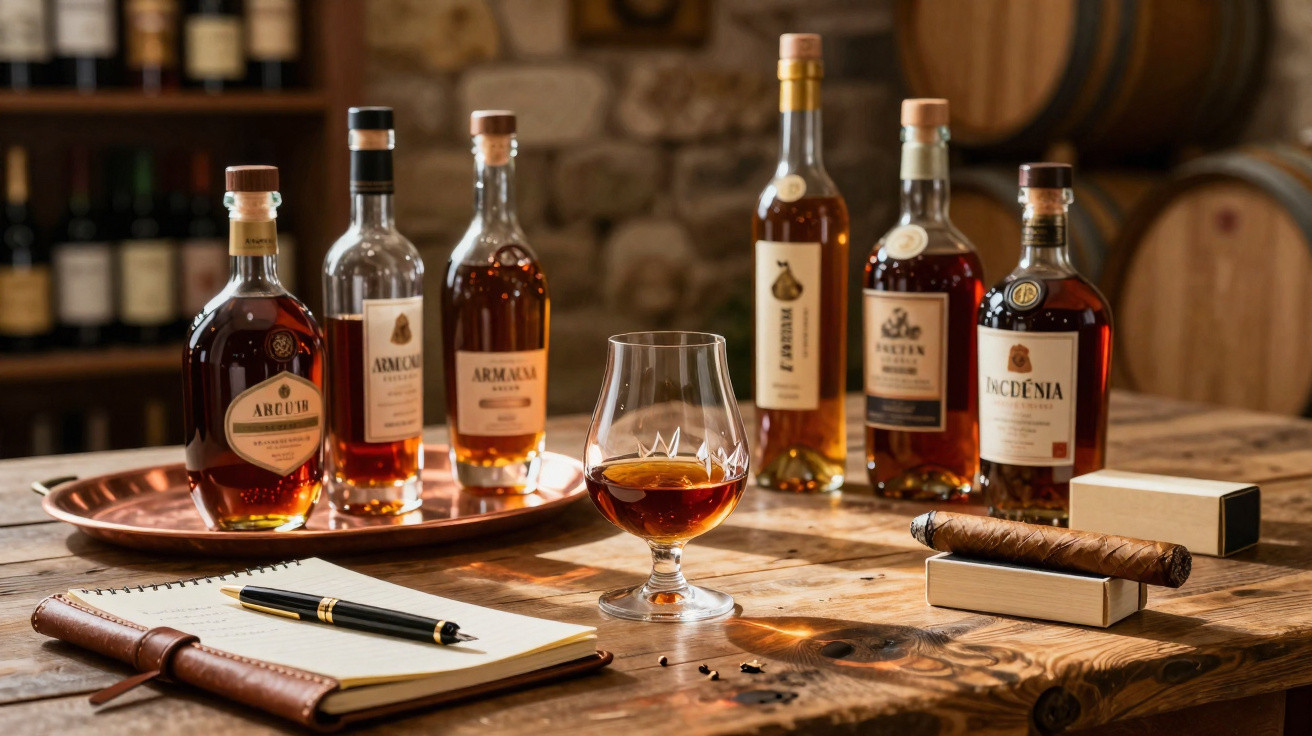
Among its most devoted admirers, Armagnac ranks as one of the world’s most alluring brandies. Beyond those enthusiasts, though, this great French spirit has found it difficult to reach a broader public, particularly in the United States. As The Sopranos viewers may remember, even Artie Bucco saw his $50,000 investment in an Armagnac producer disappear in Season 4; it never became “the next vodka,” as he had forecast.
Armagnac has, however, begun to attract more attention in recent years. That is overdue, given its extraordinary complexity and breadth of aromas and flavours. Raj Bhakta, founder of Bhakta Spirits, has helped introduce the category to a younger generation through his focus on it and by building one of the world’s most extensive collections of very old-vintage Armagnac. He explains: “Armagnac is all about earth, spice, smoke, brioche, dark fruits, dark wood, and nuts.”
“Armagnac is deep, intense, and outspoken. The same is true of Armagnac’s flavor profile, which is vigorous and full of character,” Bhakta says. “Dried figs, tobacco, espresso, roasted meat, plum cake, chestnuts, crème brûlée, Szechuan pepper, iron, and hay. With very old vintages, the flavors just keep going. You can run out of words trying to describe them all.”
Although it is often set alongside Cognac, Armagnac is unquestionably a distinct spirit in its own right. “Where Cognac is smooth, polished, and consistent on the palate, Armagnac is rustic, mercurial, and kaleidoscopic,” says Bhakta. “Rustic in a regal way. Not unrefined, just wild. In a time of increasing homogeneity, Armagnac is unafraid to be itself.”
Paul MacDonald, head bartender at The Lovers Bar at Friday Saturday Sunday in Philadelphia, values the contrast in how the two are made, too. “Cognac has always been a luxury item,” he says. “It’s the drink of aristocracy and royalty, and its production is dominated by huge power players that spread the category’s prestige far and wide. It’s designed to be rich, smooth, velvety, and comforting.” Armagnac, meanwhile, has traditionally been associated with farmers and labourers. Its identity has always centred on small-scale production, craftsmanship and terroir. Armagnacs generally offer more angular, lively profiles, with evident brightness and freshness. “If Cognac is comforting,” Macdonald says, “Armagnac is scintillating.”
For all the pleasure and subtlety Armagnac delivers when drunk neat, it is equally impressive in cocktails. Still, Cognac should not simply be exchanged for Armagnac, since the two are too different for a straight substitution.
“The key here is to avoid treating it like a replacement for Cognac,” MacDonald cautions. “Cognac is like a soft pillow on which a cocktail’s other flavors sit, and Armagnac is more like a channel chiseled into stone: You can decide which flavors to pour into the channel, but it will decide in what direction and shape they’ll flow.”
When the balance is right, though, the outcome can be spectacular.
Take a Vieux Carré: “Replacing Cognac with an older single vintage Armagnac can instantly elevate the drink into something smoky, spicy, brooding, and epic - the full cinematic IMAX experience,” Bhakta notes.
Armagnac may also replace certain whiskies, provided its differences are kept in mind. “A French Manhattan with a well-aged Armagnac single vintage is like an analog surround sound experience of Miles Davis, complexity-wise, while the cocktail with the regular rye might in comparison feel like listening to ‘Never Gonna Give You Up’ by Rick Astley through Spirit Airlines earbuds.”
With apologies to Rick Astley and Artie Bucco, Armagnac is well worth discovering. These six bottles are excellent places to begin.
Château de Laubade, Bas-Armagnac
Dating back to 1870 and committed to sustainability, this producer has long stood out. Ana Paula Moraes, general manager at L’Atelier de Joël Robuchon and Le Jardinier in Miami, says Château de Laubade Bas-Armagnac “Offers elegance and structure, with notes of dried apricot, vanilla, toasted almond, and warm spice. It’s refined, balanced, and consistently high quality.”
Château de Pellehaut Reserve
Château de Pellehaut Reserve combines Armagnacs matured for between nine and twenty years before blending, yet remains notably affordable. Tom Brander, beverage director at Wilder in Philadelphia, observes: ”It is affordable and full of flavor: Distinctively plummy with a generous herbal bite; it is a great base to a cocktail,”
Domaine Boingnères Bas-Armagnac
“This is one of the most compelling traditional producers in Bas-Armagnac, led by fifth-generation producer Martine Lafitte,” Moraes explains. Of Domaine Boingnères Bas-Armagnac specifically, she says it is “Deeply layered, with dried plum, candied orange peel, leather, baking spice, and pronounced rancio. The structure and intensity make it especially well-suited for the richer moments of a tasting at L’Atelier de Joël Robuchon, where it can stand alongside more decadent flavors.” Though it is frequently overlooked, Armagnac’s compatibility with food is a significant part of its appeal: its structure and nuance give it particular versatility at the table.
Jean Cavé Vieil Armagnac Hors d’Age
Now in its fourth generation, Jean Cavé matures this expression for more than a dozen years, creating an Armagnac with abundant elegance and sweet spice. MacDonald of Friday Saturday Sunday praises Jean Cavé Vieil Armagnac Hors d’Age as an “Extremely bright, vibrant spirit that shows a ton of fresh fruit, but well mellowed by its long aging.”
L’Encantada XO Cigar Reserve
Made from Armagnacs aged between 12 and 40 years, the robust L’Encantada XO Cigar Reserve works as well on its own as it does alongside a Cohiba or Montecristo. “As the name implies, it really elevates a cigar or a special occasion,” Brander says. MacDonald concurs, calling it “An incredibly rich and complex sipper. Dark, oxidative, intense, and lingering. The ultimate warming digestif: This is the brandy that you want a St. Bernard to bring you when you’re stranded in a blizzard.”
PM Spirits Overproof VS Bas-Armagnac
“PM Spirits overproof Armagnac is a great mid-range sipper,” Brander explains. “A distinctive blend of different vintages, it is overproof at 52% but drinks much lighter without a harsh lingering burn.” He particularly enjoys the orchard-fruit and floral notes of PM Spirits Overproof VS Bas-Armagnac, qualities that make it both easy to sip and an excellent cocktail component.







Comments
No comments yet. Be the first to comment!
Leave a Comment