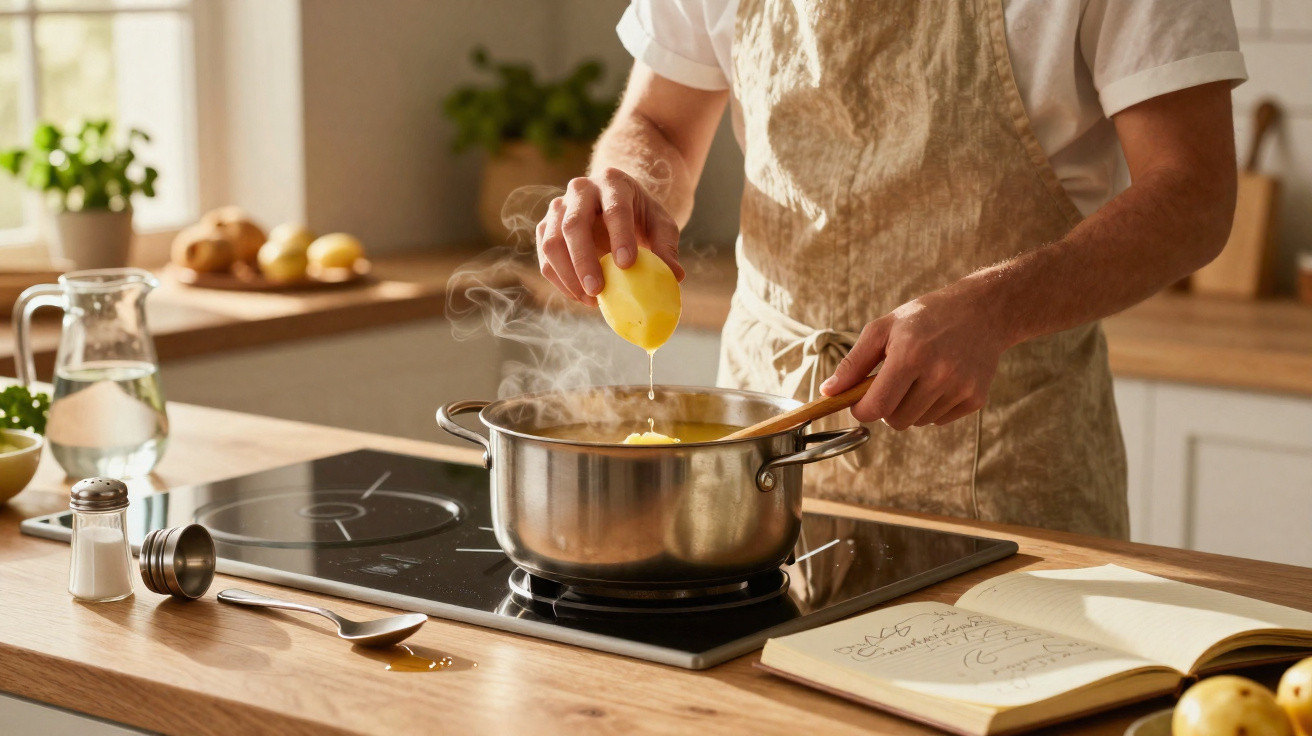
You know the precise moment dinner has gone wrong. You take one mouthful and immediately flinch inside: it is far too salty. The spoon knocks against the saucepan, steam clouds your glasses, and a flush of panic rises up your neck. Your guests will arrive in 15 minutes, the last of the stock is gone, and you are standing there with a ladle, looking into a soup salty enough to strip paint. You go back over every step: did you add salt twice? Was the stock salty already? Did you get overconfident with the shaker?
This is when a helpful friend tends to offer the familiar advice: “Don’t worry, just drop a potato in, it’ll soak up the salt.” It sounds magical, reassuring and like the sort of kitchen solution your nan would insist on. Yet one slightly uncomfortable question lingers in the steam above that ill-fated soup: does it really work?
The kitchen myth everyone knows
The idea that a potato can rescue salty soup is one of those pieces of culinary folklore that seems to come from everywhere and nowhere at once. Your mum has heard it, your flatmate stands by it, and an anonymous recipe commenter presents it as unquestionable truth. It carries the reassuring quality of inherited wisdom, as though it began with somebody’s grandmother at a hob in a home permanently scented with onions softening gently in butter. Like many folk remedies, it feels both old and dependable.
We have all wanted a solution like this to be real. Perhaps you added too much salt because you were distracted, stressed, or attempting to cook three dishes while replying to a work email on your phone. The prospect of one modest peeled potato being dropped in as the hero of the hour is deeply tempting. A mistake becomes an anecdote for later: “I thought dinner was ruined, but then I remembered the potato trick…”
There is something profoundly human about trusting these little moments of kitchen magic, too. Cooking is not simply about weights and timings; it involves memories, feelings and a little superstition. Many of us were raised in kitchens where nothing was weighed and recipes relied more on instinct than science. When somebody says a potato will “absorb” the extra salt, part of us does not scrutinise the claim. We simply want it to work.
What really happens when you add a potato to salty soup
Imagine the scene: your soup is over-salted, so you peel a potato, lower it into the pan and leave it to simmer. You might halve it first because somebody once said this “exposes more surface area”. There it sits, lightly bobbing as if it understands its heroic assignment. After ten minutes, you lift it out with a slotted spoon, feeling hopeful and almost apprehensive. You taste the soup again. Perhaps it is… marginally improved? Or perhaps it tastes precisely the same, and you are now irritated with a vegetable.
The less exciting but more useful answer is that a potato does not magically draw salt from soup as a sponge would. Salt is drawn to water. When it can either remain dissolved in a large pan of hot liquid or move into the cells of a potato, it generally remains where it is. The liquid, including the salt, circulates throughout the dish. That is diffusion: everything seeks equilibrium, rather than salt obligingly moving into the potato because you told it to.
A potato will, however, take in some liquid and release starch. That escaping starch can alter how the saltiness feels in your mouth, occasionally making it seem less severe. The soup may appear thicker, gentler and less sharply salty on the surface. In that limited sense, the potato trick may make a small difference. It does not, though, remove salt from the pan in any significant or measurable quantity. The salt remains there, merely wearing softer clothes.
The peculiar reassurance of a half-truth
There is a certain reassurance in a tip that works a little, though not for the reason we assume. A potato may soften the edge somewhat, particularly in very thin, brothy soups. It gives you time and headspace to stop panicking and decide what to do next. In this respect, the potato is not a salt remover so much as a therapy tuber: a small, starchy pause button.
Realistically, nobody carries out a complete chemical analysis of their soup on a weeknight. You taste, alter things and hope for the best. If using the potato trick encourages you to pause, breathe and pay closer attention, it has its own modest magic, even if science is quietly rolling its eyes in the background. The kitchen is one of the few parts of adult life where we still happily indulge in these small, comforting myths.
Practical ways to rescue oversalted soup
After the first wave of panic has passed and the potato has enjoyed its moment, there are reliable, unglamorous ways to bring soup back into balance. The most dependable is also the least dramatic: dilute it. Add extra liquid, whether water, unsalted stock, or some milk or cream if the soup suits it. You are not taking salt away; you are giving it a greater volume in which to disperse. It is less romantic than believing “a potato will fix it”, but it is how restaurants quietly rescue dishes every day.
Adding more solid ingredients is another useful option. If the soup can accommodate them, include extra unsalted vegetables, beans or noodles. Think of it as extending the error. That excessively salty broth now has more ingredients to season rather than simply scorching your mouth. A vegetable-filled minestrone can move from “oh no” to “actually, this is lovely” with a few additional carrots and a tin of beans that were definitely not part of the first plan.
Acid is another understated hero. Lemon juice, a splash of vinegar or a spoonful of tomato purée will not remove salt, but they can divert attention from it. They stimulate other areas of your palate, so the salt does not dominate quite so loudly. This is why a little lemon in an overly salty chicken soup can make it seem fresh and bright rather than dense and briny. Your tongue stops protesting and decides dinner may not be so bad after all.
Milk, sugar and the “oh no, what have I done” stage
Some cooks use sugar to counter too much salt, and in very small quantities it can be useful, particularly in tomato-based soups. Sweet and salty flavours interact in interesting ways, and a pinch of sugar may smooth out harshness. The risk is that one error leads to another: first too salty, then too sweet, then simply odd. It becomes a tug-of-war between flavours, with the soup as the battlefield.
Dairy is often more forgiving. A swirl of cream, some coconut milk or a spoonful of yoghurt stirred through at the end can reduce the impact of salt, much as milk softens a strong cup of tea. The overall flavour becomes fuller and less piercing. This approach is best for creamy soups, curries and chowders, rather than clear broths or delicate consommés. A slightly over-salted mushroom soup can suddenly become a rich, velvety dish that seems entirely intentional.
Behind all of this lies a simple lesson: the most effective rescue methods are practical rather than glamorous. They are not the sort of thing you would boast about on social media. Nobody uploads a TikTok to announce, “I added 300ml of water and some extra carrots and now it’s fine.” Yet this is what much home cooking is really like: less magic, more small and sensible adjustments towards balance.
Why the potato story endures
If potatoes do not genuinely slurp salt from soup as we have been told, why will this story not disappear? In part, people simply enjoy a neat trick. There is real satisfaction in having a secret solution ready to offer a friend in trouble: “Don’t worry, I know what to do.” It makes cooking feel less like an exam you might fail and more like a puzzle you can work out.
It also comes with a sense of comfort passed between generations. Perhaps your mum used the trick. Perhaps you watched an aunt do it at Christmas, as a potato slowly sank into an over-seasoned pan of gravy while everybody laughed and poured more wine. Whether it genuinely “worked” was almost beside the point. The important part was the shared ritual and the reassuring belief that adults always knew a way through when something went wrong.
Kitchen mistakes can feel surprisingly personal. When soup is spoiled, it is not merely the food that has failed; it is your time, effort and pride. You were trying to feed people, care for them and perhaps impress them a little. That hurts more than a salty mouthful. The potato becomes a small symbol of reassurance: this can be fixed; you are not a disaster; you are simply somebody who cooks.
Kitchen myths as comfort blankets
If we were entirely rational, we would discard all these myths and stick to tested, reliable methods. Measure your salt. Taste while cooking. Choose low-sodium stock. Make adjustments gradually. It is all sensible and very adult. But a kitchen without small stories and half-remembered family advice would feel a little sterile, more like a laboratory than a home.
A myth can survive because it gives us a tale to share at the table afterwards. “I nearly ruined this, but then I tried that old potato thing, then added some cream and extra veg, and somehow it all came good.” The finished soup tastes not only of chicken, tomatoes or lentils, but also of mild chaos, recovery and relief. Food is seldom only food; it carries the drama involved in making it.
So, yes, the potato trick has shaky science behind it. It is somewhat overrated and may occasionally help indirectly. Yet it belongs alongside tapping eggs on the “right” side of the bowl or insisting tea can only brew properly in a favourite mug. These minor, slightly irrational habits form part of the quiet rituals that make cooking feel like life rather than logistics.
What salty soup can teach you once the panic has passed
If you have ever stood over a pan of ruined soup, quietly swearing, you are far from alone. There is a shared sort of shame in the experience, as though everyone else moves through their kitchens with the ease of television chefs while you alone are searching “how to save oversalted stew” one-handed. The truth, passed quietly from kitchen to kitchen, is that everybody gets it wrong sometimes. Even skilled cooks. Especially skilled cooks. They simply recover more quickly.
When the panic subsides, over-salting offers a few understated lessons. You learn to season later rather than earlier. You remember that stock cubes may contain surprisingly high levels of salt, and that bacon or soy sauce contribute their own saltiness. You begin tasting more regularly and noticing how flavour builds gradually, instead of adding one large, heroic pinch and hoping for the best. These may be unexciting lessons, but they stay with you longer than any flawless Instagram soup.
When you eventually serve the repaired soup-perhaps diluted, bulked out, sharpened with lemon or softened with cream-something in you eases. Your guests eat and chat, and somebody asks for another helping. Nobody knows about the small crisis from half an hour earlier, the sacrificed potato or the quiet swearing. You remember that a meal is not about perfection. It is about feeding people, making an effort and turning minor disasters into stories.
So, the next time your soup is too salty and somebody confidently says, “Stick a potato in, it absorbs the sodium,” you will know that the science is slightly dubious. You will probably still try it, though, if only because the ritual is comforting. Then you will add water, a few more vegetables and perhaps a squeeze of lemon, before standing for a moment to taste, adjust and learn. Somewhere amid the steam and the clink of the spoon, you will have the quiet, reassuring thought: you have not ruined it. Not yet. Not while you are still stirring.














Comments
No comments yet. Be the first to comment!
Leave a Comment