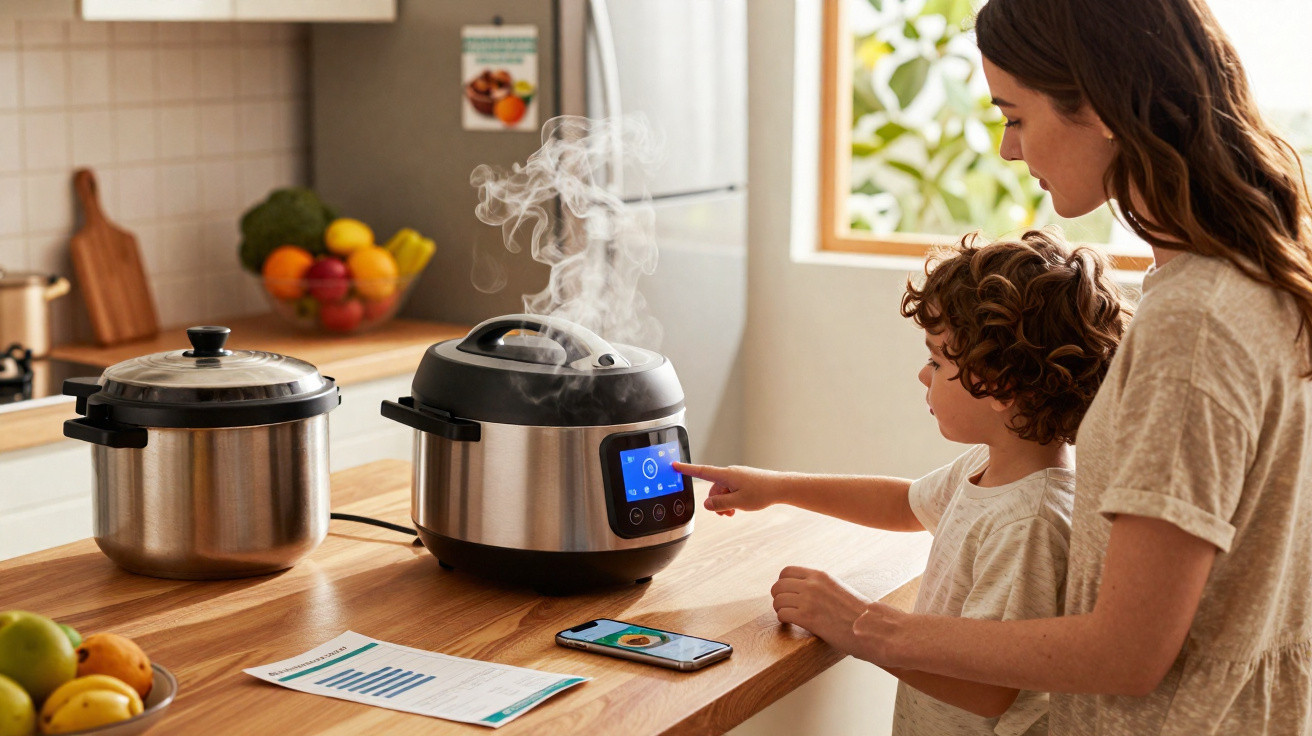
Parents flick through their phones for homework updates, messages and delivery orders while a compact smart cooker quietly works on the worktop. There is no fierce blast of steam or hissing valve requiring attention. Instead, a gentle beep sounds and the bright display reads: “Dinner in 12 minutes.”
For many households, that illuminated screen has taken over from the whistle once heard in flats and suburban houses alike. The pressure feels greater today: small kitchens, children underfoot and constant distractions. Families want speedy home-cooked meals, but not if they involve scalded hands, piercing alarms or uncertain timing. As a result, the heavy metal pot is returned to the cupboard and a streamlined multi-cooker earns its place on the counter.
A genuine change lies behind this seemingly minor exchange.
Why pressure cookers are losing their place in family kitchens
Taste is not usually the first concern people raise. Fear is. Speak to enough people and similar memories emerge: “My grandma’s cooker exploded once”, “I’m scared to open it”, “I don’t trust that sound.” Traditional pressure cookers have carried an image of danger for generations. Although current models are safer, that reputation still sits at the back of many people’s minds.
Meanwhile, family life has become relentlessly busy: work, children, commuting and screens all compete for attention. Few people want a cooking method that needs watching as closely as a security guard. Turning a dial, selecting a programme and leaving it alone can feel almost miraculous. Safety has shifted from requiring the cook to know exactly what they are doing to letting the appliance take charge.
Smart appliances fit naturally into that gap.
Browse any parenting Facebook group or Reddit discussion about “easy weeknight dinners” and the same distinction appears. Conventional pressure cookers tend to feature in fond recollections, whereas smart multi-cookers appear in photos of the meal being made that evening. A 2023 UK survey found that ownership of multi-cookers among young families had almost doubled over three years, while pressure cooker sales were static or declining.
A mother in her thirties from Madrid describes it like this: “My mum swears by her pressure cooker, but I don’t have the nerves for it.” In a photograph of her worktop, a squat multi-cooker and a small air fryer sit plugged in beside each other. Lentil stew cooks in one and chicken thighs in the other. The large metal pressure pot is somewhere in the top cupboard “with the Christmas stuff”.
Even in places where pressure cooking is deeply rooted in the culture - including India, Brazil and parts of North Africa - digital displays are increasingly appearing in cramped kitchens. The message remains consistent: lower risk, greater control and fewer unexpected moments.
This change centres on a new definition of “safe”. A traditional pressure cooker is safe when the cook is attentive, nearby and reasonably experienced. Smart multi-cookers reverse that principle. They are marketed on the basis that the appliance can account for human tiredness and distraction. Sensors, locking lids, automatic pressure release and guided on-screen instructions turn an anxious job into something more like using a capsule coffee machine.
The emotional response matters just as much as the engineering. A countdown visible from the other side of the room is reassuring. A lid that cannot physically open while pressurised removes a very particular worry. Automatic keep-warm settings mean a delayed work call does not ruin dinner. The danger has not vanished, but it is handled in a more forgiving, contemporary way.
In short, as family life became more chaotic, appliances learned to look after themselves.
How families are using smart multi-cookers rather than taking risks
The most useful choice for many households is a single appliance that quietly performs three or four roles. A capable multi-cooker can pressure cook, slow cook, steam and sauté using the same pot. The key difference is simple: choose the setting, shut the lid and leave it to work. There is no flame to regulate, no whistle to monitor and no wondering whether another minute will turn dinner to mush.
A straightforward routine comes up repeatedly in homes that have switched: batch cooking once or twice weekly using hands-off settings. A large quantity of beans, pulled chicken or vegetable curry can cook while the children are in the bath. Once the cycle is complete, the cooker changes to warm mode, and the adult opens it whenever everyday life permits. The secret isn’t culinary genius, it’s predictability.
That predictability alone can make weekday dinners feel manageable rather than chaotic.
What is the mistake most often admitted by new owners? Assuming a smart cooker is magical, throwing everything in without thought and expecting success. Pasta then becomes paste, while vegetables dissolve into a beige haze. Let’s be honest: nobody really cooks like that every day. Most people are improvising under pressure, both literally and figuratively.
Smart cooking delivers the best results when a few essentials are observed: use sufficient liquid to create pressure, avoid filling beyond the maximum line, and add ingredients with vastly different cooking times at appropriate stages. Many households build up a set of weekly “house recipes” - chilli, rice bowls, soups and pulled meat. Once those are reliably mastered, the appliance stops feeling like a novelty and becomes a quiet helper in the background.
There is emotional relief, too, in avoiding an aggressive hiss every night. One parent said: “When the old cooker started screaming, my toddler would grab my leg and cry.” With a smart pot, preparing dinner can be almost silent.
“My grandmother listened to the whistle to know when food was ready,” says Amina, a 42‑year‑old nurse. “I listen for the soft beep on my phone notification. Same goal, different kind of trust.”
That calm confidence is supported by several habits families commonly pass on to one another:
- Begin with one or two “no-fail” recipes, repeating them until they become routine.
- Only use the delay timer once you fully understand how long the food can safely be left.
- Keep in mind which foods should never be pressure cooked, such as some dairy sauces and very delicate fish.
- Wash the silicone seal and valve regularly to prevent unusual odours and blocked safety mechanisms.
- Share minor scares and near misses with other people before they develop into serious accidents.
The wider story behind the quiet kitchen revolution
Viewed more broadly, the old pressure cooker represents more than steel and valves. It belongs to a period when home cooking required concentration, knowledge and a degree of courage. Its loud whistle demanded attention. You could not casually watch a series while the pot roared away on the hob. You needed to listen, assess and respond. There was pride in “knowing” the cooker as if it were a temperamental friend.
The era of smart appliances reflects another kind of kitchen, where people are continuously multitasking and cooking must fit around everything else occurring in the same 20 square metres. On a Tuesday evening, the person making dinner may also be replying to work messages, checking a maths assignment and mentally planning tomorrow’s tasks. In that setting, an appliance that tolerates distraction feels less like laziness and more like a kindness.
Yet this is not simply a rejection of older methods. It is a translation of them into modern routines. Families still want deeply simmered flavours, tender meat and soft beans. They just want the results without the sharp anxiety of asking, “is this safe?” The whistle has given way to a soft beep, and fear of an explosion has become a push notification. Between those two things is a quiet admission shared by many people: they want food that feels homemade without a process demanding heroic concentration.
The metal pot will remain on certain shelves. It may reappear during holidays, or when energy bills hurt and cooking on the hob seems cheaper. But in daily life - especially for parents drifting off on the sofa while dinner completes itself - the future of “pressure” is looking ever more digital and a little more forgiving of distracted people.
| Key point | Detail | Why it matters to the reader |
|---|---|---|
| Less fear, more control | Smart cookers lock the lid, regulate pressure and show an easy-to-read countdown. | Reassures people raised with fears of explosions and violent whistles. |
| Genuine time savings | Automatic programmes, keep-warm functions and hands-off cooking allow other tasks to be done at the same time. | Makes home cooking possible without watching the pot or staying in the kitchen. |
| New family routines | Batch cooking, repeated “no-fail” recipes and online tip-sharing become part of the routine. | Helps turn a gadget into an everyday ally, particularly in homes with children. |







Comments
No comments yet. Be the first to comment!
Leave a Comment