The chopping board is clean - or so the sink full of soapy bubbles would have you believe. But when you cut into an apple and take a bite, yesterday’s garlic is still there, lingering on every slice. The board appears immaculate, yet it smells like an unpleasant fridge.
On a hectic weekday evening, that small problem can ruin an entire meal. You scrub more vigorously, try another washing-up liquid and search for “how to remove onion smell from cutting board” with damp hands.
Some people replace the board. Others simply put up with it.
There is, however, a less obvious solution already in your kitchen.
It takes under a minute.
The hidden issue with your chopping board
Many people assume that a quick wash and thorough rinse will clean a chopping board properly. Under the tap, onion scraps, meat juices and tomato marks seem to vanish. Yet once the board has dried, a faint reminder of old meals returns the next time you chop herbs.
That odour persists because it is not merely sitting on the board; it has seeped into it.
Porous materials, particularly wood and bamboo, hold onto minute food fragments and oils that washing-up liquid cannot always reach completely.
You may not spot the problem on a Tuesday evening. You are worn out, dinner was prepared in a hurry and you are already looking at your phone. The following morning, you use that same board to cut oranges for breakfast, only to notice that the citrus carries a slight fish smell. Instantly, the kitchen seems less hygienic.
On a chopping board shared by the family, successive meals leave their mark: grilled chicken, crushed garlic, chopped coriander and sliced strawberries.
Each meal leaves behind a trace that your eyes may miss, but your nose remembers.
The science behind it is straightforward. Smells travel in volatile compounds, which attach themselves to grease and tiny fibres. Both wooden and plastic boards develop microscopic knife scratches where these molecules collect. Washing-up liquid breaks down part of the residue, but not all of it.
Water by itself spreads odours rather than neutralising them. Hot water can even open up wood pores, allowing smells to penetrate further.
This is why a board may look “photo ready” on the worktop while still smelling of last week’s stir-fry.
The lemon and salt chopping board trick
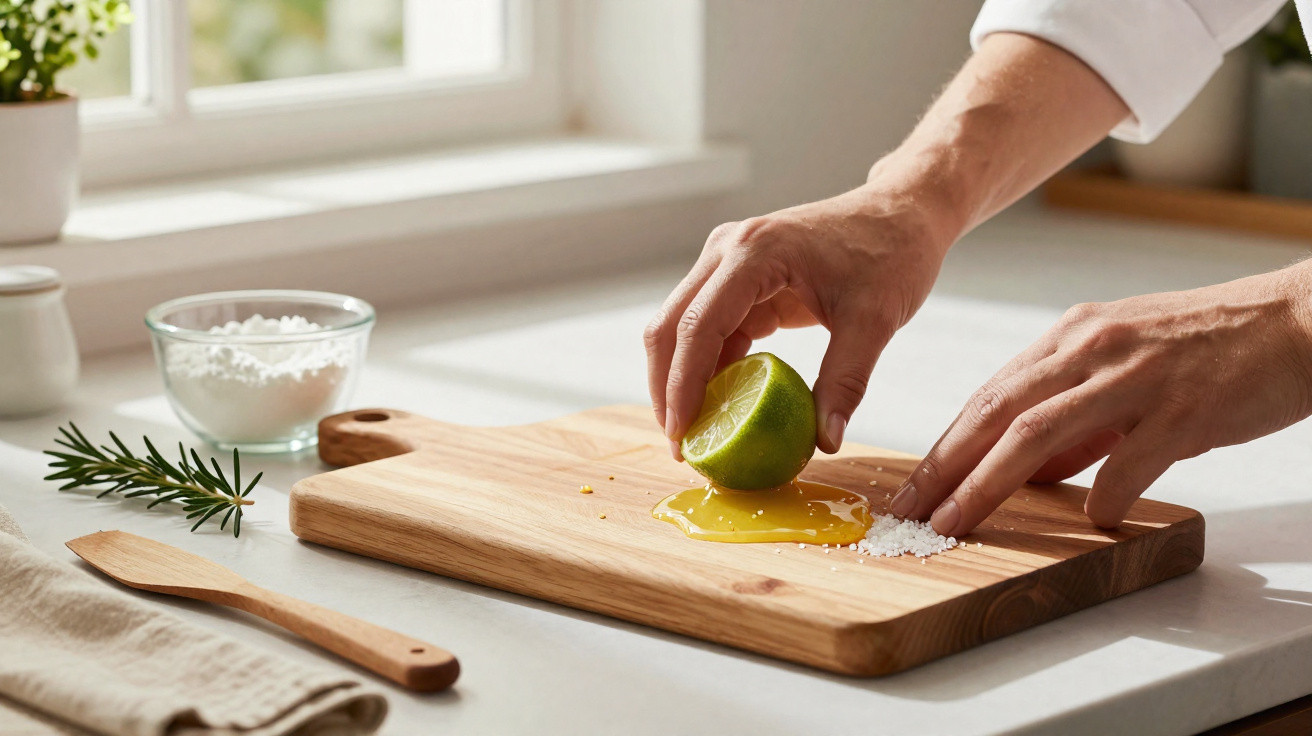
Try this instead: halve a lemon, scatter coarse salt over a dry board, then rub the surface with the lemon as though it were a small citrus sponge.
The salt provides mild abrasion, helping to loosen trapped particles and oils. Meanwhile, the lemon juice saturates the wood with acid that neutralises many persistent odour molecules.
Leave the salted lemon juice on the board for 3–5 minutes. Rinse it using warm, rather than boiling, water, then stand the board upright and allow it to air-dry.
The effect on a smelly board can seem almost dramatic. As you scrub, the onion-fish-garlic haze gives way to a fresh, sharp scent. It is not an artificial “lemon washing-up liquid” fragrance, but the smell of an actual kitchen garden.
This method also works on plastic boards, especially in fine knife marks filled with lingering flavours. Use less salt, choose a finer grain and avoid using it aggressively on deeply coloured boards that mark easily.
Let’s be honest: nobody really does this every day. Once a week, or simply after making a particularly strong curry, can still make a world of difference.
The most frequent error is attempting it on a board that is already soaking wet. On a wet surface, the salt and lemon slide about instead of working into the fibres. Another mistake is leaving the board submerged in the sink for ages after scrubbing. Prolonged soaking can warp wood and encourages odours to return.
Also remember the board’s edges and any juice groove. These corners are exactly where smells tend to collect.
“After I tried the lemon-and-salt scrub once, my board went from ‘kind of suspicious’ to ‘I’d happily slice peaches on this,’” says Emma, a home cook who cooks fish twice a week.
- Use coarse salt for wood and fine salt for plastic.
- Always dry the board standing upright, rather than laid flat.
- Repeat the method weekly if you often cook with garlic, onion or fish.
A chopping board that does not reveal your previous meal
A chopping board with a neutral smell subtly improves everyday routines. You can cut fruit without being reminded of last night’s marinade. You can prepare herbs for visitors without worrying that they may taste of yesterday’s burger.
On a shared kitchen worktop, it is a small act of consideration that nobody necessarily sees, but everybody can taste.
More deeply, it is one of those simple habits that makes a home kitchen feel slightly more trustworthy.
| Key point | Details | Why it matters to readers |
|---|---|---|
| Use lemon and coarse salt on dry wood | Spread a light layer of coarse salt over a fully dry wooden board. Rub it in with the cut side of half a lemon, using small circular motions. | This makes the most of the salt’s abrasive action and the lemon’s acidity, so odours genuinely disappear rather than simply being covered with fragrance. |
| Leave the mixture briefly | Once you have scrubbed the board, let the salty lemon juice remain for 3–5 minutes before rinsing it with warm water. | It gives the acid time to break down smell molecules lodged in pores and knife marks. |
| Dry upright and oil occasionally | Place the board on its side to dry away from direct heat, then apply a light coating of food-safe mineral oil every few weeks. | This helps prevent warping and limits future odour absorption, allowing the lemon and salt method to work more quickly and last longer. |











Comments
No comments yet. Be the first to comment!
Leave a Comment