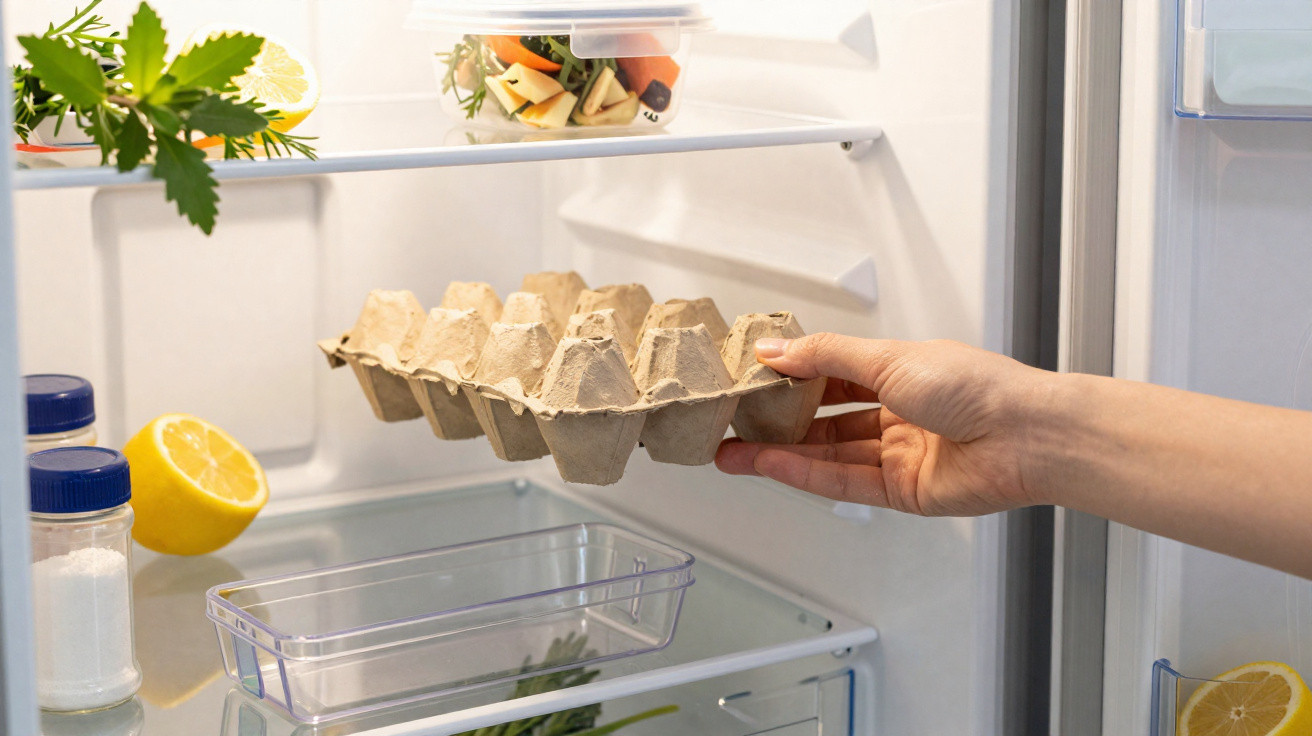
A TikTok clip tells her to bin the carton and arrange her eggs in the glossy plastic holder built into her fridge. It appears tidier, more “organised”, and perfect for a Sunday reset video. She pauses, then casually puts the cardboard carton into her shopping basket anyway.
A few days later, she opens the fridge and notices the lingering scent of the previous evening’s garlic pasta. Her eggs are beside yesterday’s leftovers. Again, she starts to wonder why her omelettes occasionally taste slightly… strange. The eggs look flawless, but clearly something is not right.
One small fridge habit could be subtly altering the flavour of your breakfast.
Why the modest cardboard carton does more than you think
In most fridges, it is easy to spot: a line of egg-shaped spaces in the door, laid out like a miniature display. Using it seems sensible. Yet, if freshness and flavour matter to you, it is close to the least suitable place to keep eggs.
Eggshells look impermeable, but they contain countless microscopic pores. These act as tiny gateways for moisture and odours. Eggs placed loose in a plastic holder are exposed to every smell drifting through the fridge, whether it is cheese, onion or a partly covered casserole on the shelf nearby.
The original cardboard carton quietly acts as their protector. It prevents direct exposure to circulating air and provides a more stable small-scale environment. It may not look stylish, but it works remarkably well.
Think of the last time you cleaned the fridge before visitors arrived. You may have wiped down shelves, moved jars around and thrown away an out-of-date sauce. Eggs, however, are often shifted without much consideration. They can end up beside chopped melon or pungent blue cheese, uncovered in the built-in holder.
Many home cooks sense that something is wrong well before they identify the cause. A quiche has a faintly “fridgey” flavour. Scrambled eggs seem to carry a trace of last week’s sliced ham. The frying pan, butter or seasoning gets blamed; the way the eggs were stored rarely does.
Food safety bodies in the US and across Europe consistently offer the same understated guidance: leave eggs in their original carton and keep them in the main compartment of the fridge, rather than in the door. This is not merely a cautious official rule. It reflects the way eggshells actually allow gases to pass through.
An egg’s shell contains roughly 7,000 to 17,000 micro-pores. These minute openings allow gases to travel both in and out. As powerful food smells circulate in the fridge, their volatile compounds can pass through the pores and become trapped in the egg white and yolk.
A plastic egg holder offers little protection from airflow. Cardboard, by contrast, works in two ways: it limits exposure to odours while cushioning temperature fluctuations. As a result, eggs are less prone to taking on unwanted smells and to ageing too fast. It is science in the form of an unexciting box.
How to store eggs so they stay fresh, neutral and taste like eggs
The simplest solution is to leave eggs where the supermarket placed them: in the cardboard carton. Put the entire box on a central fridge shelf, preferably near the back where temperatures are steadier. Avoid the door and ignore the attractive plastic holder.
Close the carton after each use. Its flap does more than stop eggs rolling out: it reduces continual contact with circulating air and travelling odours. Those thin cardboard layers form a barrier that plastic seldom provides.
One more small point matters: keep the eggs with their pointed ends facing downwards. This leaves the air cell at the top and away from the yolk, helping them retain their quality for longer. It is a tiny adjustment with a genuine effect over days and weeks.
Modern fridges are essentially odour factories. There may be garlicky leftovers, sliced onions in a takeaway container, uncovered cheese, fish wrapped only “just enough”, or half a lemon sitting in a bowl. Every item gradually releases invisible aromatic molecules into the shared air.
Everyone knows that moment when opening the fridge brings a peculiar mix of last night’s meal and something unidentified from two weeks earlier. In that setting, eggs behave like sponges. Left exposed in a plastic holder, they can absorb the history of everything around them.
Let’s be honest: nobody really does this perfectly every day, but wrapping strongly scented foods more carefully or storing them in sealed containers protects your eggs too. It creates a chain reaction of small, almost effortless, good habits.
People can feel quietly guilty when eggs are scattered across the door holder, with some left in the carton and others loose on a shelf. That sort of disorder is ordinary life, not a personal failing. The key is choosing one manageable routine: “eggs live in their carton on the middle shelf, always”. Once that rule is in place, there is no need to keep reconsidering it.
“The original egg carton is not packaging to throw away, it’s part of the food safety system,” explains one food scientist. “When consumers remove eggs from it, they usually increase odor absorption and shorten the ‘best taste’ window without realizing it.”
There is another useful benefit that gets little attention: cardboard cartons generally display the best-before date, farm code and sometimes storage guidance. Throwing away the packaging to make the fridge look less cluttered also removes those helpful freshness prompts.
- Keep eggs in their original closed cardboard carton on a central fridge shelf.
- Avoid the door holder: it is warmer, experiences more temperature changes and is exposed to more odours.
- Put strongly scented food into sealed containers to preserve the overall smell of the fridge.
- Store eggs pointed end downwards to prolong quality and keep the yolks centred.
- Do not wash eggs before storing them; doing so removes their natural protective layer.
Rethinking the fridge door and the subtle effect of everyday habits
Once you notice it, the integrated egg holder starts to seem less like a smart feature and more like an outdated habit trap. Fridges have retained this arrangement for decades, even as food science advice has changed. It is rather like finding an ashtray in the back seat of a brand-new car.
The carton, meanwhile, barely draws attention. Brown, grey or pale in colour, it clashes with the pristine white plastic interior of a modern fridge. Still, this plain box protects flavour, texture and safety more effectively than the sleek holder supplied with the appliance.
Day to day, this small decision influences the way breakfast tastes: whether eggs are clean, neutral and rich, or have a slight reminder of last night’s curry.
| Key point | Detail | Benefit for the reader |
|---|---|---|
| Keep eggs in their carton | The carton reduces their exposure to air and odours | A cleaner flavour and eggs that smell less like the fridge |
| Avoid the plastic door holder | This area is warmer and subject to greater temperature variation | Better freshness and less risk of deterioration |
| Manage strongly scented foods | Use airtight containers and take more care with wrapping | A better-smelling fridge and more neutral eggs for cooking |












Comments
No comments yet. Be the first to comment!
Leave a Comment