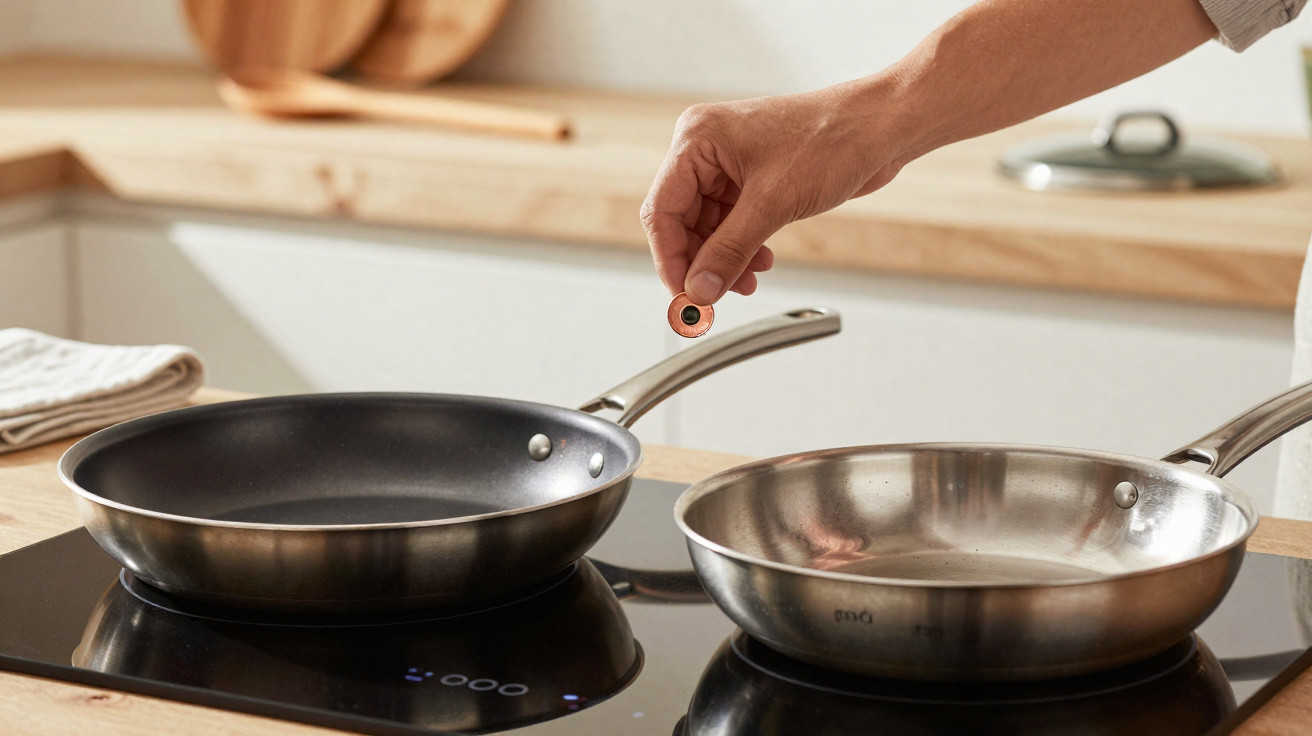
Sleek induction hobs are now common in UK kitchens, yet a small detail beneath your pans may be silently adding to your costs.
More households around the country are choosing induction cooking for its rapid heating and cleaner indoor air compared with older gas burners. However, a straightforward 25p test using a fridge magnet can show whether your costly hob is performing as it should.
Why a 25p magnet could transform your induction hob
Induction may appear simple: a smooth glass top, rapid boiling and accurate temperature control. Underneath that polished surface, though, it works very differently from conventional electric or gas cookers.
Rather than warming the glass, an induction hob produces a magnetic field. This passes through the glass and generates electrical currents in the pan’s base, turning the pan itself into the source of heat.
If your pan base is not magnetic enough, your induction hob wastes energy, cooks unevenly and can even shut itself off.
That is where the 25p test is useful. In seconds, an inexpensive fridge magnet can indicate whether your cookware is genuinely suited to your hob or whether efficiency is being lost whenever you fry an egg.
The simple magnet test every induction owner should try
According to appliance specialists, the fastest compatibility check uses an ordinary refrigerator magnet – the type found on millions of fridge doors across the UK.
How to test your pans, step by step
- Pick up a small magnet normally kept on your fridge.
- Turn the pan over to make its base easy to reach.
- Hold the magnet firmly against the centre of the base.
- Carefully lift and tilt the pan to check whether the magnet remains securely attached.
- Test around the outer edges as well as the centre of the base.
If the magnet grips firmly and does not slide off easily, the pan is likely suitable for induction. If it skates across the surface or falls away, your hob may struggle to heat it efficiently.
Shops may describe pans as “induction ready”, but a magnet check can be more reliable than a marketing label. For instance, many older stainless-steel pans appear substantial while containing alloys that react only weakly to magnetic fields.
Which pans work – and which ones quietly drain your energy
Cookware materials behave very differently on induction hobs. While some strongly engage with the magnetic field, others barely respond at all.
| Material | Works on induction? | What to expect |
|---|---|---|
| Cast iron | Yes | Heats powerfully, retains heat effectively, and may be heavy and slow to cool. |
| Carbon steel | Yes | Reacts quickly, suits searing, and requires seasoning like cast iron. |
| Magnetic stainless steel | Usually | Provides even heating when the base is thick; quality differs greatly between brands. |
| Aluminium (without special base) | No | Will barely warm up, or may not be recognised by the hob at all. |
| Copper (without special base) | No | Attractive, but largely ineffective on induction by itself. |
| Glass or ceramic | No | Remains cold while the hob attempts to operate harder. |
Many modern “tri‑ply” and “multi‑ply” pans are made from layered metals. They generally work well on induction if their outer base layer is magnetic. Where the base is mainly aluminium or copper, the hob may repeatedly switch on and off or decline to start.
What happens when your pans don’t match your hob
When food is slow to cook or bubbles only in one area, many people blame their hob. In a notable number of instances, the pan is actually at fault.
If a pan fails the magnet test, you may notice several problems:
- The hob may fail to identify the pan and not heat it at all.
- Heat may be limited to a small area, leaving the edges cold.
- Water may take longer to boil, making meals more expensive to cook than necessary.
- The hob may “pulse”, turning itself on and off as it struggles to detect the cookware.
Uneven heating doesn’t just slow dinner – it can damage delicate non‑stick coatings and shorten the life of both the pan and the hob.
Low-cost pans can also warp under intense, concentrated heat. Once a base curves upwards, it no longer makes proper contact with the cooking zone. The result can be scorching in the centre and merely warm soup at the sides.
Why this matters as gas hobs face a policy squeeze
As part of the UK’s broader net zero ambitions, ministers and campaigners have encouraged households to move towards electric cooking. With quick responsiveness and less wasted heat, induction has become a popular choice for kitchens replacing gas.
However, the quoted efficiency figures depend on suitable pans being placed on those glossy hobs. When cookware works against the technology, the savings achieved in everyday use fall. Some households may find their bills unchanged or even higher, and conclude that induction has been overhyped.
Before blaming the appliance or paying for a costly replacement, owners can use a 25p magnet test as a quick practical check.
How to upgrade your pans without wasting money
There is no need for households to replace every saucepan and frying pan at once. A gradual, considered approach is often kinder to both budgets and the environment.
Start with the pans you use most
For many families, just three or four items are used every day: a medium frying pan, a large frying pan, a medium saucepan and perhaps a stockpot. Checking these first reveals where replacing cookware will bring the quickest gains.
- Give priority to pans used several times weekly that fail the magnet test.
- Choose a thick, level base to distribute induction heat more evenly.
- Steer clear of very cheap, thin pans, which can warp and soon need replacing.
- Make sure a new pan’s diameter matches your hob’s cooking zones.
Taking a magnet into a shop may feel a little eccentric, but it removes the uncertainty. When shopping online, look for brands that state their bases are fully induction compatible rather than simply “induction suitable”, an imprecise description that can conceal poor performance.
Common induction mistakes that quietly cost you cash
Although the magnet test addresses one important problem, day-to-day habits also affect induction performance in real kitchens.
Pan size and placement
Most induction hobs require a minimum pan size for each zone. A small espresso pot placed on a large ring may not activate the sensor. Pans that cover only a small part of the coil also leave part of the energy field unused.
A good rule of thumb: choose a pan that roughly matches the circle marked on the glass and keep the base centred on the zone.
Heat settings and cookware wear
An induction hob can go from a gentle simmer to a vigorous boil within seconds. Repeatedly using the highest setting may burn oil, harm non-stick finishes and create rainbow marks on stainless steel.
Many chefs advise beginning at a medium-high level before reducing the heat when food reaches temperature. Allow the pan a brief preheat instead of selecting maximum power in an attempt to speed things up.
Extra tips for safer, cleaner and cheaper induction cooking
A properly matched induction arrangement can provide benefits beyond faster cooking and reduced bills.
- The glass top remains cooler than a conventional electric hob, helping to reduce baked-on spills.
- Quicker heat adjustment lowers the risk of pans boiling over and wasting food.
- Electric cooking avoids nitrogen dioxide emissions from gas burners, which may irritate lungs in small kitchens.
- As heat is concentrated in the pan, kitchens often stay cooler during lengthy cooking sessions.
Families with young children may also appreciate the “auto‑off” function when a pan is lifted away. Once the hob no longer detects an appropriate base on the zone, it cuts power, lowering the chance that a forgotten ring will heat empty metal.
For homes planning later improvements, some energy advisers recommend combining an induction hob with time-of-use tariffs or home solar power. Because induction cooking is so quick, many meals can be moved into periods of cheaper or self-generated electricity. Over a year, that small practical adjustment can often save more than buying another smart gadget.
A single modest magnet and a few minutes in the kitchen can show whether existing pans are already suited to that future, or whether gradually changing to more appropriate cookware could deliver the performance promised by sleek black glass hobs.











Comments
No comments yet. Be the first to comment!
Leave a Comment