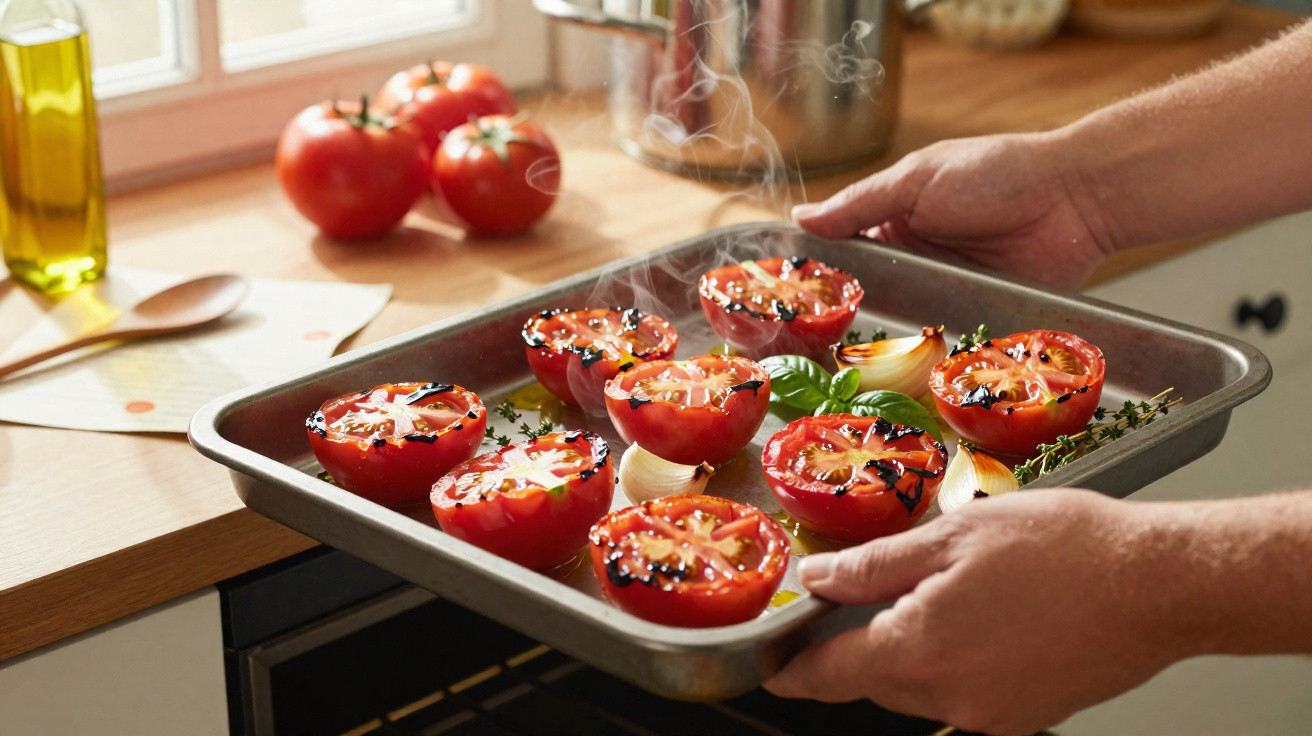
The oven door swung open with a gentle rush of heat, and the atmosphere in the kitchen shifted at once. A tray of halved tomatoes, their rims only beginning to blister, gave off an aroma utterly unlike the modest scent from a pot on the hob. It was deeper, almost smoky, with the bright-sweet intensity that comes only when vegetables are taken slightly beyond their usual limits.
Beside them, a pan of tomatoes boiling on the hob seemed almost apologetic: pale, watery and compliant.
The roasted tomatoes, meanwhile, appeared defiant.
Once those roasted halves went into the blender with garlic, olive oil and a pinch of salt, the first mouthful came as a small revelation. It was still tomato, only more emphatic. More layered. Somehow both richer and fresher at once.
That is the odd part: once you roast tomatoes for sauce, it becomes hard not to question why you ever boiled them in the first place.
The understated issue with boiling tomatoes for sauce
Boiling tomatoes is the method many of us learned first. There is the large saucepan, clouds of steam, a lengthy simmer and red splatters across the splashback. It feels like the “proper” traditional approach, and the quiet blurp-blurp of a pot on a Sunday afternoon has its own comforting appeal.
But, looked at more closely, boiled tomatoes often seem to lose some of their character. Their flavour becomes diluted in the cooking liquid, the kitchen smells more of steam than summer, and you find yourself adding spoonful after spoonful of salt and sugar in search of depth.
The resulting sauce is perfectly decent, and can sometimes be very good. It is simply seldom memorable.
Imagine arriving home from the market carrying a weighty bag of late-summer tomatoes, the sort that seem to bruise if you so much as glance at them. You cut them into pieces, put them directly into a saucepan, switch on the heat and wait: ten, twenty, thirty minutes.
Their lively colour fades. Foam forms across the top. You stir, season and perhaps add basil, but something remains absent. The sauce tastes… polite: agreeable, but faintly flat.
Most of us know that feeling: tasting homemade tomato sauce and quietly wishing it had more in common with the version from a little neighbourhood trattoria.
Boiling surrounds tomatoes with water, effectively keeping them in a flavour sauna. Their own juices escape, then continue circulating through the pan without ever becoming properly concentrated. The extra liquid takes time to cook away, and during that process delicate aromatics may disappear.
Roasting reverses the process. The heat meets the cut side head-on. Water rises away as steam instead of returning to the sauce. Sugars caramelise on the baking tray, acidity softens, and the tomato flavour becomes more compact and intense.
Here is the unexpected truth: the “secret ingredient” in a full-flavoured tomato sauce is often not extra garlic or expensive olive oil. It is simply less water and more heat, used well.
Why roasting tomatoes transforms tomato sauce
The essential technique is almost absurdly easy. Halve the tomatoes, or quarter larger ones, and place them cut-side up on a baking tray. Add a drizzle of olive oil and a scattering of salt. You might tuck in one or two garlic cloves, still in their skins, among the tomatoes.
Put the tray into a hot oven at around 200–220°C (400–430°F), then leave it alone. The tomatoes soften and slump, reduce in size and deepen slightly around the edges. That is when the transformation begins.
When they emerge, there is no thin, watery pool. Instead, you have concentrated, jam-like tomato flesh that can be blitzed into sauce in thirty seconds.
A home cook in Lyon told me she began roasting tomatoes by chance. During one summer, her small hob was already filled with pans, so she put the tomatoes in the oven “just to get them out of the way.”
She left them there for forty minutes. On opening the oven, they appeared a little charred and, truthfully, somewhat alarming. Nevertheless, she blended them with a ladleful of pasta water and a knob of butter.
Her children, normally uninterested in anything red and vegetal, asked whether she had bought a different ketchup brand. They cleared their plates with bread. That evening, she wrote “ROAST TOMATOES” on a sticky note and fixed it to the fridge door as though it were a rule for life.
Roasting does more than concentrate the flavour: it alters it. As the tomatoes cook, their naturally occurring sugars caramelise, moving the taste from sharp and acidic towards something rounder and almost fruity. The acidity seems lower, even where it is not technically reduced, because the caramelised flavours offset the tang.
Roasting also makes lycopene, the antioxidant responsible for tomatoes’ red colour, more available. Heat releases it from the tomato cell walls, while a little fat from the olive oil helps the body absorb it more readily.
So the fuller, more luxurious flavour is not imaginary. It is chemistry quietly working to your advantage, turning an ordinary sauce into something with the impression of slow cooking and restaurant quality, even on a weeknight.
How to roast tomatoes for sauce without making it complicated
This “recipe” is more an instinctive action than a rigid set of instructions. Start by heating the oven, so it is fiercely hot when the tomatoes reach the tray. In this case, high heat is your friend.
Use whichever tomatoes are to hand: cherry tomatoes, plum tomatoes or large, crumpled heirlooms that look as if they have had a difficult day. Cut them up, place them close together without piling them on top of one another, and coat them with enough olive oil for every piece to shine. Add salt and, if they are out of season and lacklustre, perhaps a pinch of sugar.
Then do not interfere until they have visibly collapsed and browned around the edges. That is the sign you are looking for.
The greatest obstacle is fear: fear of scorching them, fear of getting it “wrong.” As a result, the tray is often removed too soon. The tomatoes will be soft but still pale and damp, with no time for their flavour to intensify.
In truth, nobody does this every single day. On some evenings, you will still empty a jar into a pan and call it dinner. That is absolutely fine.
On the occasions when you do roast tomatoes, take them slightly further than feels natural. Do not let them become black and bitter; simply bring them to the edge of caramelisation. If the smaller pieces roast too far, they will add a touch of smokiness, which can work beautifully with the sweetness of the rest.
There’s a quiet thrill the first time you taste your own roasted tomato sauce and realize, with a mix of pride and annoyance, that it’s better than what you’ve been buying for years.
- Choose a wide tray so the tomatoes roast rather than steam.
- Use baking parchment to make cleaning easier and to retain every sticky, flavour-packed piece.
- Put garlic and onions on the tray to create an all-in-one base that can go straight into the blended sauce.
- Blend in a splash of pasta water or stock to alter the thickness.
- Finish with fresh basil or a drizzle of raw olive oil for a bright top note.
A small change in how you experience tomato sauce
Choosing roasted tomatoes rather than boiled ones is not a sweeping culinary revolution. It is a modest turn in direction, another way to make a dish you assumed you knew by heart. But once you notice the contrast, returning to a pale, watery simmer can be difficult.
It is not only the recipe that changes, but the mood of cooking it. The oven suddenly handles the patient part while you get on with other things. There is less mess splashed around the hob. The sauce tastes as though you spent hours tending it, although you were actually free for most of that time.
You also begin to pay closer attention to the seasons. Tomatoes from early summer require less roasting; those from later in the season become darker and sweeter; winter tomatoes respond well to extra time in the oven and a little chilli or smoked paprika. Gradually, this simple technique teaches your palate to recognise nuance in something as familiar as red sauce.
The next time you pick up a bag of tomatoes, you may pause by the hob for a moment before turning towards the oven instead, almost automatically.
| Key point | Detail | Value for the reader |
|---|---|---|
| Roasting concentrates flavour | High heat removes excess water and caramelises natural sugars | A richer, deeper sauce without additional ingredients |
| The oven does the work | Cooking is hands-off once the tomatoes are on the tray | Simpler weeknight meals with “all-day” flavour |
| Better texture and nutrition | A thicker, velvety sauce and more available lycopene | A satisfying mouthfeel and potential health benefits |










Comments
No comments yet. Be the first to comment!
Leave a Comment