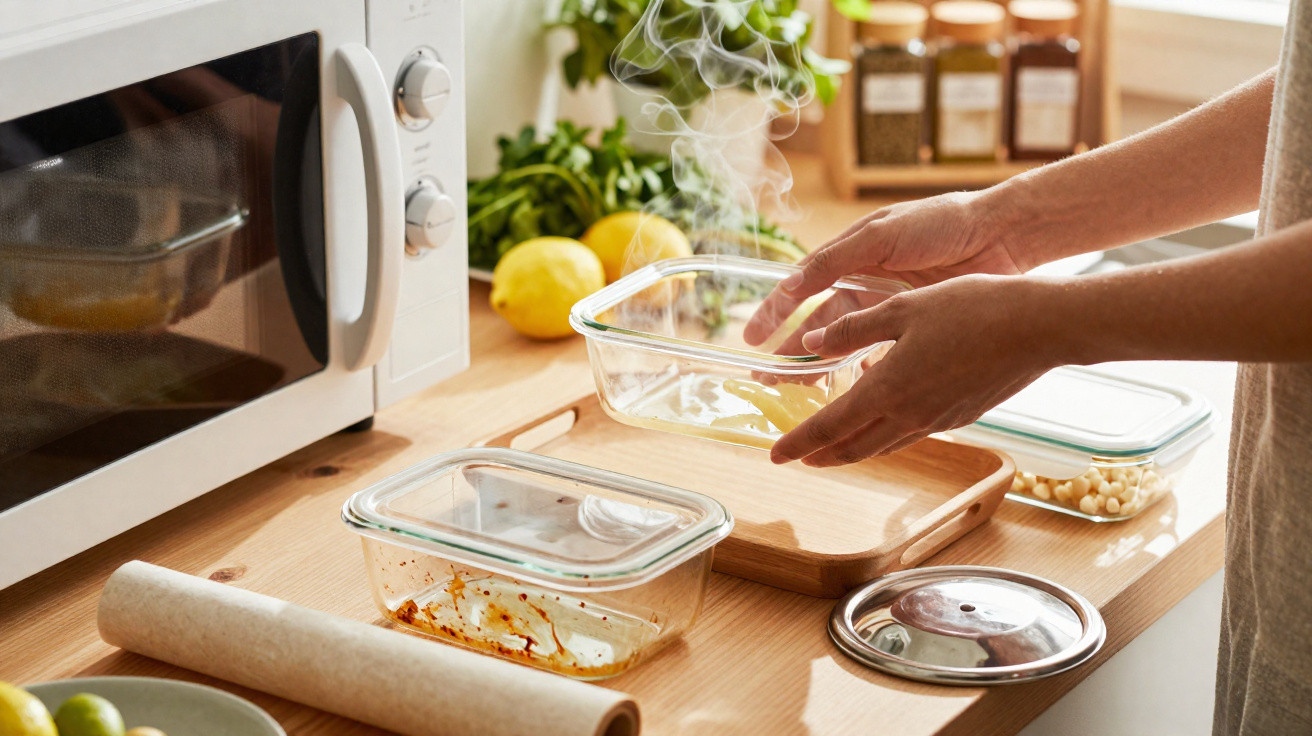
Behind the familiar, reassuring hum, researchers increasingly say the concern is not the food, but the container holding it when you press “start”. What seems like an innocuous habit could gradually add unseen particles and chemicals to meals-substances you never intended to consume.
The everyday shortcut that can quietly backfire
In many homes, it happens without thought. You take yesterday’s takeaway in its plastic tub, remove the lid and put the container directly into the microwave. It creates almost no washing-up and takes hardly any effort, which is precisely why toxicologists are becoming increasingly concerned about it.
Recent European and US survey data indicate that most families use a microwave at least daily, commonly to warm ready meals or leftovers in their original packaging. However, many of these containers were not made to withstand repeated high-temperature heating.
Risks linked to microwave use rarely come from the appliance itself, but from the plastic, films and disposable trays that surround your food.
Across many kitchens, one flimsy tub gets reused repeatedly: first for a takeaway curry, then pasta, then soup. Every microwave session places the plastic under further strain. It can crack, become cloudy and start shedding minute pieces. Scientists are increasingly connecting this apparent convenience with contamination.
The hidden problem with “microwave-safe” plastic
For most people, one marking is enough: when a container is labelled “microwave-safe”, it appears to be approved for use. Researchers say that this sense of security does not reveal the full picture.
In Europe, for instance, applicable standards mainly assess whether a material warps or melts when heated. They do not usually examine in depth how many particles or chemicals enter a hot meal following months or years of frequent use. Comparable shortcomings exist in numerous markets outside the EU.
A container can survive the heat test and still leak additives, dyes and microplastics into food during everyday use.
Laboratory research published from 2021 to 2023 showed that widely used food-grade plastics may release millions of microscopic pieces during microwave heating. In some tests, lightweight PET packaging released more than four million particles into one serving.
What figures reveal about material types
Several research groups compared materials by heating water or food simulants in typical containers before measuring the particles emitted. Their results broadly sit within the following ranges:
| Material type | Typical particle release per heated portion | Relative safety profile |
|---|---|---|
| Lightweight PET plastic | Over 4 million fragments | Low |
| Certified polypropylene (PP) | Around 300,000 fragments | Moderate |
| Tempered glass or plain ceramic | Not detectable in tests | High |
Although these results were produced under controlled conditions, they illustrate the potential scale of the issue. Glass and ceramic scarcely register, whereas plastic performs very differently-particularly thin, takeaway-style tubs.
From microplastics to hormone disruption
Scientists are more concerned about cumulative exposure over many years than about one reheated lunch. The discussion centres on two key groups: microplastics and endocrine-disrupting chemicals.
Microplastics are minute pieces of plastic, frequently smaller than a human hair. After being swallowed, they may move through the body while carrying additives on their surfaces. Endocrine disruptors are substances that imitate hormones or interfere with how they work. Food packaging can contain some of these chemicals as plasticisers, stabilisers and colourants.
Even at low doses, hormone‑disrupting chemicals can nudge the body’s signalling systems in the wrong direction when exposure becomes chronic.
Long-term research associates these substances with:
- Metabolic changes, including weight gain and insulin resistance.
- Increased cardiovascular risk caused by inflammation and lipid imbalance.
- Lower fertility and changes to reproductive development.
- Possible effects on thyroid function and child development.
Researchers emphasise that these outcomes can develop slowly and without obvious signs. There is no immediate stomach ache to tell you that today’s leftover lasagne included an additional dose of microplastics. The issue is the way daily habits can compound exposure and risk over decades.
Why the “microwave-safe” symbol is not the whole story
Many containers display wavy lines or a small microwave symbol. This only means that, under normal heating, the item should not melt out of shape or catch fire. It does not promise that the material remains chemically stable after repeated high-temperature use, or if it is used beyond the circumstances in which it was tested.
Consumer organisations in Europe and North America are therefore seeking clearer information on labels. They want maximum temperatures, a safe limit for reuse cycles and dedicated warnings about fatty or acidic foods, which may speed up chemical migration. Regulators have begun reconsidering certain rules, though new standards often develop more slowly than household behaviour changes.
Changes you can make at home from this week
Lowering exposure does not mean abandoning the microwave. Instead, it means changing the routine around its use. Rather than heating food in the packaging in which it arrived, keep food storage separate from food heating.
- Move leftovers into a glass or ceramic dish before reheating.
- Stop using plastic tubs once they become scratched, cloudy or distorted.
- Do not let cling film touch food in the microwave; loosely cover it with a plate or baking paper instead.
- Keep heating periods as brief as reasonably possible, stirring halfway through to distribute heat.
- Make sure dishes and bowls do not have metallic decoration, as this can create sparks.
A simple swap from plastic tubs to glass dishes removes most of the known microwave‑related contamination at household level.
Households that batch-cook may find a compact set of stackable glass containers with airtight lids especially useful. Their initial price is higher than that of disposable trays, but they can last for years and remain stable through repeated washing and heating.
The pull between convenience and safety
Ready-meal brands and food-delivery platforms have built their business models around speed. Meals are delivered in sealed, thin plastic packaging that prioritises convenience above all else. Many consumers now anticipate moving food from the fridge to the plate in fewer than five minutes, with very little washing-up.
This pressure on time influences everyday choices. After arriving home late, reheating dinner in the tray it came in can seem entirely natural. Toxicologists argue that this pattern of thinking, rather than one product alone, leads to unsafe practices. Each shortcut can add further exposure in households using plastic containers several times daily.
The economic implications are troubling too. International health organisations estimate that contact with hormone-disrupting chemicals-many associated with plastics-costs Europe alone tens of billions of euros annually in healthcare costs and lost workdays. Such costs are rarely reflected in the price of a microwaveable meal.
Safer food and container pairings
Laboratories that assess food-contact materials recommend several combinations that offer both safety and practicality, without requiring an entirely new kitchen.
- Soups and sauces: use deep ceramic bowls or mugs to reduce splashing.
- Solid meals: choose flat glass plates intended for oven use, which are also suitable for microwaves.
- Frozen food: defrost it in the fridge when possible, or place the contents in a glass dish before heating.
- Covers: use slightly damp baking paper or a purpose-made microwave glass lid instead of tightly stretched plastic wrap.
These alternatives might mean washing one extra plate, but they reduce the amount of plastic directly touching piping-hot food. Across many years, this adjustment may be more significant than any individual dietary change.
Reading packaging labels more critically
Packaging commonly uses comforting terms such as “BPA-free”, “microwave-safe” and “food grade”. Every one of these claims has limitations. “BPA-free” can simply indicate that one concerning substance has been removed while related chemicals remain. “Food grade” signals compliance with a basic requirement, rather than safety in every conceivable situation.
A more careful approach considers the packaging as a whole. Thin, pliable plastics and brightly coloured single-use trays generally cope less well with microwave stress than thick, clear containers explicitly marketed for repeated kitchen use. When uncertain, regard packaging as packaging intended for disposal, rather than cookware for the long term.
Beyond the microwave: related habits worth reconsidering
The microwave debate raises a broader issue: the way heat affects packaging in everyday life. Similar chemical migration can happen if a plastic bottle is left in a hot car, boiling water is poured into a flimsy cup, or oily sauces are stored for weeks in old takeaway containers.
One straightforward experiment at home may change how you view this. Put two identical portions of tomato-based sauce into separate containers, one a glass jar and one a plastic tub, and leave them for a few days. Heat each as you normally would. Differences in taste, smell and colour may already become noticeable. Such sensory differences point towards unseen reactions involving plastic surfaces and additives.
Considering these behaviours together, rather than as isolated errors, can help lower overall exposure. Using a reusable glass bottle, choosing stainless-steel lunch boxes for school and avoiding very hot drinks in disposable cups all follow the same principle now being applied to microwave-heated meals.












Comments
No comments yet. Be the first to comment!
Leave a Comment