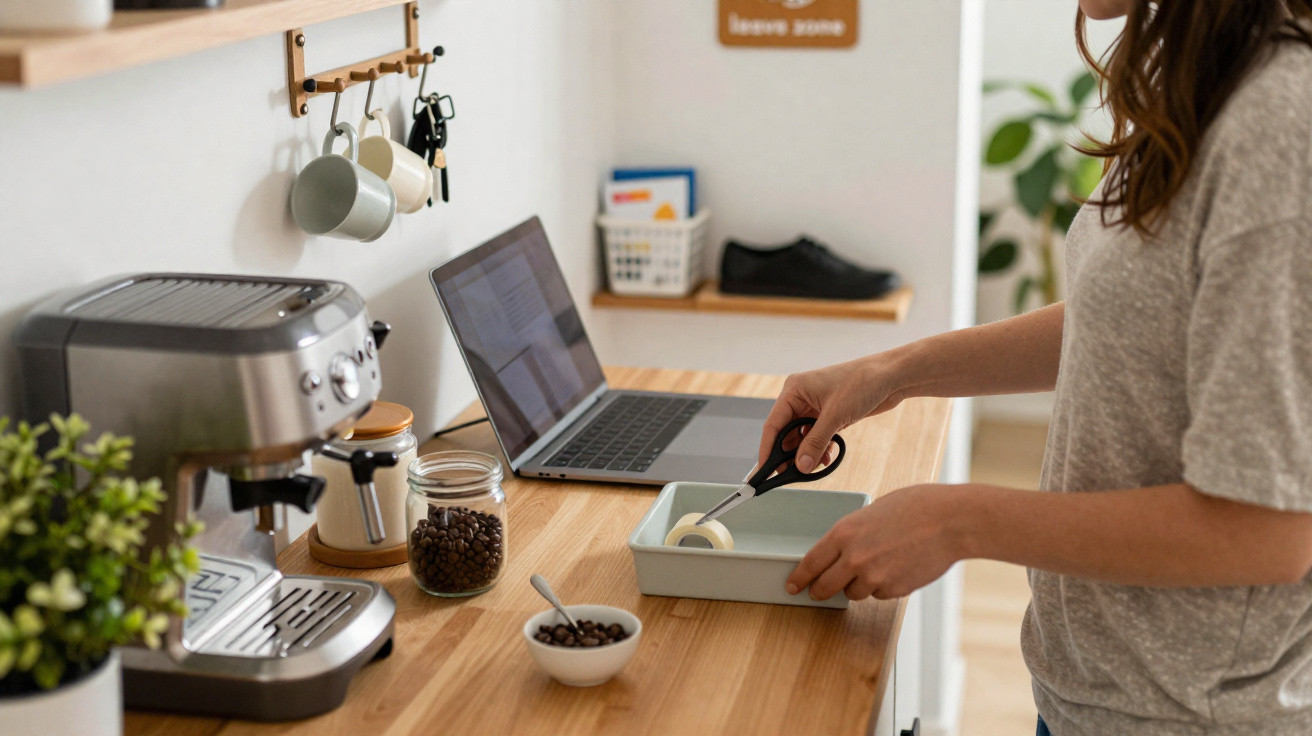
Your kitchen may look “tidy” by every conventional measure. Each item has a category and every category has a designated spot. Yet whenever you cook, make coffee or pack lunchboxes, you lose small amounts of time searching for things that ought to be easy to find.
The same applies to cables knotted together in a tidy box, skincare products sorted by brand and stationery arranged by colour. It may look attractive, but it is slow to use. The categories make perfect sense in theory; your day-to-day life does not.
Imagine instead that tea sits beside the mugs, lunchboxes contain the snacks and chargers are kept precisely where you use your laptop. Nothing necessarily “matches”, but everything works smoothly.
That seemingly minor change can transform more than just your cupboards.
Why “where things live” matters more than “what things are”
Step into a typically organised home and you will spot the pattern immediately: shelves marked “Pasta”, “Cereal” and “Snacks”, plus drawers labelled “Make-up”, “Hair” and “Skin”. It appears sensible, perhaps even Instagram-ready. But watch somebody get three children ready for school and out of the door by 8:10, and the weaknesses quickly become obvious.
Cereal may be in one cupboard, bowls in another and vitamins in a third. You end up walking back and forth across the kitchen simply to prepare breakfast. Everything remains “in its category”, but the routine feels like wading through treacle. That is the hidden cost of organising items according to what they are rather than how they are used.
A productivity coach based in London told me she notices this arrangement in nearly every client’s home. One client had an immaculately labelled pantry but still felt that she “never had time”. Once they mapped out her morning, the coach counted seven separate journeys across the kitchen to prepare a single packed lunch. There was no chaos and no mess-only a layout working against her habits.
They ran a small experiment. All the lunch supplies-wraps, spreads, snacks and reusable cutlery-were moved into a single “lunch zone” close to the fridge. A task that had previously taken ten minutes was reduced to four. Across 200 school days each year, that quietly gives back almost 20 hours. That is half a working week saved from the familiar question, “Where did I put the breadsticks?”
There is a straightforward reason it works: your brain records life as actions, rather than categories. You do not think, “I will now engage with the condiments category”. You think, “I’m making a sandwich.” When possessions are sorted into categories, your brain must maintain a mental list of where everything is. That constant background monitoring is draining, whether or not you consciously notice it.
Organising by use takes away part of that invisible mental burden. Begin with the question: What am I trying to do here? Then shape your storage around the answer. Your home becomes less like a museum of possessions and more like a collection of systems that support everyday routines. There are no more mental treasure hunts: reach, pick up, do the task, finished.
Organising by use: turn rooms into action zones
The simplest way to change your perspective is to map your day rather than your drawers. Choose one problem area-the kitchen worktop, your desk or the hallway-and note the small tasks you perform there repeatedly. Make coffee. Pack a bag. Complete your bedtime skincare routine. Each repeated task can form a small “zone”, even if it occupies only part of one shelf.
Next comes the subtle magic: put everything required for that task into its zone, regardless of its official category. Keep coffee, filters, sugar and mugs within one reach. Put keys, headphones, travel card and sunglasses together in a bowl by the door. Place night cream, lip balm and floss in a small tray beside your toothbrush, rather than separating them into brand collections.
Create grab-and-go bundles. Keep a bill-paying kit containing envelopes, stamps, pens and a notepad in a folder where you actually deal with paperwork. Store tape, glue, spare screws and a mini screwdriver in a “repair basket” beneath the sink. You are creating ready-made starting points throughout your home, so you do not waste energy before the task has even started.
A frequent obstacle is the inner voice saying, “But all the make-up should stay together,” or “All cables belong in the tech drawer.” Usually, that voice belongs to an imagined future visitor, rather than to you. It wants your home to look orderly in a photograph, not to function brilliantly at 7:03 on a Monday when your laptop is at 3%.
There is also a genuine emotional dimension. Many of us were raised to believe that “proper” organisation meant putting similar items together, folding everything and storing everything out of sight. Ignoring that rule can feel slightly wrong, even childish, despite making life noticeably easier. On a difficult day, you may feel as though you are failing at adulthood because your power bank now lives in your handbag rather than in the official gadget drawer.
Let’s be honest: nobody truly maintains that system every day. No one keeps a flawless category-based arrangement in real life without spending time and stress on it. People whose homes “always look tidy” either clean constantly, conceal the clutter or arrange things by use without consciously realising it. You are not lazy when your categories repeatedly fall apart. You are simply using the wrong rulebook.
One professional organiser I spoke to explained it this way:
“A home that works is one you can reset in ten minutes after a long day. If your system needs an hour, the system is wrong – not you.”
This is where organising by use excels so quietly. It makes resetting almost effortless because belongings return to the place where the action happens, rather than to an abstract category home. After dinner, plates are put near the table, lunchboxes go back to the lunch zone and spices return to the cooking corner. Your future self does not need to think; your hands simply follow the route.
- Set up micro-zones for coffee, lunches, homework, bedtime, outgoing post and dog walks.
- Keep tools with their tasks: store scissors beside wrapping paper and a lint roller near the wardrobe.
- Put items where you stand when using them, rather than where they look best on a floor plan.
- Ignore “keep everything together” rules: duplicates across several zones can often save time.
- Trial the idea in one room for two weeks before introducing it throughout the home.
Small experiments that quietly reshape your routines
The advantage of this approach is that there is no need to reorganise your entire house. Begin with one small area that regularly frustrates you: the desk where a pen is never available, the bathroom shelf that turns mornings into a search, or the cupboard where making packed lunches begins with a deep sigh.
Choose one daily or weekly task, collect every item you need for it and place them all in one accessible location. Then simply live with the setup. Pay attention to how often you skip a step, forget fewer things or finish sooner. Notice the way your shoulders relax when making a simple snack no longer involves juggling three cupboards.
This method encourages you to view your home as a living prototype instead of a completed project. Try a coffee zone beside the kettle; if it makes the worktop feel cluttered, reduce its size. Test storing dog leads by the door; if they get in the way, move them to a hook inside a cupboard. The goal is not to “get organised” once and for all. It is to keep refining the space until your routines feel as though they are running downhill.
Eventually, you may find yourself gathering what you need for a task almost automatically because the zones are doing the thinking for you. That is when you see that the real benefit is not a neat drawer. It is the dozens of small points of friction quietly removed from your day.
| Key point | Detail | Benefit for the reader |
|---|---|---|
| Organise by action, not category | Create zones around routines such as coffee, lunch and keys | Reduces time lost searching and walking back and forth |
| Keep tools close to where they are used | Place objects where you stand when using them | Lowers mental effort, forgotten items and decision fatigue |
| Test through small experiments | Change only one area at a time for two weeks | Lets you adjust without pressure and retain only what works |








Comments
No comments yet. Be the first to comment!
Leave a Comment