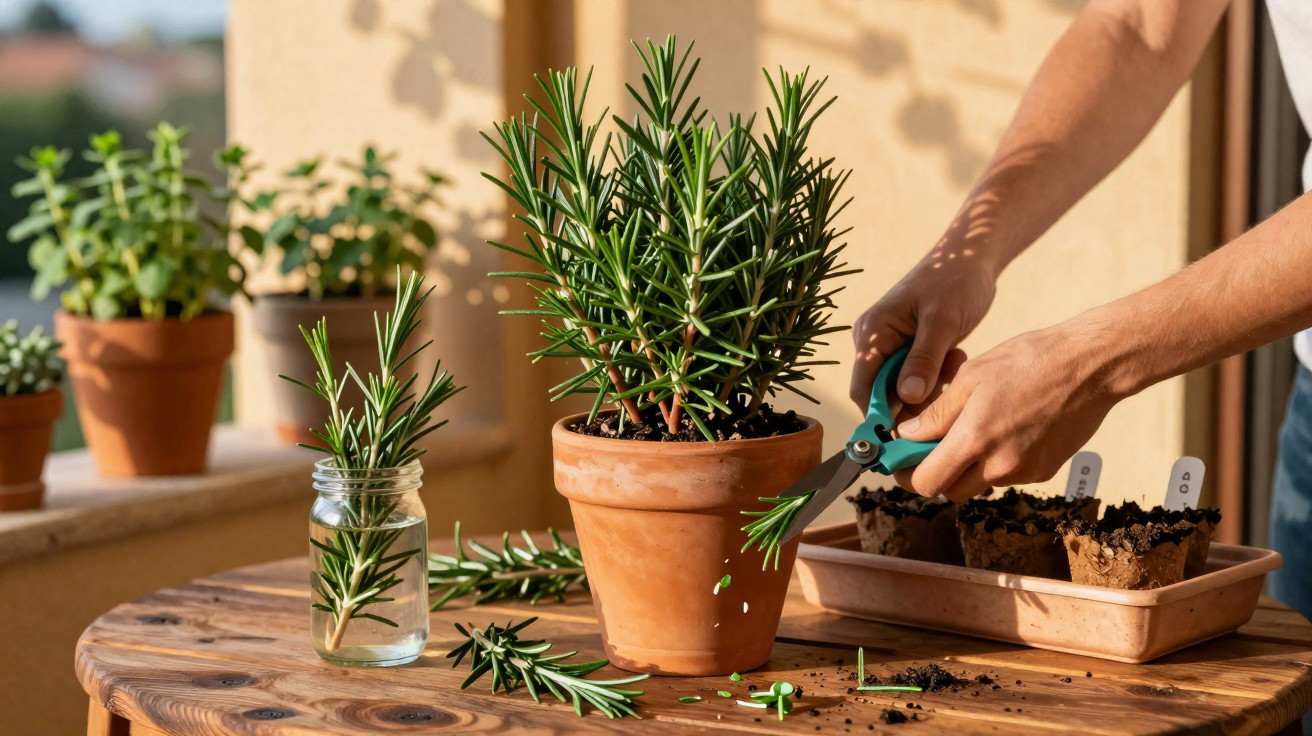
If you grow rosemary in the garden or in a pot, you may know the pattern: it starts out dense, fragrant and deep green, then gradually develops more brown branches and bare patches. The good news is that this is rarely caused by a “poor location”; it is almost always the result of incorrect or missing pruning. A few straightforward rules will keep rosemary compact, aromatic and healthy for years.
Why rosemary needs pruning at all
Rosemary originates from the Mediterranean, where it grows as a small shrub. Left entirely to its own devices, it becomes heavily woody, develops dry branches in the centre and loses vigour. Regular pruning addresses precisely this problem.
“Regular, careful pruning encourages young green wood, denser foliage and a more intense fragrance.”
The main benefits of regular pruning are:
- encouraging fresh new shoots
- a compact, bushy habit instead of long, broom-like stems
- more intensely flavoured needles
- easier harvesting for cooking and drying
- a sturdier plant that copes better with wind and weather
Whether it is growing in a pot on the balcony or in a gravel garden bed, rosemary eventually loses its ornamental appeal without occasional pruning – and its flavour often becomes weaker too.
The right time: when should you prune rosemary?
Spring pruning after flowering
The best time for the main prune is late spring. In many areas, this means March to April, once the flowers have faded and severe frost is no longer expected.
Follow these rules:
- cut only into the green, soft growth
- shorten shoots by roughly one third
- make clean, smooth cuts rather than crushing the stems
This encourages plenty of fresh side shoots. The results are usually visible within a few weeks: denser foliage, a fresher colour and more flavour. In exposed, colder locations, it is better to wait until April so that late frosts do not damage the cut surfaces.
Young plants should only be lightly pinched back in spring: shortening the soft tips by around 5 to 8 centimetres is entirely sufficient. This helps establish a compact, rounded shape early on.
Light shaping prune in autumn
A second, much gentler prune can be carried out in October. This is for maintenance rather than major rejuvenation:
- remove dry, dead twigs
- shorten damaged, overly long or misshapen shoots
- lightly thin the crown so air can reach the centre
It is important to prune on cool, sunny and dry days. Wounds heal more slowly during prolonged damp weather, giving fungal diseases an easier opportunity to establish themselves.
In particularly cold regions, autumn pruning should be kept very light so that no tender new growth is exposed to frost.
Times when you should never prune
There are three periods that are entirely unsuitable for pruning rosemary:
- Severe winter frost: cut surfaces can freeze, shoots may die back and diseases can enter more easily.
- Heatwaves in high summer: pruning combined with heat stress is a dangerous combination for rosemary and can cost you the entire plant.
- Peak flowering: hard pruning at this stage takes substantial energy from the plant and weakens it unnecessarily.
Restraint is also advisable in very wet weather. Open cuts during persistent rain provide an entry point for fungi. It is better to wait for a dry day with some sunshine.
Pruning rosemary according to its age
Young rosemary: shape gently, do not cut back hard
With plants up to around two years old, the aim is not major intervention but building a good framework. Pruning too severely at this stage does more harm than good.
“Never remove more than a quarter of the green growth from young plants.”
Practical steps:
- remove 5–10 centimetre tips using your fingers or secateurs
- always cut just above a pair of leaves or a node
- work around the whole plant to create an evenly bushy shape
The outcome is a dense, rounded shrub that will remain noticeably vigorous for longer in later years.
Older rosemary: gradual rejuvenation
Many mature rosemary shrubs are brown and bare near the base, producing growth only at their tips. In this situation, a gradual rejuvenation programme over two to three years is the answer.
Proceed as follows:
- in the first year, completely remove mainly dead, grey-brown branches
- moderately shorten individual shoots in areas that still contain green growth
- always leave enough leafy branches behind – rosemary needs foliage to supply energy
This lets the root system adjust to the reduced crown. A well-rejuvenated old shrub can remain productive for many more years.
Emergency hard pruning – significant risks
When a completely woody rosemary plant has been neglected in the garden for years, severe pruning can seem tempting. However, caution is essential.
“As a rule, rosemary will not regrow from old brown wood. Cutting too deeply can ruin it permanently.”
If a few green buds are still visible on the woody section, an emergency attempt may be worthwhile: cut shoots back by no more than half, loosen the soil, water carefully and then be patient. It can take months for fresh shoots to appear – and there is no guarantee.
Rosemary pruning in pots and garden beds
Pruning rosemary in a pot
In a container, the roots are severely restricted. Consequently, every cut has a greater effect than it would on a plant growing in garden soil.
- remove around one third less growth than you would from rosemary in a bed
- consistently shorten only the green, soft sections of shoots
- avoid waterlogging after pruning at all costs and empty saucers
Potted rosemary recovers more slowly, especially where the compost drains poorly. Moderate but regular watering after pruning, together with a sunny, sheltered position, will support recovery.
Pruning rosemary in a garden bed
Rosemary shrubs planted in open ground have access to considerably more nutrients and water, as well as a larger root volume. This makes them more tolerant of pruning.
On well-established plants, shoots can be shortened by up to two thirds of their length, provided the cuts remain within green growth. A sharp, clean pair of secateurs allows you to:
- remove crossing branches and those growing towards the centre
- thin the crown so air can circulate through it
- create shapes such as a half-sphere or a loose hedge
Rosemary in a garden bed generally handles stronger corrections better too, provided it is growing in a sunny, fairly lean position.
Special forms: trailing or spherical
Low-growing, ground-covering varieties should be kept flat. Shoots that break upwards disrupt the spreading appearance and should be removed consistently.
For a perfect ball shape, shorten all shoots evenly around the plant by about one third, walking around it several times until the outline is right. Two such shaping sessions each year are usually enough to create a dense green sphere that gives structure to beds and paths.
Common rosemary pruning mistakes
Cutting into old wood – the taboo
Probably the most frequent mistake is cutting too far into brown, hard wood. Rosemary rarely produces new growth from it. The result is bare, dead branches in the middle of the shrub.
“Before every cut, test with your fingernail: it must be green and fragrant beneath the bark – otherwise, do not cut.”
By strictly limiting cuts to green, still-flexible sections, you will maintain a vigorous shrub with dense foliage.
Removing too much at once
Taking away more than one third of the green growth in one go throws the plant out of balance. The roots suddenly have far less foliage to support, energy reserves are diverted to wound healing, and new growth is greatly delayed or may fail to appear altogether.
Instead, spread major corrections over two to three years. This allows rosemary to recover after each measure and build up strength again.
Incorrect tools and unsuitable weather
Blunt, dirty secateurs crush shoots and transfer diseases from one plant to another. Better practice is to:
- use sharp, clean secateurs or small scissors
- use sharp hedge shears for larger shrubs if necessary
- clean tools regularly and disinfect them briefly
The best conditions during the day are dry, bright and reasonably sunny – fitting for rosemary’s Mediterranean origins. Wet, cold days are unsuitable because pruning wounds close more slowly.
Propagating rosemary from cuttings – making good use of prunings
Taking and preparing cuttings
Spring pruning produces plenty of young, healthy shoots, making it the ideal source material for cuttings. Suitable pieces are shoots from the current year measuring around 15 centimetres long.
Proceed as follows:
- strip off the lower leaves from approximately half of the cutting
- leave only the leafy upper portion
- avoid branched and flowering shoots; choose simple, straight ones instead
Rooting in water or compost
There are two common methods:
| Method | Advantages | Particularly suitable for |
|---|---|---|
| Water | Roots are clearly visible, making it easier to check progress | very young, soft spring shoots |
| Compost | stronger roots, less stress when moved | semi-woody summer shoots |
For the compost method, use a 1:1 mixture of good-quality potting compost and coarse sand. Insert cuttings around 5–7 centimetres deep, firm the compost and moisten it lightly.
While they are rooting, keep the pots in a bright position but out of full midday sun. The compost should remain only lightly moist, as waterlogging quickly leads to rot.
Caring for young plants and planting out
Fresh new growth usually appears after four to six weeks, signalling that the root system is working. The young plants can then be moved into slightly larger pots, again using a sandy, loose compost.
If you intend to plant them in the ground, wait until the frost-free spring. Choose a sunny, sheltered and preferably lean site. In heavy soils, add a layer of gravel or grit to the planting hole so water can drain away quickly.
A useful addition to pruning is a mineral mulch of gravel or grit around the base of the plant. It keeps the soil sufficiently dry, stores a little warmth and protects the roots during winter.
Following these basic rules means you will have little reason to worry about your rosemary: with regular, moderate pruning, good timing and some patience, this Mediterranean shrub will remain a dependable supplier for the kitchen – and an attractive feature in the garden or on the balcony – for years.
















Comments
No comments yet. Be the first to comment!
Leave a Comment