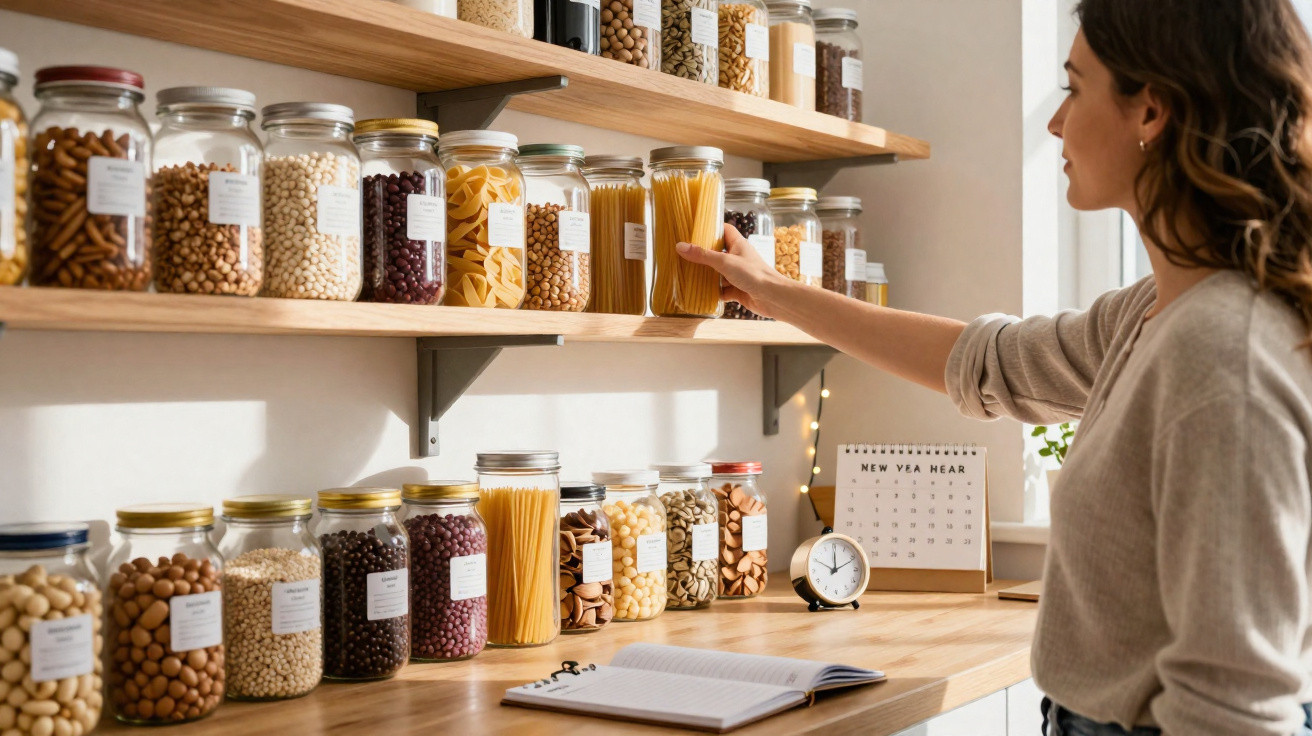
The final food shop of the year nearly always follows the same pattern.
You arrive home carrying bags of “fresh start” ingredients, push the door open with your hip, then stop dead in front of the cupboard. There are partly used packets, three jars of identical pasta sauce and crackers that have gone soft at the back. Somewhere beyond the abandoned couscous sits a tin of beans that went out of date two Christmases ago. You shuffle, pile and squeeze everything in, promising yourself you will deal with it “after the holidays”. You never do.
But picture a single, small rule that changes this familiar scene without fuss. There are no colour-coded tubs, no Pinterest-style transformation and no three-hour Sunday declutter. Instead, food is arranged in a way that means it gets eaten rather than binned in a guilty panic before collection day. It is a rule you can recall when you are exhausted, distracted or already thinking about pudding.
This pantry organisation rule quietly stops food waste before the new year has even started.
The pantry problem you cannot ignore
When you look inside somebody’s pantry, you see more than ingredients. You see unfinished plans: gluten-free flour from that attempt to “eat better”, four tins of chickpeas bought during a motivated spell, and the posh jam received last winter that remains unopened while it waits for a “special breakfast” that never happens. The shelves may be full, but not in a reassuring sense. They resemble a record of discarded intentions, stacked one over another.
That is how the understated problem begins. Once shelves become overcrowded and haphazard, your brain no longer properly registers what you own. Use-by and best-before dates merge together, duplicates accumulate and making dinner becomes a guessing game about what remains usable. Food slips to the rear and stays there until it is too late. It is not deliberate; the disorder simply makes waste seem unavoidable.
Across the UK, households discard millions of tonnes of edible food each year, with a substantial proportion of that waste starting in untidy cupboards. Researchers describe this as “out of sight, out of mind waste”. You might call it “I’ll clean this before the new year”, before avoiding that cupboard unless absolutely necessary.
Consider the shelf in your own kitchen that is something of a graveyard. It may be the highest shelf, where tall bottles obscure little jars, or the corner where cereal boxes tilt like drunken skyscrapers. This is your pantry’s Bermuda Triangle: food enters, but it does not emerge - at least not before it is too late. The more items you pile there “just for now”, the less likely they are to be used. Memory cannot win against a cluttered shelf.
A European food-waste initiative study reached an almost embarrassingly straightforward conclusion: people with even casually organised pantries threw away considerably less food. It was not because they were more conscientious or more disciplined. They could simply see their supplies and identify what needed using this week rather than next month. That is the entire principle.
This is where one modest habit can alter everything: the “Use-First Front Row”. It may sound obvious, perhaps even overly so, but in reality it subtly changes how you eat during the final weeks of the year.
The reasoning is both ruthless and elegant. Anything that is near its date, already open or inconvenient to use belongs in one dedicated front section. It is not dispersed around the shelves, half concealed or mixed in with bulk purchases. It is a literal front row saying “eat me next”. Your eyes encounter it first, every time, so placement replaces memory.
The “Use-First Front Row” pantry organisation rule that saves food
The rule is simple: whenever food comes into or goes out of your pantry, reserve the front 20–30 cm of one shelf solely for “use-first” items. Nothing more is required: no app or spreadsheet. This clearly marked front row always contains the same category of food - anything that should be eaten before the new year, or as promptly as possible.
There is no need to overhaul the entire pantry. Simply designate that front strip as your priority lane. Open packets, tins approaching their date, a solitary tortilla and a jar containing one spoonful of pesto all belong there. They should not go above it, behind it or “wherever there’s space”. This slim area becomes a tangible instant to-do list. Even if time is short, moving one half-open bag to the front is enough. It counts.
Imagine a late-December Tuesday evening when you stare into the cupboards with no energy to follow a recipe. Rather than searching aimlessly, you look straight at the front row. You find half a jar of tikka paste, a tin of coconut milk nearing its date and already-open rice crackers. Dinner suddenly becomes tikka-style roasted vegetables with rice crackers on the side. Is it sophisticated? No. Will it prevent you from ordering a takeaway and throwing that jar away in January? Yes.
Jules, a single dad who began following the rule last year, saw a difference within a few weeks. “I used to do a big clean right before New Year’s Eve and fill two garbage bags,” he says. “Last year, I filled half a bag. Half. And it wasn’t because I was extra disciplined. I just kept shoving stuff to the front every time I came home from the supermarket.” His pantry is still not Instagram-perfect - but that was never the aim.
The figures support accounts such as his. In several small household trials, participants who created a visible “eat me first” section reduced edible pantry waste by 25–40%. They did not achieve this through greater willpower, but by reducing friction. The more instinctive a rule becomes, the better it works. This small front-row routine transforms an intimidating task - “organize the whole pantry” - into a five-second action repeated regularly. That is how behaviour becomes established: not through one major clear-out, but through dozens of small prompts.
Its effectiveness comes from the limitation. When the front row has no room left, do not force another item into it; instead, use something from that area in your next meal. This mild pressure changes passive guilt into manageable daily action. Rather than asking, “What am I in the mood for?”, you begin to ask, “What can I use tonight from the front?” That shift lowers food waste without a moral lecture.
Making the rule work in everyday life
Begin with a single shelf, preferably one at eye height. Empty only its front strip, roughly the depth of a cereal box placed sideways, and make it your “Use-First Front Row”. Next, briefly scan the rest of the pantry and take out every item dated before March, along with all opened packets and isolated leftover ingredients. Do not dwell on each decision. Put them into the front section, with labels visible and taller items towards the back of the strip so that nothing is concealed.
Visibility, not beauty, is the objective. Each time you unpack groceries, take ten seconds to review that front row. When a new purchase has an earlier date than an item already there, place the new one at the front and shift the older product behind it. This is classic “first in, first out”, pared down into one manageable zone that a tired mind can cope with, even on a Wednesday evening in December.
There will naturally be occasions when you pay no attention to it. Some evenings call for pasta with ready-made sauce and nothing even slightly strategic. That does not mean the rule has failed. The next time you cook, the “use-first” foods will still be in view. They do not vanish because yesterday was imperfect. The front row stays put and quietly reminds you.
Let us be honest: nobody truly does this every single day.
What most people can manage is doing it “most days, sort of”. After coming home from the shop, you can spend 30 seconds bringing the oldest crackers to the front. When opening a fresh jar, you can move the nearly empty one into the front row. These are the smallest possible actions, and they still matter. During a season when every task can feel overwhelming, a tiny rule that survives your tiredness is invaluable.
“The turning point was when I stopped trying to have a perfect pantry,” says Maya, who shares a tiny flat with two roommates. “We just taped a label on the front of one shelf: EAT THIS FIRST. Now, before anyone orders takeaway, we check that spot. It’s saved money, but more than that, it’s saved us from that awful feeling of throwing away full packets in January.”
To make the routine stick, treat the front row as an active and changing shortlist, not a static display. Swap items in and out two or three times a week. Mention it to anyone you share the kitchen with, and point it out when guests are helping to cook. Allow the rule to become part of how your household talks, rather than presenting it in “life hack” language.
- Claim the space – Mark out the front row with tape or a marker so that everyone can see it.
- Keep it deliberately small – A slim section encourages rotation rather than stockpiling.
- Link it to a regular moment – Shopping put away, kettle boiled or dishwasher running = 30 seconds to refresh the front row.
A small rule with wider effects
There is a quiet satisfaction in entering the new year with a pantry that is not a museum of expired good intentions. No dramatic purge is necessary, and neither is a shame-driven clear-out. Instead, there are simply fewer moments of asking, “how did this go bad?” The “Use-First Front Row” will not make you a completely different person. It makes your kitchen a slightly more forgiving place, where food has a better opportunity to do what it is meant to do: be eaten rather than regretted.
Psychologically, the rule softens the difficult gap between the life you hope to lead and the one you actually lead. You do not wake up magically changed on 1 January. You wake up with a pantry already guiding you towards less waste, more purpose and, yes, a little more imagination. Pasta with that nearly empty jar of olives; soup from the final, lonely lentils. It may not be glamorous, but it is genuine.
Practically speaking, this narrow strip of shelving can also prompt conversations. Friends may open your pantry and notice the clear “eat me first” area. Children learn to check it before reaching for snacks, while partners stop purchasing a fifth tin of tomatoes “just in case”. Without speeches or arguments, your household begins to follow one small shared rule.
We have all stood over the bin, throwing away stale nuts and dusty tins while promising, “Next year will be different.” Perhaps this is how that promise finally lasts: not through an ambitious resolution, but through a quiet front row that whispers each evening: use what you already have.
| Key point | Detail | Benefit for the reader |
|---|---|---|
| Use-First Front Row | The front 20–30 cm of a shelf is set aside only for foods that need eating soon. | Immediately reduces waste and guilt linked to forgotten food. |
| A seconds-long ritual | Put products with short dates or opened items in this area as a matter of course. | Easy to maintain with a busy schedule, without a major cupboard-organising project. |
| Visibility rather than perfection | The purpose is to see food, not to create an “Instagram” pantry. | Makes the method easy to adopt without aesthetic pressure or a sense of failure. |




Comments
No comments yet. Be the first to comment!
Leave a Comment