
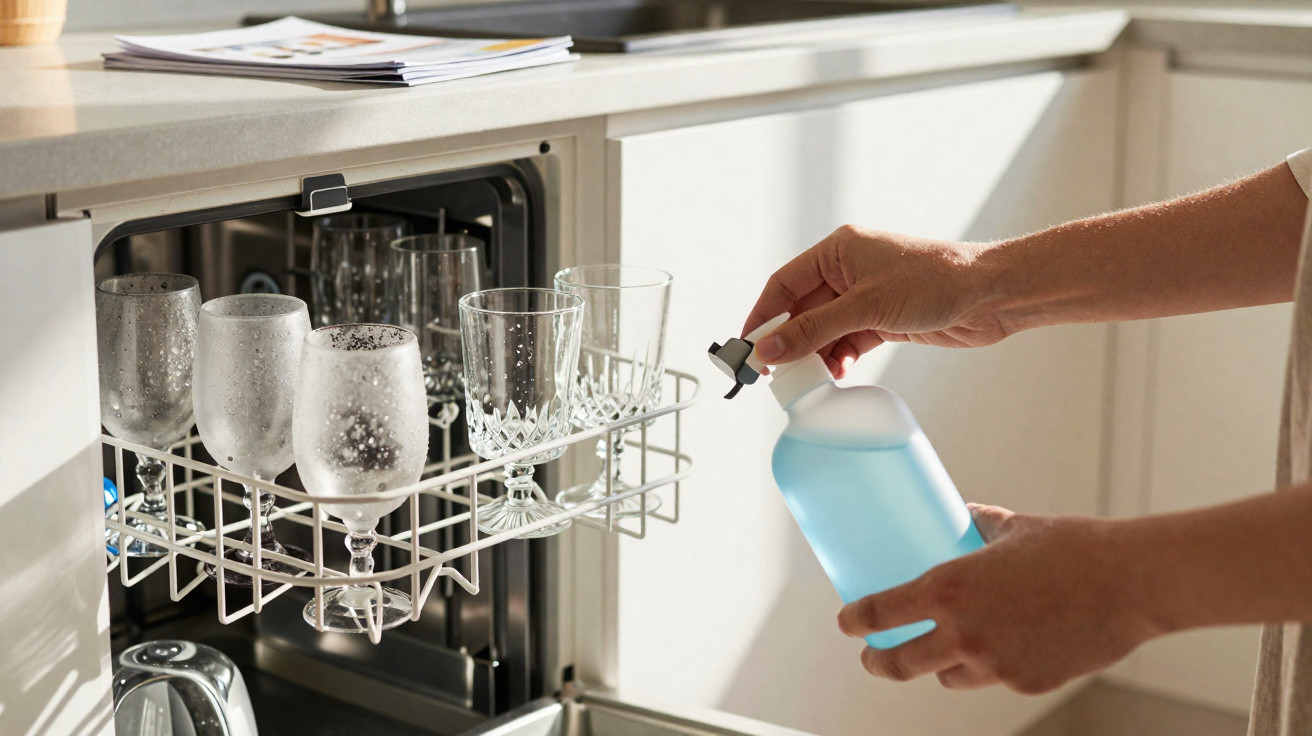
We have all seen it: the dishwasher whirs, the programme finishes, and the glasses emerge looking… weary. Cloudy rings. Milky marks. The sort of dull finish that makes dinner seem less special, even when the meal itself is flawless. Hard water and detergent deposits are usually to blame, creating a stubborn coating that will not shift politely. Yet one small trick changes the outcome-no specialist product, elaborate method or replacement appliance required. All you need is a cupboard staple with an understated talent.
Every cloudy circle seemed to tell the story of yesterday’s wash, with a trace of limescale lingering beneath the rim. Technically, the dishwasher had completed its task, but the sparkle had vanished and the table felt underwhelming before breakfast had even begun.
I once watched a neighbour open her dishwasher, put a small cup on the upper rack and fill it with ordinary white vinegar. She gave a knowing wink, as though it were a family secret passed down alongside a pie dish. After one cycle, the glasses looked as though a film-set prop master had approved them. The answer was vinegar.
Why a splash of vinegar restores the shine
Glasses do not simply “get dirty” in the dishwasher; they accumulate a delicate layer of minerals and residual surfactants that survive the rinse. Hard water contains calcium and magnesium, which dry into light-catching patches and turn clear glass hazy. The low pH of vinegar breaks down those mineral crystals and loosens the soapy coating that adheres to smooth glass surfaces.
We have all experienced a disappointing dishwasher load, followed by a late-night search for better detergents. A small amount of white vinegar-around half to one cup-can give the story a different ending. In hard-water regions (roughly 80–90% of U.S. homes, as well as many other places), it can mean the difference between glasses that are merely “clean-ish” and ones that gleam, making even water appear more luxurious than it is.
The reason is straightforward: those chalky marks are largely carbonate minerals that cling stubbornly to surfaces. The acetic acid in vinegar reacts with them, making them soluble again so they can be washed away during the rinse. It can also alter the rinse water’s surface tension, helping droplets run off rather than linger and dry into spots. Vinegar doesn’t perfume the problem; it removes it at the source.
How to use the dishwasher vinegar trick safely
Choose plain white vinegar with 5% acidity. Pour 1/2 to 1 cup into a robust mug or small bowl, then stand it upright on the top rack. Load the glasses normally and run a standard or eco programme using hot water. As the vinegar slowly spills out, it dilutes through the wash and rinse, tackling deposits without soaking the appliance seals in undiluted acid.
Avoid pouring vinegar directly into the detergent drawer or rinse-aid compartment; at that concentration, it may be tough on gaskets over time. Never mix it with products containing chlorine bleach, as the two should not be used together. Try this method when haze begins to return or after washing a large number of glasses. Realistically, no one is doing it every day.
For such a simple method, it can feel like a cheat. Where the water is especially hard, this minor adjustment can become a domestic triumph visible at every meal. Think of vinegar as a targeted reset, not a new religion for your dishwasher.
“We tried every rinse aid on the shelf. The day we started using a cup of vinegar on big glass loads, the fog lifted-literally,” says Dana, who runs a small bistro where glasses have to sparkle under bar lights.
- Use white vinegar rather than apple cider or balsamic vinegar, avoiding unwanted scent and staining.
- Begin with 1/2 cup, increasing to 1 cup if the marks remain.
- Place the cup upright on the top rack; do not fill the rinse-aid compartment.
- Wipe up any spills on stone worktops straight away, as vinegar may etch natural stone.
- If you use this approach weekly, check your dishwasher manual and inspect the gaskets from time to time.
Beyond clear glasses: changes around your kitchen
Once that film disappears, the whole kitchen can seem brighter-both in the literal way light travels through water, tea and wine, and in the way a well-laid table affects the atmosphere. People notice it without consciously realising, much as they appreciate a view or a freshly cleaned window. When a splash from a bottle in the cupboard achieves that result, it feels like a modest, personal success that demands very little effort.
You may use fewer polishing cloths, waste less hot water on repeat washes and stop feeling tempted to buy another expensive detergent whenever the seasons turn. Tell the friend who believes their dishwasher is “over”, then wait for the photograph of a glass shining like a bell. The trick isn’t dramatic-it’s repeatable, which is what matters on a Tuesday night.
| Key point | Detail | Benefit for the reader |
|---|---|---|
| Cup-and-splash method | 1/2–1 cup of white vinegar in a mug on the top rack | Simple, no tools or dismantling required |
| Hard-water solution | Dissolves calcium and magnesium film during the rinse | Crystal-clear glasses without hand-polishing |
| Safe habits | Do not pour into dispensers; avoid bleach mixtures; use occasionally | Results without putting gaskets or finishes at risk |














Comments
No comments yet. Be the first to comment!
Leave a Comment