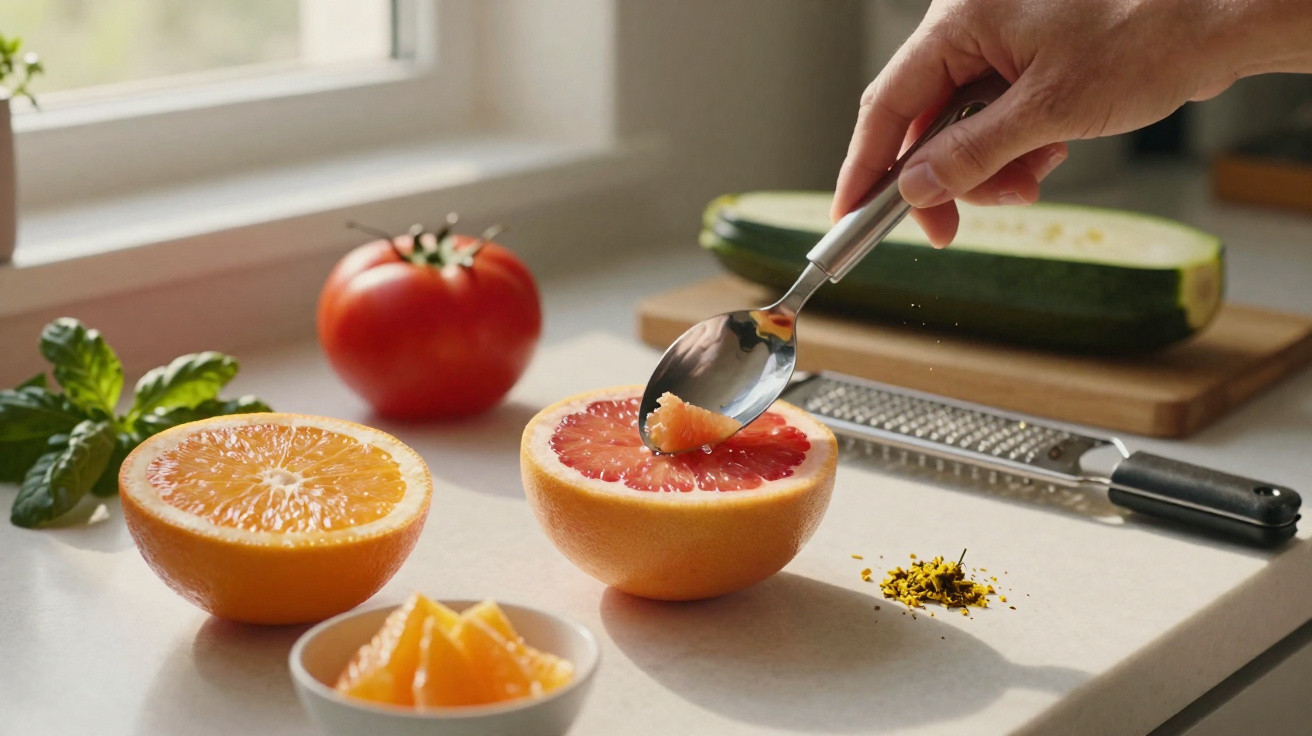
Juice sprays, pulp clings on and knives slip – many people struggle with even simple citrus fruits.
A small invention puts an end to that.
Anyone who enjoys grapefruit, oranges or kiwi will know the issue: either half the flesh stays stuck inside, or the plate ends up covered in a sticky mess caused by a knife. Special fruit spoons promise to solve precisely this everyday irritation – and are currently giving kitchen enthusiasts plenty of aha moments.
What makes special fruit spoons different
At first glance, these spoons appear unremarkable. Looking more closely, however, reveals that the bowl and edges are finely serrated, almost like a miniature saw. Those tiny teeth are exactly what makes them effective.
The fine serration cuts through the membranes of citrus fruits without crushing the flesh, helping you get more edible fruit from every piece.
The featured set includes two spoons in different lengths:
- a compact spoon measuring around 15 cm – easy to handle for smaller hands and smaller fruit
- a longer, slimmer spoon of approximately 17 cm – suited to deeper skins and larger fruit
Both versions are made from stainless steel. This material is considered durable, rust-resistant and neutral in taste. The spoons can be washed by hand or simply put in the dishwasher.
How fruit spoons work with grapefruit, oranges and more
Using them is straightforward: halve the fruit, place the spoon inside, cut along the membranes around the flesh and lift it out. The teeth on the tip and sides of the spoon slice through the delicate membranes without turning the inside into a mushy pulp.
Typical uses include:
- Grapefruit: Run the spoon along the skin and release each segment separately, without juice splashing in every direction.
- Oranges: Useful when you want to eat orange halves straight from the skin rather than peel the whole fruit.
- Lemons and limes: Scrape out any remaining flesh after juicing – handy for marinades or drinks.
Many users report wasting noticeably less fruit flesh when using fruit spoons. This is especially apparent with grapefruit, where a considerable amount traditionally remains in the skin, as the tool removes significantly more.
Fruit spoons are useful beyond citrus fruits
Their versatility becomes particularly interesting when the spoons are used for other jobs. The narrow, serrated edge works for much more than citrus fruit alone.
Scooping out soft fruit neatly
Whether it is kiwi or exotic fruit with a soft centre, the spoon grips effectively where an ordinary teaspoon reaches its limits.
- Kiwi: Cut it in half, insert the spoon just beneath the skin, cut once around the edge and release the flesh in one piece.
- Dragon fruit: Score the thick skin, insert the spoon and comfortably lift out the soft interior.
- Ripe pears: Remove the core or cut away soft patches without ruining the entire fruit.
Its long handle makes it easier to manoeuvre inside fruit and, if necessary, provides some leverage. Even firmer fruit such as apples can therefore be worked on with precision.
A useful tool for cooking and stuffing vegetables
Away from the breakfast table, the spoon set also serves as a compact kitchen tool when cooking:
- Stuffed courgettes or peppers: Remove the inside cleanly without damaging the outer skin.
- Preparing cucumber: Scrape out seeds accurately – ideal for stuffed cucumber boats or tzatziki.
- Melon: Remove seeds and soft flesh, or shape small fruit balls.
Anyone who likes preparing stuffed vegetables can save both knife work and frustration with this spoon set, as the outer shell stays intact.
What users value about fruit spoons
Reviews on major online platforms repeatedly highlight similar points. Many buyers say they underestimated this simple kitchen tool for a long time and now use it regularly.
Many users describe it as an “unassuming but extremely practical helper” that they would no longer want to be without in everyday life.
Frequently mentioned advantages include:
- very easy to use, quick to explain and ready for immediate use
- noticeably less juice splatter when eating grapefruit
- more fruit flesh is used and less ends up in the bin
- a solid, high-quality feel thanks to stainless steel
- easy cleaning and dishwasher suitability
Many purchasers say they initially ordered the spoon only for grapefruit, but gradually found further uses for it – from a kiwi spoon to a tool for stuffed vegetables.
Fruit spoons and a zester: a duo against food waste
Anyone wanting to use every part of citrus fruit can pair a fruit spoon with a fine zester. While the spoon removes the flesh, the grater deals with the aromatic skin.
| Tool | Use |
|---|---|
| Fruit spoon | Loosening fruit flesh from the skin, removing seeds and hollowing out vegetables |
| Fine zester | Grating the skin of lemon, lime and orange for baking and cooking |
This makes it possible to use almost the entire fruit: the skin can go into cakes, desserts or dressings, while the flesh can be added to muesli, bowls or served directly on the plate. Anyone who bakes regularly or enjoys cooking from scratch can not only reduce leftovers this way, but also add more flavour to their dishes.
What to consider when buying fruit spoons
When comparing different options, several points stand out as having a direct effect on everyday use.
- Material: Stainless steel lasts a long time, resists rust and feels hygienic. Thin, cheap versions may bend.
- Handle length: A longer handle provides more leverage, while a shorter one often sits better in smaller hands.
- Serration: Neat, fine teeth cut more precisely; coarse serrations are more likely to tear the fruit flesh.
- Cleaning: Anyone wanting minimal effort should check that the spoons are dishwasher-safe.
For households where children eat too, it is worth considering the shape: rounded tips are more comfortable without compromising function.
Everyday ideas for using the set well
One practical approach is to keep the spoons directly in the fruit bowl or near the breakfast area. When they are within easy reach, people are more likely to choose fresh fruit because it feels less effortful.
A few kitchen examples:
- Morning: Quickly scoop out half a grapefruit and serve it with yoghurt and oats.
- Lunch: Fill a hollowed-out tomato with couscous or quinoa, with the spoon handling the fine work.
- Evening: Hollow out a courgette, fill it with minced meat or a vegetarian mixture, then bake until golden.
- Snack: Halve a kiwi or dragon fruit and eat it directly with the fruit spoon.
Anyone looking for a small kitchen upgrade that genuinely earns its place in everyday use will often find a fruit spoon set an unexpectedly excellent choice. Because the tool looks so simple, the difference from conventional spoons becomes clear on first use.
















Comments
No comments yet. Be the first to comment!
Leave a Comment