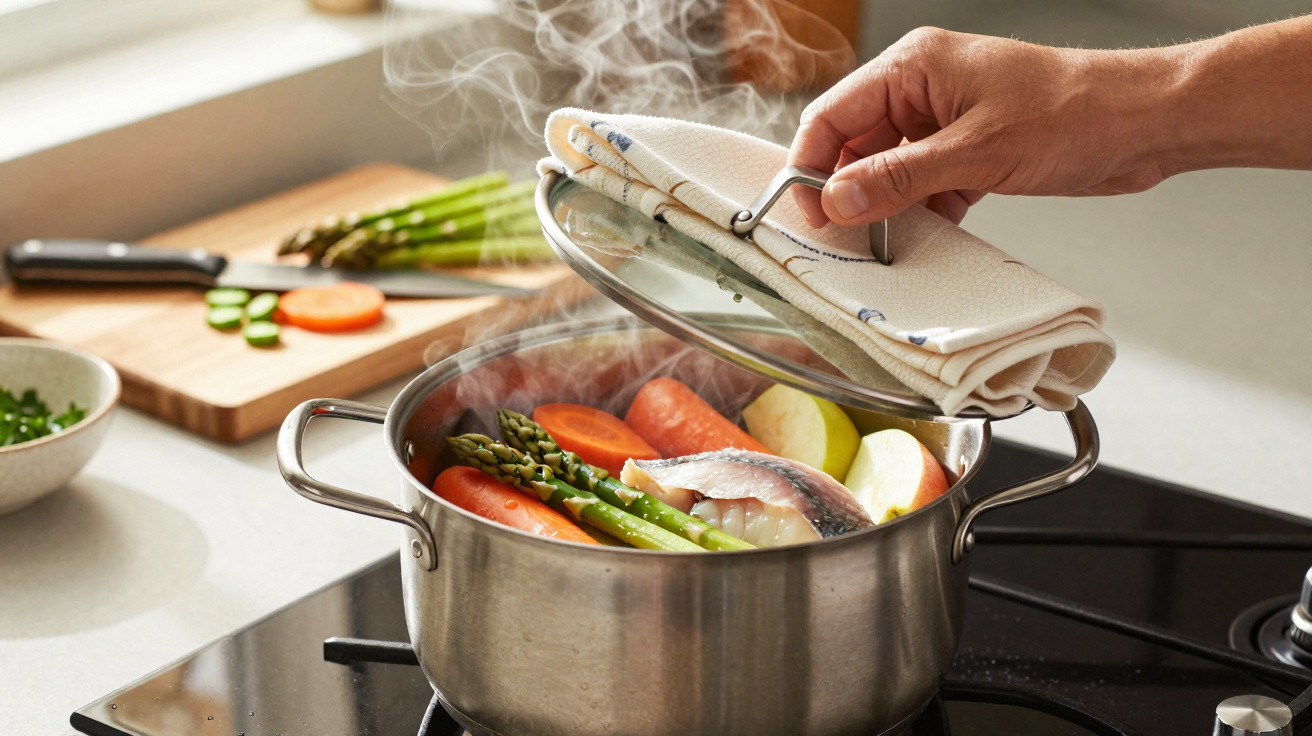
Many home cooks assume that gentle cooking without water or fat requires an expensive cast-iron casserole dish with a specialist lid. In reality, the ordinary saucepan in the cupboard is often enough – provided you know how to make purposeful use of the moisture already inside the ingredients and achieve a genuinely tight lid seal.
Gentle cooking without water: what really does the work in the kitchen
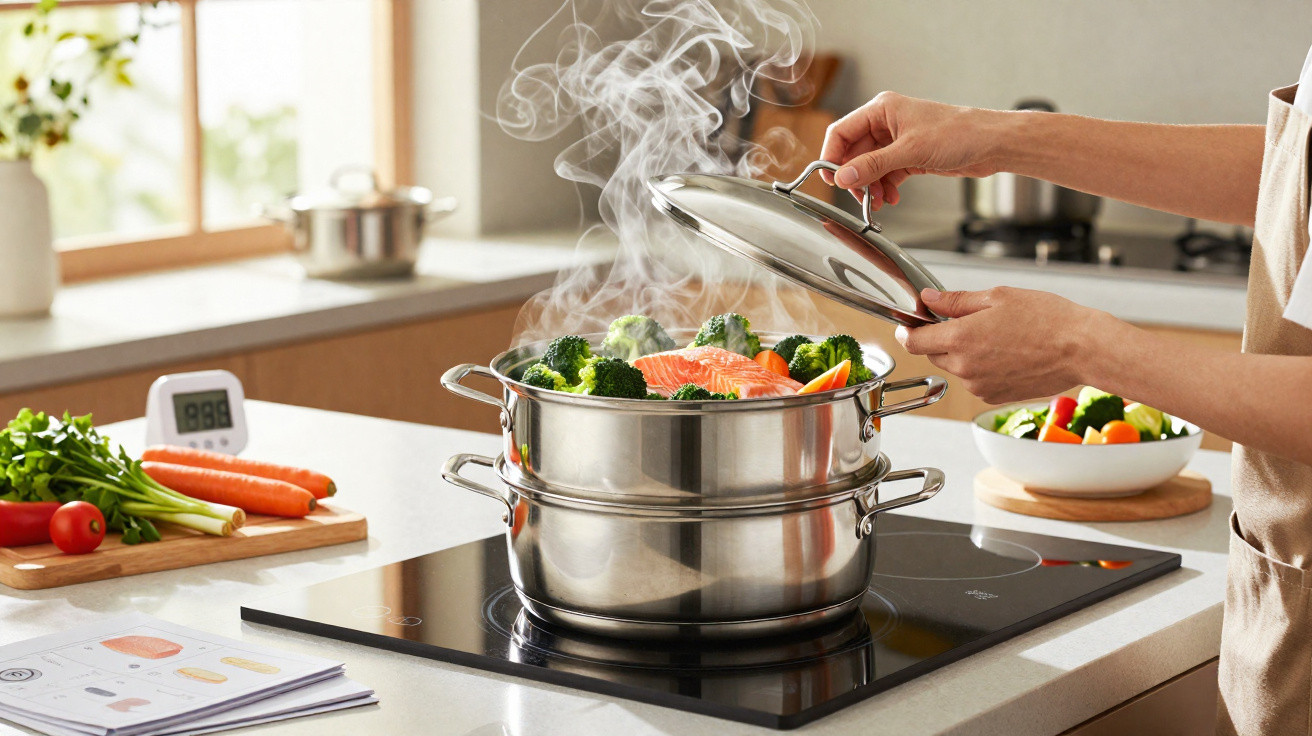
The crucial point is this: the pan itself does not create the result; it is the water naturally present in vegetables, fruit or fish. Every carrot, leek and piece of salmon contains a substantial amount of water. Used correctly, that moisture creates a form of mini steam-cooking directly in the pan, with no additional liquid required.
The method relies on a natural cycle:
- Heat turns the water contained in the food into steam.
- The steam rises and meets the cooler lid.
- It condenses there into tiny droplets.
- These droplets fall back onto the food, moistening it again.
“Rather than drowning everything in water, we simply use the ingredients’ own juices and let them circulate in the pan.”
This cycle does not require fierce heat. Instead, the technique works at roughly 60 to 80 degrees Celsius. That is far gentler than conventional frying. Flavours stay cleaner, vegetables retain their bite and colour, and delicate fish does not dry out.
Why an everyday saucepan can become a “miracle pan”
First, the good news: a heavy, coated luxury cocotte may be nice to have, but it is not essential. Two features that many standard pans already offer matter far more:
- A thick base, which distributes heat evenly and prevents hot spots.
- A reasonably well-fitting lid, so that moisture remains inside the pan.
Suitable options include:
- a sturdy stainless-steel casserole,
- a heavy frying pan with a lid,
- an enamelled or stainless-steel roasting dish.
In many kitchens, the real weak point is not the pan but its lid. Once steam escapes around the edges, the pan gradually loses moisture. This is where a simple yet effective trick comes in.
The tea-towel trick: making the lid almost airtight
A basic kitchen towel can upgrade the lid so that almost all moisture stays in the pan. The process could hardly be easier:
- Dampen a clean tea towel with water.
- Wring it out thoroughly until it is only slightly damp.
- Fold it several times to make a wide strip.
- Place this strip around the rim of the pan.
- Put the lid on top and press it down firmly.
“The damp cloth acts like a seal – steam stays inside, and the evaporation cycle really gets going.”
For safety, the towel must not hang over the edge towards a gas flame or hob. It should sit entirely on the rim and must never be dry, so it cannot overheat or, in extreme cases, catch fire.
Which foods are suitable for cooking without water and fat
Ingredients with a high water content respond especially well, above all vegetables. The method comes into its own particularly in spring, when fresh produce with intense flavour is available.
Vegetables: from carrots to asparagus
Particularly suitable choices include:
- carrots, ideally young carrots with a little of their tops,
- leeks,
- white cabbage or pointed cabbage,
- endives,
- green and white asparagus,
- courgettes and other summer squashes.
Even a simple combination quickly makes a flavoursome pan dish. A classic example for two people might include:
- 600 g carrots, cut into slices or batons,
- 2 leeks, sliced into rings,
- 1 onion, thinly sliced,
- 1 pinch of salt,
- pepper to taste,
- fresh herbs such as parsley or chives to serve.
Once the vegetables have cooked in their own juices, a touch of salt and some pepper are often all they need. The sweetness of the carrots becomes more pronounced, the leeks taste fuller, and herbs add a fresh finish.
Fish and fruit: a gentle method for delicate ingredients
Those who feel confident can try fish. Fillets with a slightly firmer texture, such as salmon or cod, work well. They remain juicy inside in the gentle steam and are less likely to break apart. Low heat and keeping the lid firmly closed are essential.
Fruit can also be cooked this way, for example:
- apple pieces for a quick compote-style dish,
- pear halves, which become soft and aromatic,
- plums for a warm dessert.
Step by step: how to cook without water successfully the first time
The process can be organised quite clearly. Following these steps soon delivers repeatable results.
1. Cut with purpose
Start with the knife. The size of the pieces directly affects how much moisture is released and how quickly heat reaches the centre:
- Evenly sized pieces ensure consistent cooking times.
- Medium-sized shapes, such as slices, batons or small florets, are a good compromise.
- Very large pieces take a long time to produce enough steam.
- Tiny dice break down quickly and can turn mushy.
2. Choose the right heat
At the beginning, use a medium setting to set the steam cycle in motion. As soon as the first moisture appears on the lid, turn the heat down. The aim is a quiet murmur from the pan, not loud sizzling.
“If you can hear the pan loudly hissing, you have already gone too far – patience wins with this method.”
If the heat remains too high, the liquid evaporates faster than it can condense. This can lead to food catching on the base, especially in thin-walled pans.
3. Lid on – and leave it there
This is the most unfamiliar part: simply keep the lid on. Every curious look releases steam, lowers the temperature and sets the process back. These signs are more useful instead:
- A steady, light film of steam on a glass lid.
- A quiet hiss, but no vigorous bubbling.
- An aroma that changes from “raw” to “rounded and soft”.
If you do need to look, do so rarely and briefly. It is better to test once after five to eight minutes than to check every 60 seconds.
Common mistakes – and how to avoid them
Most mishaps follow the same pattern: either too much steam escapes or the temperature is wrong. This overview provides useful guidance:
| Problem | Likely cause | Solution |
|---|---|---|
| Vegetables catch on the base | Heat too high, too little steam in the pan | Turn down the hob sooner, use a thicker pan, seal the lid |
| Vegetables remain hard | Pieces too large, cooking time too short | Cut smaller pieces, cook for three to five minutes longer |
| Watery texture | Opening too often, temporary loss of condensation | Keep the lid closed, use the tea-towel trick |
| Uneven cooking | Very different piece sizes | Take care to cut even shapes |
Why this way of cooking is more than just a trend
The technique does not only save calories because no oil is needed. It also reduces the amount of water used at the hob. People who would otherwise happily “boil vegetables to death” often have a revelation: the ingredients taste more intense even though less has been done to them.
From a nutritional perspective, gentle cooking in the ingredients’ own juices offers several benefits. Many heat-sensitive vitamins react badly to lengthy cooking in lots of water. The less liquid involved, the lower the risk that nutrients leach into the cooking water and later end up down the drain.
At the same time, the technique suits everyday life well: it needs no high-tech equipment, works in small kitchens and can easily be combined with other methods. If desired, you can briefly increase the heat after gentle cooking to add a little browning around the edges.
For inexperienced cooks, it is worth doing a trial run with a simple mix of carrots and leeks. Once you have developed a feel for the heat, lid and steam, you can gradually move on to asparagus, cabbage or fish. Confidence grows with every attempt – and after a few evenings, you may wonder why you ever thought an expensive specialist pan was necessary.







Comments
No comments yet. Be the first to comment!
Leave a Comment