If you buy a moth orchid, its masses of blooms can often last for weeks. Once flowering ends, however, disappointment can set in: the flower spikes dry out, the leaves remain green, but fresh buds fail to appear. Before giving up on the plant too soon, check the kitchen cupboard – in particular for a classic sweet baking ingredient.
When your orchid simply refuses to flower again
Orchids are among the most popular houseplants in German-speaking countries. At the same time, they have a reputation as “divas on the windowsill”. In fact, they are fairly undemanding, although they react sensitively when something is lacking – particularly nutrients.
Many shop-bought plants are potted in a very loose bark-based growing medium. This provides plenty of air around the roots, but contains almost no nutrients. During its first year, an orchid can often still draw on reserves from the nursery. Afterwards, growth may stall, leaves stay small and hardly any new flower spikes develop.
This is exactly when hobby gardeners turn to a simple remedy: a very lightly diluted liquid made from a baking ingredient that acts as a gentle booster in the growing medium.
Why molasses can strengthen orchids
The ingredient in question is molasses, a dark syrup produced during sugar manufacture that is used in cooking, including for gingerbread and rich sauces. This syrup provides far more than sugar alone.
Molasses provides potassium, magnesium and trace elements that strengthen the root system and encourage the development of new flower spikes.
Potassium helps maintain cell stability and has a key role in the formation of flowering stems. Magnesium is a component of chlorophyll – the green pigment in leaves – and enables the plant to convert light into energy. Without this energy, orchid growth comes to a halt.
Its effect on life in the growing medium is also noteworthy: the sugars it contains feed microorganisms in the substrate. These microbes break down organic matter more quickly and make nutrients easier for the roots to access. As a result, the plant absorbs water and minerals more efficiently – the foundation for strong leaves and fresh flower spikes.
How to mix a gentle molasses fertiliser correctly
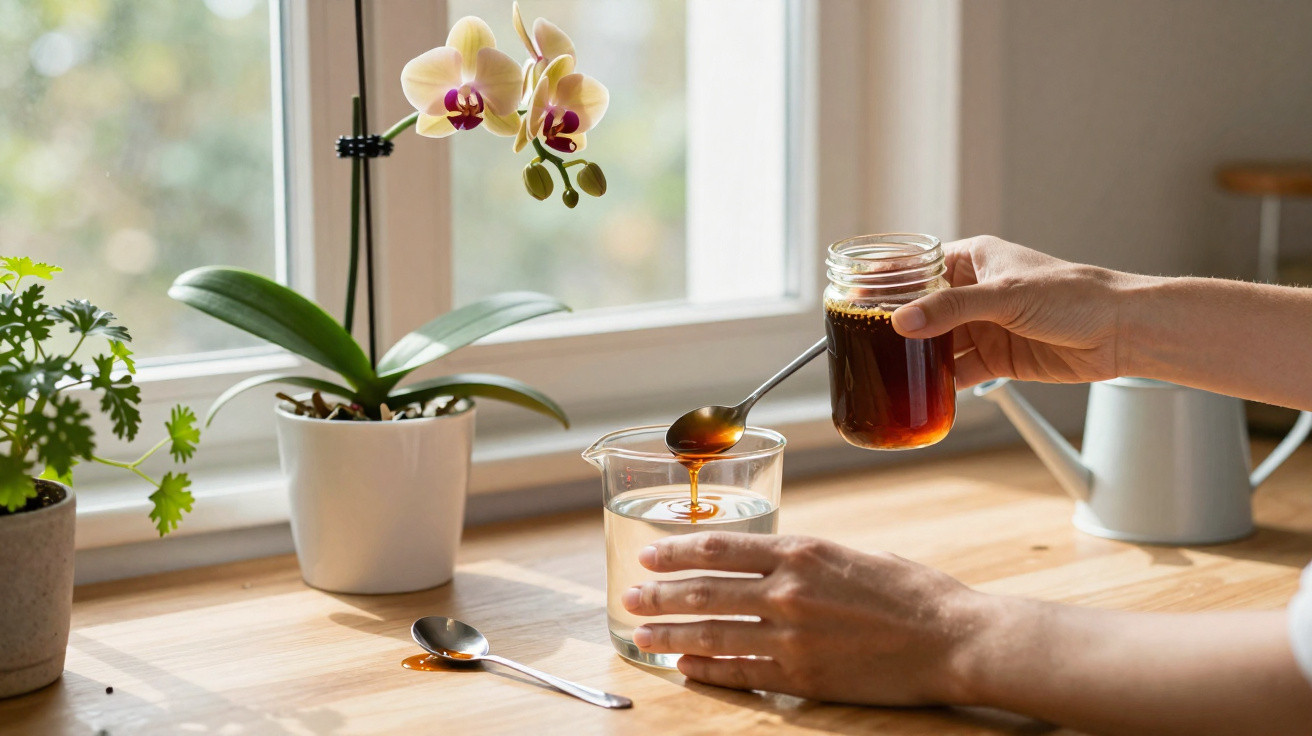
For the syrup to benefit the orchid, one point matters above all else: dilute it heavily. Just a few drops are entirely sufficient; concentrated quantities would harm the delicate roots.
Step-by-step instructions
- Prepare a clean spray bottle or watering container with a capacity of around 250 ml.
- Fill it with tap water or water that has been left to stand.
- Add half a teaspoon tip of molasses, or up to 1 teaspoon per 1 litre of water.
- Shake the container thoroughly until the syrup has dispersed completely.
- Apply the solution directly to the growing medium around the roots, rather than into the leaf joints.
Important: this mixture is not a replacement for normal watering. The plant still needs its usual water, roughly once a week depending on its position, ideally by soaking the pot or flushing it through slowly.
How often should orchids be watered with molasses?
When it comes to nutrients, less is usually more. For Phalaenopsis and similar indoor orchids, one application each month is enough.
A weakly dosed application of molasses once a month is sufficient to stimulate growth and flower production.
Using sweetened water more often can create several problems:
- over-fertilisation of the fine roots;
- salt deposits in the growing medium;
- increased growth of algae and fungi.
Ideally, combine the syrup with a specialist orchid fertiliser that is also heavily diluted. For example, water normally for three weeks, use the heavily diluted molasses solution during one week, then apply a light orchid fertiliser the following month. This gives the plant a broad range of nutrients without overloading it.
Warning signs: when the sweet treatment becomes too much
Molasses remains a product with a high sugar content. If used too generously, it can attract unwelcome visitors or upset the microbial balance in the pot.
Typical signs of overdoing it
- Small flies or gnats hovering over the pot, known as fungus gnats.
- Ants on the windowsill.
- A white, fluffy coating on the surface of the growing medium.
- Sticky patches on the pot or outer cachepot.
- A slightly sour or fermented smell.
If these signs appear, the plant needs a kind of “reset”: flush the pot thoroughly with lukewarm water, allow it to drain and use only plain water for a few weeks. In some cases, it may even be worthwhile repotting it completely in fresh orchid growing medium.
Other kitchen leftovers that orchids like – and their limits
Molasses is not the only kitchen-based option that can support orchids. Gardening influencers and amateur botanists also use other leftovers, but always very diluted and only infrequently.
| Home remedy | Effect | Application note |
|---|---|---|
| Banana peel water | Primarily supplies potassium for flower formation | Leave to infuse only briefly, dilute heavily and use sparingly because of the risk of rot |
| Eggshells | A source of calcium that strengthens plant tissue | Grind very finely and use only a small amount, as decomposition is slow |
| Rice water | Contains a little starch and minerals | Use only when fresh; do not leave it standing, as the liquid turns quickly |
| Tea bags | Add traces of nutrients | Use only occasionally and do not allow them to rot directly in the pot |
Compared with these alternatives, molasses has the advantage of keeping for a long time, being precisely dosed and relatively hygienic. An opened bottle can remain in the kitchen cupboard without issue and provides tiny portions for several plants over many months.
When the molasses trick is particularly useful for orchids
It is especially worthwhile during periods when the orchid needs energy to produce new structures. Typical times include:
- after heavily pruning old flower spikes;
- in spring, as the days become longer again;
- after repotting into fresh growing medium;
- when new leaves emerge but no flower spikes follow.
Anyone with several orchids can make a useful comparison: give one plant the sweet addition regularly and leave another without it. Differences in leaf colour, root strength and willingness to flower generally become noticeable after a few months.
What you should still remember
Even the best syrup cannot rescue a plant kept in the wrong location. Orchids need bright conditions but not intense direct sunlight, steady temperatures and humidity. If they sit immediately above a radiator, roots and buds can dry out quickly. In permanently wet pots, roots will rot regardless of how good the nutrient supply is.
It therefore makes sense to consider the whole picture:
- choose a bright position away from harsh midday sun;
- use a transparent inner pot so the roots can be monitored;
- soak weekly in lukewarm water, then allow it to drain thoroughly;
- avoid watering into the crown leaves to prevent rot.
Those who follow these basics and use the molasses trick selectively significantly improve the chances that a “difficult” orchid will produce a second or third spectacular display of flowers. Many hobby gardeners report stronger roots, deep-green leaves and visibly more blooms – all from a product that may previously have been kept in the cupboard only for cakes and biscuits.












Comments
No comments yet. Be the first to comment!
Leave a Comment