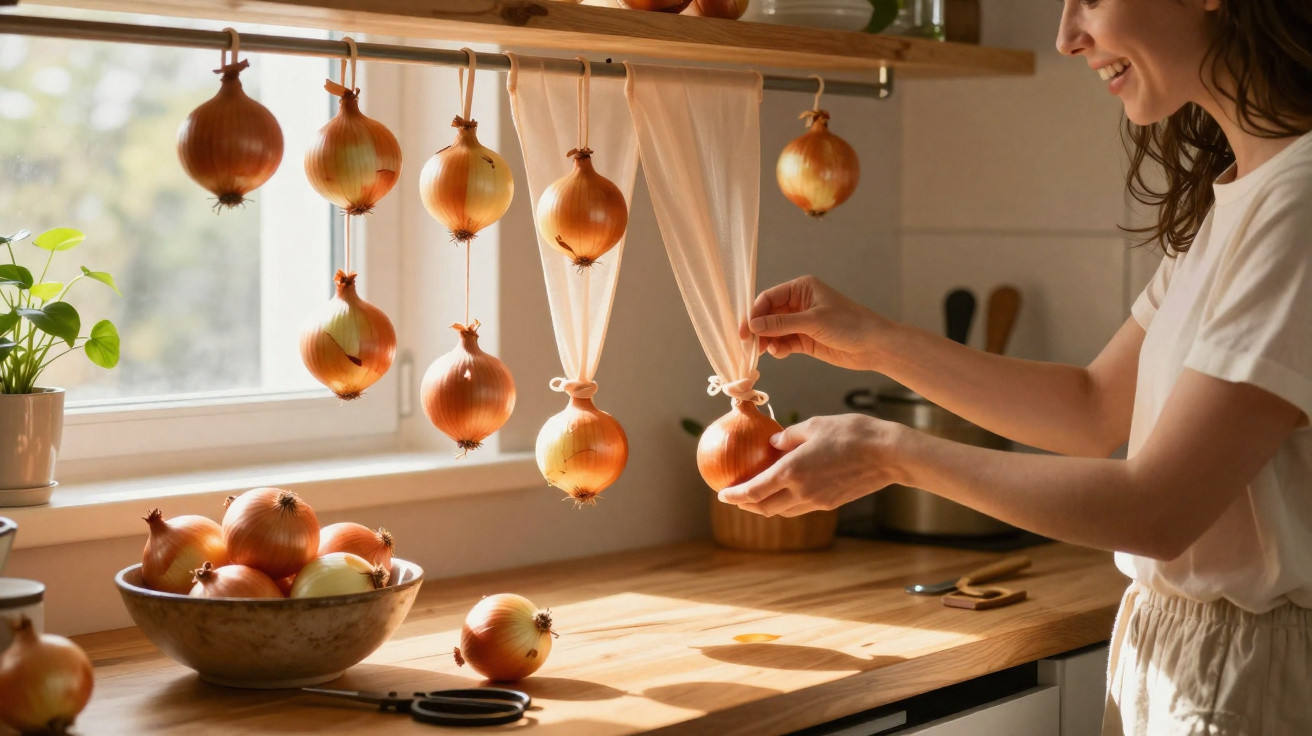
Soft, yielding rings. A mild, guilty smell drifting from the fruit bowl. Anyone who has seen a kilo of onions turn from solid to floppy within a fortnight will recognise that little disappointment. This is why a traditional, mildly ridiculous-looking kitchen and allotment trick keeps resurfacing: put onions into pantyhose one at a time, knot them between each one, then hang them where they can breathe. It resembles washing on a line. In practice, it is based on science.
I came across it for the first time in a chilly pantry at the back of a Leeds terrace, where the air seemed crisp and pure. An older neighbour took a single onion from a ladder of tan tights suspended from a nail, her scissors making a sharp, metronomic snip. She cooked with the calm confidence of somebody who dislikes waste and understands the seasons instinctively. Her onions were as firm as cricket balls. In the dim light, the pantyhose shone amber, holding each bulb apart and exposed to the air. Those tights were definitely not intended for wearing.
The strange onion-storage trick that genuinely works
It seems silly right up to the point you use it. Put an onion into the leg of some pantyhose, make a knot above it, add the next onion, knot it again, and continue until you have a line of golden spheres. Suspend it in a cool, dark place, then leave it alone for weeks. There is no plastic trapping sweat, no onions pressing against one another, and no unpleasant liquid collecting at the base of a bowl. For onions, airflow rather than cold is the true protector. The tights provide that circulation on every side.
Most of us know the experience of picking up an onion only for our fingers to disappear into something soft and depressing. One winter, I tried a basic comparison in my own kitchen: one half of a sack went into a ceramic bowl by the hob, while the other half was tied into pantyhose near the back door. After six weeks, the bowl contained two leaking onions and a strong odour. The string of tights had one soft patch; everything else remained firm-skinned and pungent. There was no magic involved-just air, separation and gravity quietly doing their jobs.
The explanation combines biology with physics. After harvesting, onions need to release a trace of moisture, before their papery outer layers must remain dry during storage. Unlike plastic, nylon does not hold in vapour, while the knots form small individual “rooms” that stop rot spreading through contact. Suspending the bulbs removes pressure, preventing bruised areas where mould can take hold. Light encourages sprouting, heat hastens deterioration and stagnant air supports fungus. The pantyhose method counters each of these problems: a fairly dark spot, cooler conditions, a light draught and no overcrowding.
How to store onions in pantyhose: step by step
Pick onions that are firm and properly cured, with dry, crisp necks. Brush away any loose soil but leave the skins intact. Use a clean leg from a pair of pantyhose or tights-ideally new, or thoroughly washed-and place one onion in the toe. Secure it with a firm knot just above the bulb. Add another onion, tie another knot and carry on until you have made an orderly chain. Hang it from a hook somewhere cool, dry and dim, such as a pantry, shed, cellar or shaded utility room. When you want an onion, cut immediately above a knot and leave the remaining bulbs in place. Tie, hang, forget-that’s the whole method.
A handful of straightforward guidelines makes the approach more reliable. Choose onions bred for storage-brown, yellow or robust red varieties-rather than sweet, high-moisture types that will not keep for months. Keep the chain away from direct sunlight and sources of heat. Avoid the fridge, where humidity can become clammy. Store potatoes separately because they release moisture that encourages onions to sprout. If an onion starts to feel soft, use it quickly or compost it instead of leaving it in the chain. Realistically, nobody manages this daily. A brief check by touch each week is enough.
Pay attention to both spacing and tension. Each knot needs to be tight enough to keep the onion in place, but not so tight that it cuts into the bulb. Allow roughly a finger’s width between onions to let air circulate. Nylon, fishnet and knee-highs can all work. The objective is full 360-degree ventilation with every bulb kept separate. Your future self will appreciate the effort when the weather is freezing and supper begins with a fresh slice and a clean aroma.
“My gran called it the poor man’s store cupboard,” a northern greengrocer told me. “Keep ’em dry, keep ’em apart, keep ’em cool-easy as that.”
- Ideal temperature: from a cool room to a cellar, approximately 4–10°C
- Best varieties: storage yellow and red onions with dry skins
- Bad neighbours: potatoes and apples stored nearby
- Good neighbours: garlic, shallots and dried chillies on the same rack
- Check-in: feel them briefly once a week, then snip one off and continue
What actually prevents onions from spoiling
The greatest threat is moisture remaining where it does not belong-between bulbs, beneath the skin or inside a sealed bag that holds in their moisture. Pantyhose are porous, allowing that gradual exhalation to keep moving. Contact is the next problem. Fungi thrive on a route between onions, and a bowl of bulbs is practically a motorway. Knots interrupt that route. Heat and light are the third threat, quietly inviting onions to sprout. Hung against a shaded wall, the onions remain in their own stable little climate, and stability helps preserve them.
There is a gentler consideration too: handling. Onions bruise when they are heaped up and knocked about in a basket. A bruise turns into a damp patch, and that damp patch turns into trouble. Inside tights, each onion sits in its own pocket, supported without being compressed, while gravity helps keep its neck dry. If you grow your own onions, cure them first for two to three weeks in an airy place, until the necks have sealed and the outside skins feel brittle. That sealing stage can be the difference between storing them for two months or six.
Keeping times differ, although this method extends them. A sturdy yellow onion may remain sound for three to six months this way, and some last even longer where temperatures stay cool and consistent. Sweet onions have a shorter lifespan because they contain more water and less sulphur. That is not a problem: use the sweet onions first, hang the long-keepers and enjoy the staggered supply. This technique is as much about timing as chemistry. It gives you back some time.
Why the pantyhose onion trick feels relevant again
A string of onions gently moving in a quiet room has a reassuring quality. It is visible thrift. It also offers a small resistance to the cluttered cupboard conditions that make food spoil sooner than necessary. When a method has endured in cellars, greengrocers’ back rooms and allotment sheds for decades, it has usually proved its value. Storing onions in pantyhose is not quirky simply for effect. It addresses an ordinary problem with a memorable, practical and visual solution.
| Key point | Detail | Benefit for the reader |
|---|---|---|
| Air beats cold | Ventilation and separation prevent rot more effectively than refrigeration | Fewer wasted onions and no lingering fridge smells |
| Spacing with every knot | Each bulb has its own pocket, preventing rot from spreading | Months of storage without unexpected sliminess |
| The right onion in the right place | Choose a cool, dark location and storage varieties rather than sweet onions | Clear, practical steps for dependable results |













Comments
No comments yet. Be the first to comment!
Leave a Comment