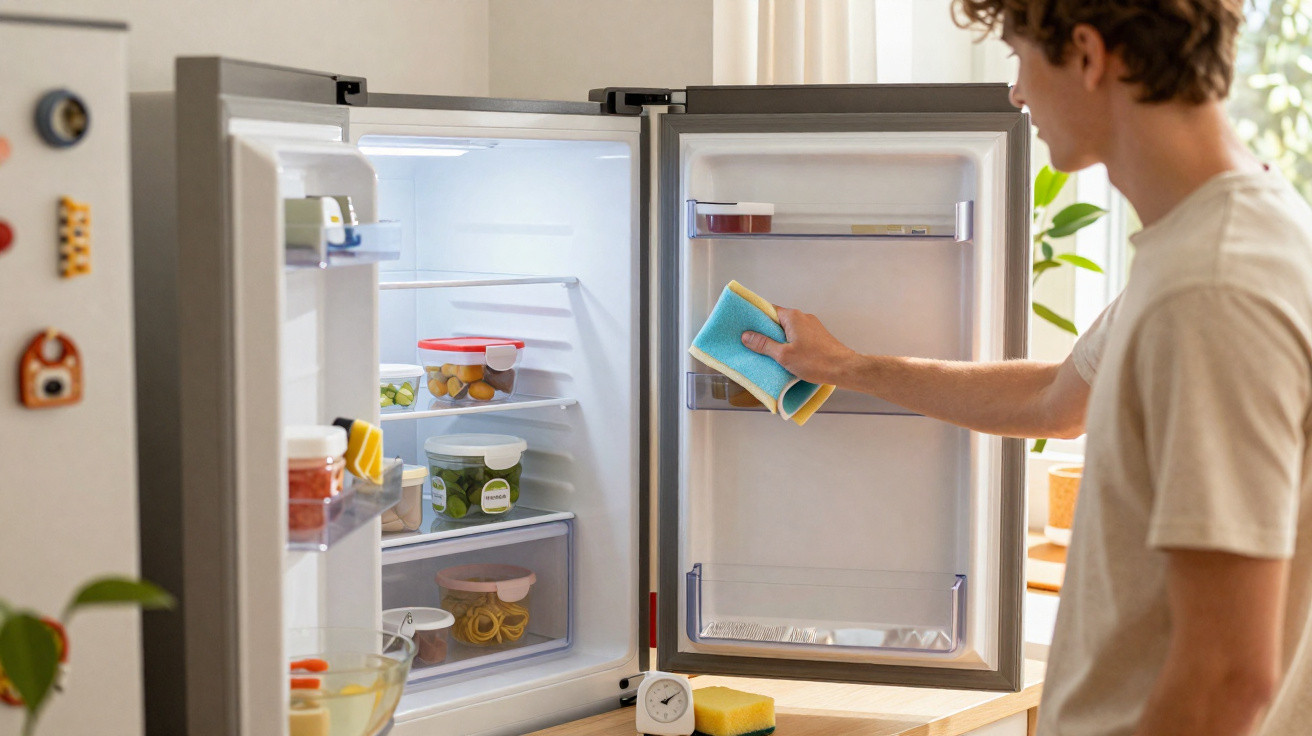
Your electricity bill rises while storage space shrinks. Many people give up. Others get organised, without relying on gadgets.
As temperatures climb and the door is opened more often, frost starts appearing everywhere. The good news is that a straightforward routine and a few precise actions are enough to break the cycle and keep your freezer stable.
Why frost returns so quickly
Frost forms when humid air reaches extremely cold surfaces. Every time the door opens, water vapour enters. Every lukewarm dish makes the problem worse. A worn door seal only adds to it.
The most common triggers
- Putting food away while it is still lukewarm, which fills the air with moisture.
- Opening the door repeatedly or for too long, particularly at mealtimes.
- Flattened or dirty seals that allow air to leak in.
- Air vents blocked by overfilled drawers.
- An appliance pushed against the wall, preventing heat from escaping.
“Once frost on the walls exceeds 5 mm, start defrosting. This is the point at which energy consumption begins to spiral.”
The cost of a layer of ice
Ice acting as insulation on the walls makes the compressor run for longer. Depending on the thickness of the frost and the model, electricity use can rise by 10 to 30%. Usable capacity is reduced, while temperatures become less even. Some foods develop freezer burn, whereas others no longer freeze properly.
An appliance that has to work too hard wears out sooner. A noisy fan, more frequent cycles and temperature spikes during automatic defrosting are all signs that the root cause needs addressing, rather than merely dealing with the result.
“Aim for -18 °C at the centre of the food. Do not rely only on the display: a thermometer positioned between two packets reveals the real temperature.”
The simple, effective method, step by step
The aim is to remove the frost, eliminate moisture and stop it reforming quickly. Allow 30 to 40 minutes and follow these safe steps.
An 8-step action plan
- Get a cool box or large insulated bag ready, along with two ice packs.
- Unplug the appliance. Take out the drawers and shelves, then keep the food chilled.
- Put a bowl of very hot water on a shelf and close the door for 5 minutes. The steam loosens the ice.
- Open the door and replace the water if it has cooled. Lift away the ice with a plastic spatula, never a knife.
- Mop up thoroughly. Wipe with a cloth moistened with food-safe household alcohol or vinegar to dry and deodorise the interior.
- Dry the seals. If they feel sticky, dust them lightly with talcum powder to maintain a good seal.
- Put the shelves and drawers back, then reconnect the appliance. Wait until it reaches -18 °C before returning the food.
- Make a note of the date. In a well-organised kitchen, one cycle every 8 to 12 weeks is enough.
“Never use sharp objects or a heat gun. Repairing a punctured evaporator often costs more than the appliance itself.”
Aluminium: for or against?
Aluminium conducts heat and can help frost flakes come away more easily. When used carefully, it can make maintenance easier. Used carelessly, it obstructs airflow and interferes with sensors.
How to use it safely
- Never cover the rear wall, air outlets or drainage channel.
- Place removable sheets only on shelves and at the bottom of drawers, making them slightly smaller than the surface.
- Do not use adhesive tape: fold the edges to keep them in place. Replace the sheets as soon as they turn white or buckle.
- Remove them before an automatic defrost cycle if your model has one.
For a longer-lasting option, choose thin silicone mats or reusable non-stick sheets, which are easy to remove and clean. The purpose remains the same: reduce sticking and save time at the next maintenance session.
“Golden rule: protect removable surfaces, never the cooling components. Airflow must remain unobstructed.”
Which type of freezer develops the least frost?
| Technology | Frost | Maintenance | Energy consumption | Noise |
|---|---|---|---|---|
| Static | Visible frost on walls | Regular manual defrosting | Low to medium | Low |
| Fan-assisted cooling | Less frost, more even temperature | Less frequent | Medium | Medium |
| No frost | Virtually no user-visible frost | Annual cleaning of drainage outlets | Medium to high | Medium to high |
Small habits that make all the difference
- Pack food into flat portions in tightly sealed bags. Less air means less moisture.
- Allow food to cool in the fridge before freezing it. This improves thermal stability.
- Organise food by area: meat, vegetables and ice cream. You will find items faster and keep the door open for less time.
- Wipe frosted packaging before putting it back. This prevents the air from becoming saturated again.
- Test seals with a banknote: if it slides out easily, replace the seal.
- Leave 5 cm behind the appliance so heat can escape.
“A 10-second opening lets in enough moisture to create frost. Prepare what you need, then close the door quickly.”
When to suspect a fault
Frost forming in localised “icicles” near one corner? The seal may be misshapen. Frost that reappears evenly and very quickly after defrosting? The door may not be closing properly, or the appliance may be too full. Water beneath the drawers? The drainage channel could be blocked by a piece of ice.
If the temperature varies by more than 4 °C within an hour when the door has not been opened, the sensor or control board should be checked. A technician can inspect the circuit pressure and the condition of the evaporator.
What this method saves in practical terms
A 200 to 300-litre freezer commonly uses 180 to 260 kWh per year. A 15% increase in consumption caused by frost represents 27 to 39 kWh. At an average price of €0.23 per kWh, that is equivalent to €6 to €9 per year. The saving is greater if the appliance is old or heavily loaded.
Stable temperatures also cut food waste. There is less freezer burn and fewer discarded packets. A simple inventory written on the door with a marker reduces door openings made just “to check” and helps keep stock rotating.
Practical questions everyone asks
How often should you defrost?
Take action as soon as there is 5 mm of ice. In a family kitchen, this often means 4 to 6 times a year for a static model.
Do you need to empty it completely?
Yes, if you want to work quickly and properly. A cool box and two ice packs keep frozen food safe for several tens of minutes.
What should you do about smells?
A bowl of bicarbonate of soda in a corner absorbs lingering odours. Replace it every month. A cloth dampened with white vinegar is enough to neutralise them.
Aluminium, seals and ventilation: the winning trio
Removable sheets on shelves allow ice to be lifted away in one movement. Clean, flexible seals block humid air. Good ventilation at the back reduces strain on the compressor. Together, these ordinary measures keep the appliance performing as intended.
“If you are unsure, choose removable, reusable protection. Nothing stuck down, nothing on the cold walls.”
Going further: tools and routine
- An inexpensive probe thermometer to check -18 °C between two packets.
- A wide plastic spatula and a bowl of hot water kept specifically for the freezer.
- Dedicated silicone or aluminium sheets, stored with the tea towels.
- A calendar reminder every two months, with 40 minutes set aside.
This organisation reduces fluctuations and consumption peaks. It protects the compressor and makes food storage more reliable. Larger households also benefit from smoother day-to-day use, especially during periods of high heat.











Comments
No comments yet. Be the first to comment!
Leave a Comment