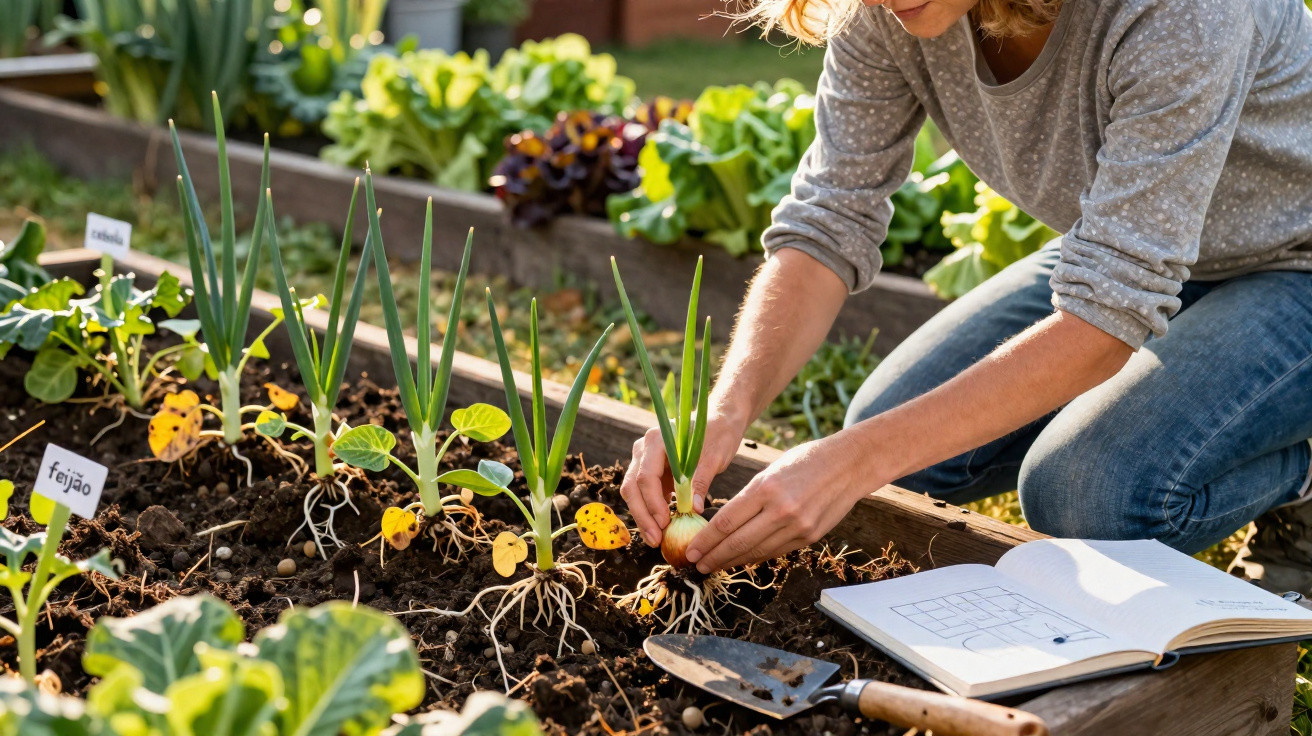
In the vegetable bed, some plants take off while others barely grow. It may look random, but it rarely is.
Many home gardeners know the situation: the same soil and the same care, yet certain rows fail to thrive. The reason is often hidden underground: chemical signals exchanged by plants that cannot smell one another.
The subtle disruptor in the vegetable bed
Plants interact through their roots. They release compounds, defend themselves and claim space. This process is known as allelopathy. There are no curled leaves or yellow patches; the plants simply develop more slowly.
Alliums in particular – onions, garlic and leeks – release sulphur-containing compounds. These molecules interfere with nutrient uptake in legumes such as beans, peas and broad beans. Fertiliser offers little help, because the restriction is at root level.
The onion + bean pairing is considered a troublesome duo: sulphur compounds inhibit rhizobia and obstruct the nitrogen supply.
These two vegetables strongly inhibit each other: onion and bean
Planting onions beside French beans or runner beans can create an invisible barrier to nutrient uptake. Beans regulate their nitrogen supply through root-nodule bacteria. Once these microbial helpers are suppressed, growth quickly loses momentum.
Peas and broad beans are similarly sensitive. At first, the plants appear healthy, then slip into a standstill after several weeks – precisely when their neighbouring plants are no longer suspected as the cause.
A practical rule of thumb from organic gardening is to leave at least 1.5 metres between alliums and legumes. Where space is limited, keep them strictly separate in different beds or containers.
Other pairings that cause problems
- Tomato + potato: both are susceptible to blight. Together, they create a humid microclimate in which spores can spread quickly.
- Spinach + Swiss chard: both belong to the beet family. Root exudates and competition for nutrients from spinach can slow down Swiss chard.
- Potato + aubergine: shared pests, such as the Colorado potato beetle, thrive with this combination. Infestations often increase sharply.
- Carrot + mint: mint produces runners and large amounts of essential oils. In a tightly planted bed, this disrupts carrot root development. It is better to grow mint in a pot at the edge.
Good fertilising cannot rescue poor plant neighbours. Soil chemistry wins over the schedule printed on the fertiliser packet.
Why this mistake happens every year
The urge to use every bit of space
Many people plan beds like a game of Tetris, filling every gap with a young plant. Although this appears efficient, it creates clashes within the root zone. Symptoms often only become apparent after 8 to 12 weeks, when moving plants is hardly an option.
Rules missing from gardening guides
The idea that “with good care, everything grows together” remains stubbornly common. It overlooks the fact that plants do not merely share nutrients; they also send out signals. These signals can alter the tiny pH environment around roots, slow enzymes or inhibit microbes.
Spacing, planning and rotation: how to arrange your vegetable bed
Anyone who enjoys mixed planting needs clear boundaries. In practice, dividing the plot by plant family works well. Keep incompatible families apart consistently, using a path, lawn edging, timber edging or a separate container area.
| Poor neighbours | Recommended distance | Reason | Better alternatives |
|---|---|---|---|
| Onion/leek/garlic - beans/peas/broad beans | ≥ 1.5 m | Sulphur compounds inhibit rhizobia and nutrient uptake | Beans with sweetcorn or lettuce; onions with carrots |
| Tomatoes - potatoes | ≥ 3 m, separate watering | Shared fungal diseases and trapped humidity | Tomatoes with basil and marigolds; potatoes separately |
| Spinach - Swiss chard | ≥ 1 m | Root inhibitors and competition | Spinach with radishes; Swiss chard with onions |
| Potatoes - aubergines | ≥ 2 m | Colorado potato beetles and a shared disease pool | Aubergines with beans or French marigolds |
| Carrots - mint | Separate containers | Runners and essential oils | Mint in a container, carrots in the bed |
What helps now: a quick plan for autumn 2025
Autumn is ideal for rearranging vegetable beds. Sketch your garden, mark out family zones and identify incompatible pairings. If you are already planting garlic, plan the bean row in the neighbouring bed from the outset, leaving sufficient distance.
Helpful companion plants can increase resilience. French marigolds and pot marigolds suppress nematodes. Nasturtiums draw aphids away. Anyone using castor bean (Ricinus) as a trap plant can gain effective protection, but must take care around children and pets: its seeds are highly poisonous.
Top 3 actions for this week
- Draw up a bed map and define zones for each plant family.
- Separate incompatible pairings: leave at least 1.5 m between alliums and legumes.
- Plan a three-year rotation: never grow the same family in the same bed consecutively.
Map, spacing, rotation. Plan first, plant afterwards – and you will achieve visibly higher yields in summer.
Questions people often ask
Can anything still be saved during the growing season?
To some extent. Remove or relocate one of the conflicting plants. If moving it is not possible, install a root barrier. For tomatoes and potatoes, take immediate action by watering only at ground level and removing affected leaves consistently.
Does this also apply to containers on a balcony?
Yes – and even more so there. Root volume is limited, so inhibitory compounds become concentrated more quickly. Use separate pots, and create distance with the spaces between them rather than simply placing pots directly beside one another.
Which matters more: rotation or mixed planting?
Both do. Crop rotation spreads disease pressure across the years, while mixed planting controls compatibility within the same year. Combining the two produces healthier crops and reduces the work involved in plant protection.
Practical extras for higher yields
A small practical test makes the effect clear: in spring, plant two rows of beans, one 40 centimetres from an onion row and one 1.5 metres away. Measure shoot length after ten weeks. In allotments, differences of 20–30 percent are often visible. That is more motivating than any theory.
Another frequently overlooked detail is wind direction. Position tomatoes upwind of potatoes. Fewer spores will land on the tomatoes, and the foliage dries more rapidly. Using drip irrigation instead of sprinklers also reduces the humid bridge between plants.
Where space is scarce, use vertical separation. Grow beans on a climbing support on the west side and onions low in an eastern bed. Place a narrow strip of herbs between them as a buffer. Thyme and sage attract beneficial insects and provide distance without “losing” growing space.
Finally, consider both the risks and opportunities: castor bean (Ricinus) works as a trap plant, but it is poisonous. In family gardens, French marigolds, nasturtiums and pot marigolds provide similar effects without the danger. Pollinator activity also increases measurably, benefiting tomatoes and strawberries alike.













Comments
No comments yet. Be the first to comment!
Leave a Comment